
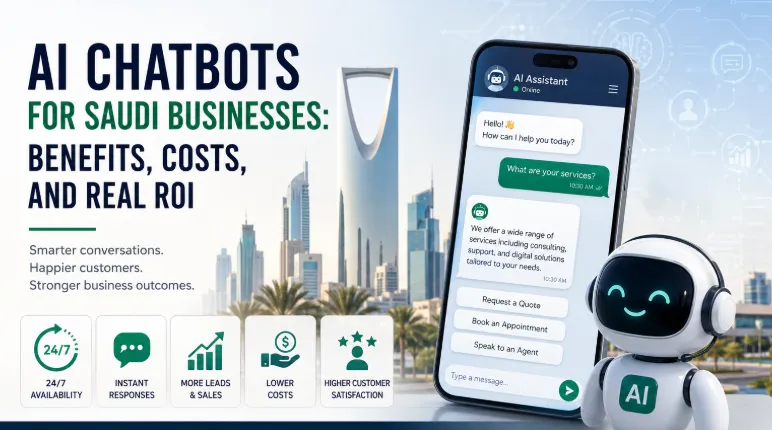
AI Chatbots for Saudi Businesses: Benefits, Costs, and Real ROI
Introduction
Customer expectations have changed dramatically over the past decade.
Today's customers expect immediate responses, personalized experiences, and support that is available whenever they need it. Whether they are browsing a website, sending a WhatsApp message, or submitting an enquiry through social media, they expect businesses to respond quickly and accurately.
Unfortunately, many organizations struggle to meet these expectations consistently.
Customer service teams are often overwhelmed by repetitive enquiries.
Sales teams spend valuable time answering routine questions.
Support requests continue to grow as businesses expand.
As a result, response times increase, customer satisfaction declines, and potential opportunities are missed.
This is where Artificial Intelligence (AI) chatbots are creating significant value.
Modern AI chatbots can engage customers, answer questions, qualify leads, automate support processes, and operate around the clock without requiring human intervention for every interaction.
What was once considered an emerging technology has become a practical business tool delivering measurable results across industries.
For businesses in Saudi Arabia pursuing digital transformation, operational efficiency, and enhanced customer experiences, AI chatbots have become one of the most accessible and impactful AI investments available today.
This guide explores how AI chatbots work, the benefits they deliver, implementation considerations, costs, and the return on investment organizations can expect.
What Is an AI Chatbot?
An AI chatbot is a software application that uses artificial intelligence and natural language processing (NLP) to communicate with users in a conversational manner.
Unlike traditional rule-based chatbots that rely on predefined scripts, modern AI chatbots can:
Understand natural language
Interpret customer intent
Answer questions intelligently
Learn from interactions
Provide personalized responses
AI chatbots can be deployed across multiple channels including:
Websites
Mobile applications
WhatsApp
Facebook Messenger
Microsoft Teams
Customer portals
They act as digital assistants capable of handling a wide range of customer interactions.
Why AI Chatbots Are Becoming Essential
Several trends are driving rapid chatbot adoption.
Rising Customer Expectations
Customers increasingly expect:
Instant responses
Self-service options
24/7 availability
Consistent service quality
Traditional support models struggle to meet these expectations at scale.
Growing Interaction Volumes
As businesses grow, enquiry volumes increase.
Common requests often include:
Product information
Pricing questions
Order status updates
Appointment scheduling
Support requests
Many of these interactions can be handled automatically.
Workforce Efficiency
Employees frequently spend significant time answering repetitive questions.
AI chatbots allow teams to focus on complex issues requiring human expertise.
Cost Optimization
Providing round-the-clock support using human agents alone can be expensive.
AI chatbots help businesses scale customer engagement without proportionally increasing staffing costs.
How AI Chatbots Work
Modern AI chatbots combine several technologies.
Natural Language Processing (NLP)
NLP enables chatbots to understand human language.
Instead of requiring exact keywords, AI can interpret conversational requests.
For example:
A customer might ask:
"What are your prices?"
"How much does this cost?"
"Can you share your pricing?"
The chatbot understands that all three questions relate to pricing information.
Machine Learning
Machine learning enables chatbots to improve over time.
As interactions increase, the chatbot becomes more effective at understanding and responding to customer requests.
Knowledge Bases
Many chatbots access company information stored within:
FAQs
Documentation
Product catalogs
Support resources
This allows them to provide accurate answers quickly.
Workflow Automation
AI chatbots can trigger business processes such as:
Creating support tickets
Scheduling appointments
Capturing leads
Updating CRM records
This transforms the chatbot into an operational tool rather than simply a communication channel.
Key Benefits of AI Chatbots
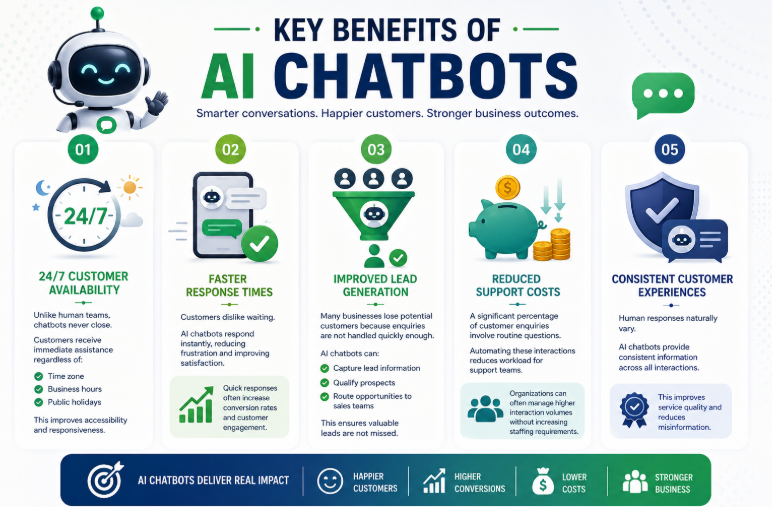
24/7 Customer Availability
Unlike human teams, chatbots never close.
Customers receive immediate assistance regardless of:
Time zone
Business hours
Public holidays
This improves accessibility and responsiveness.
Faster Response Times
Customers dislike waiting.
AI chatbots respond instantly, reducing frustration and improving satisfaction.
Quick responses often increase conversion rates and customer engagement.
Improved Lead Generation
Many businesses lose potential customers because enquiries are not handled quickly enough.
AI chatbots can:
Capture lead information
Qualify prospects
Route opportunities to sales teams
This ensures valuable leads are not missed.
Reduced Support Costs
A significant percentage of customer enquiries involve routine questions.
Automating these interactions reduces workload for support teams.
Organizations can often manage higher interaction volumes without increasing staffing requirements.
Consistent Customer Experiences
Human responses naturally vary.
AI chatbots provide consistent information across all interactions.
This improves service quality and reduces misinformation.
Popular AI Chatbot Use Cases
Customer Support
Common support activities include:
Answering FAQs
Troubleshooting issues
Tracking requests
Escalating complex cases
Support teams can focus on higher-value interactions.
Sales Assistance
Chatbots help customers:
Discover products
Compare options
Request quotations
Schedule consultations
They effectively function as digital sales assistants.
Appointment Booking
Organizations can automate scheduling for:
Consultations
Meetings
Service appointments
Demonstrations
This reduces administrative effort and improves convenience.
HR and Employee Support
Internal chatbots can answer employee questions related to:
Leave policies
Benefits
Payroll information
Company procedures
HR teams gain efficiency while employees receive immediate assistance.
E-Commerce Support
Online retailers use chatbots to:
Recommend products
Track orders
Process returns
Resolve common issues
These capabilities improve the shopping experience.
WhatsApp Chatbots: A Major Opportunity
WhatsApp has become one of the most widely used communication platforms in Saudi Arabia.
Many customers already prefer messaging businesses through WhatsApp rather than calling or emailing.
AI-powered WhatsApp chatbots enable organizations to:
Respond instantly
Automate conversations
Capture leads
Send updates
Provide support
For many businesses, WhatsApp chatbot implementation represents one of the fastest ways to improve customer engagement.
Understanding Chatbot Costs
One of the most common questions organizations ask is:
How much does an AI chatbot cost?
The answer depends on several factors.
Basic Chatbots
Simple chatbots handling FAQs and basic workflows generally require lower investment.
These solutions are often suitable for smaller businesses.
Advanced AI Chatbots
More sophisticated chatbots may include:
AI-powered conversations
CRM integration
ERP connectivity
Analytics
Multi-language support
These capabilities increase both functionality and implementation complexity.
Ongoing Costs
Organizations should also consider:
Platform subscriptions
Maintenance
Training updates
Integration support
However, these costs are often offset by productivity gains and operational efficiencies.
Measuring Chatbot ROI
ROI should be evaluated using business outcomes rather than technology metrics alone.
Reduced Support Costs
Fewer routine enquiries require human intervention.
Support teams become more efficient.
Increased Lead Conversion
Faster engagement often improves conversion rates.
Prospective customers receive immediate assistance.
Improved Customer Satisfaction
Customers appreciate convenience and responsiveness.
Higher satisfaction often contributes to stronger retention.
Increased Employee Productivity
Employees spend less time handling repetitive tasks.
More time can be allocated to strategic work.
Revenue Growth
Better engagement and faster response times frequently contribute to increased sales opportunities.
Common Concerns About AI Chatbots
"Will Customers Prefer Human Support?"
For complex issues, yes.
However, many customers prefer self-service for simple enquiries.
The most effective approach combines chatbot automation with human escalation when necessary.
"Will Chatbots Replace Employees?"
AI chatbots are designed to assist employees, not replace them.
They automate repetitive activities while humans focus on relationship-building, problem-solving, and decision-making.
"Are Chatbots Difficult to Implement?"
Modern platforms have significantly simplified implementation.
With proper planning, businesses can often deploy chatbot solutions quickly and begin realizing value within a relatively short period.
How to Successfully Implement an AI Chatbot
Define Objectives
Identify specific goals such as:
Lead generation
Customer support
Appointment scheduling
Employee assistance
Identify High-Volume Interactions
Focus on repetitive conversations that consume significant employee time.
Integrate with Business Systems
Connecting chatbots to CRM, ERP, and support platforms increases effectiveness.
Monitor Performance
Track:
Resolution rates
Customer satisfaction
Lead generation
Engagement levels
Continuous improvement is essential.
Combine AI with Human Support
The best customer experiences blend automation with human expertise.
Complex issues should be escalated seamlessly when necessary.
The Future of AI Chatbots
Chatbots are becoming increasingly sophisticated.
Future developments are expected to include:
More natural conversations
Better personalization
Enhanced multilingual capabilities
Deeper business system integrations
Greater predictive intelligence
As AI technology continues to evolve, chatbots will become even more valuable business assets.
Organizations adopting these technologies early gain important competitive advantages.
Key Takeaways
AI chatbots improve customer service, sales, and operational efficiency.
Modern AI chatbots use natural language processing and machine learning to understand customer intent.
Businesses can deploy chatbots across websites, WhatsApp, mobile applications, and customer portals.
24/7 availability and instant responses improve customer satisfaction.
Chatbots reduce support costs and increase employee productivity.
WhatsApp chatbots represent a significant opportunity for businesses in Saudi Arabia.
ROI is typically measured through cost savings, lead generation, productivity improvements, and customer satisfaction.
The most effective chatbot strategies combine AI automation with human expertise.
Frequently Asked Questions
Q: What is an AI chatbot?
A: An AI chatbot is a conversational software application that uses artificial intelligence to understand and respond to user questions naturally.
Q: Can AI chatbots integrate with CRM systems?
A: Yes. Modern chatbots can integrate with CRM, ERP, helpdesk, and other business platforms to automate workflows and improve efficiency.
Q: Are AI chatbots suitable for small businesses?
A: Absolutely. Many small and medium-sized businesses achieve significant benefits through improved customer service, lead generation, and operational efficiency.
Q: How long does chatbot implementation take?
A: Implementation timelines vary depending on complexity, integrations, and business requirements. Basic solutions can often be deployed relatively quickly.
Q: What is the ROI of an AI chatbot?
A: ROI is commonly achieved through reduced support costs, faster lead response times, increased conversions, improved customer satisfaction, and enhanced productivity.
Conclusion
AI chatbots have evolved from experimental technology into practical business solutions delivering measurable results across industries.
For Saudi businesses seeking to improve customer engagement, increase efficiency, and support digital transformation initiatives, chatbots represent one of the most accessible and impactful AI investments available today.
The benefits extend far beyond customer service.
Lead generation, sales support, workflow automation, employee assistance, and operational efficiency all contribute to strong business value.
Organizations that embrace conversational AI today are positioning themselves for a future where intelligent customer interactions become the standard rather than the exception.
Softriva helps businesses across Saudi Arabia implement AI automation solutions, chatbot platforms, workflow automation, and digital transformation strategies that drive measurable business outcomes.
Book Your Free AI Chatbot Consultation at softriva.com and discover how conversational AI can transform customer engagement and operational efficiency.


