
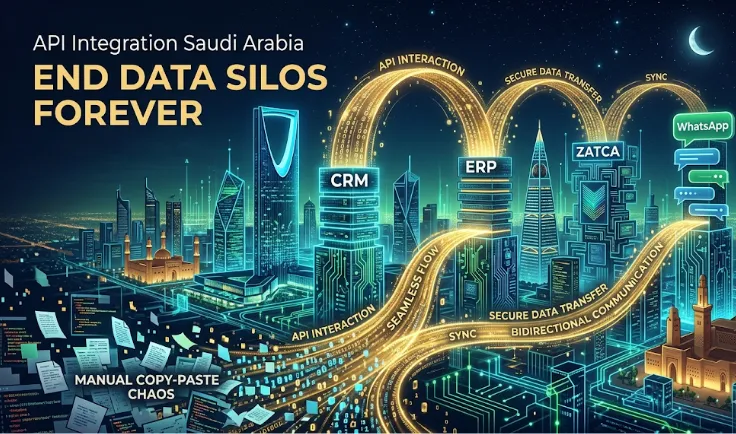
API Integration for Saudi Businesses: How to Connect Your Systems and Stop Copying Data
Introduction
Here is a question worth asking your team: how many times per day does someone in your business copy information from one system and paste it into another?
A sales manager exports a lead list from the website form, reformats it, and imports it into the CRM. A finance team member copies invoice data from the accounting system into a spreadsheet for the monthly report. An HR coordinator manually transfers approved leave requests from the email inbox into the HR system. A customer service agent opens three different applications to answer a single customer question because the information they need is spread across a CRM, an order management system, and a billing platform.
Every one of these activities is a task that an API integration should handle automatically. In a properly connected business system environment, data flows between applications without human involvement. The result is fewer errors, less staff time on administrative work, and business data that is consistent across all systems at all times.
This guide explains what API integration is, what it enables, which connections deliver the most value for Saudi businesses, and how to approach an integration project without the technical jargon that makes this topic harder than it needs to be.
What an API Actually Is
API stands for Application Programming Interface. The technical definition is less important than the practical one.
An API is a defined way for two software applications to share data and trigger actions with each other. When you tap 'Pay with Mada' on an e-commerce site, an API sends the payment request from the website to your bank, receives confirmation, and tells the website the payment was successful, all in seconds. When a new customer is created in your CRM and their details automatically appear in your accounting system, an API connection made that happen.
APIs make it possible for software applications to work together without any human in the middle copying and pasting data. They are the plumbing of a connected digital business.
Most modern business software offers an API. CRM platforms like Salesforce, HubSpot, and Zoho all have APIs. Accounting systems like QuickBooks, Zoho Books, and Xero have APIs. E-commerce platforms like Shopify and WooCommerce have APIs. Saudi government systems including the ZATCA e-invoicing portal have APIs. WhatsApp Business operates through an API. The question for most Saudi businesses is not whether their software has APIs but whether those APIs have been connected to each other.
The Business Cost of Disconnected Systems
When business systems are not connected through APIs, the cost shows up in three ways:
Staff Time on Data Transfer
Manual data transfer between systems is one of the most common and least visible wastes in Saudi business operations. It is rarely measured, because it happens in small increments throughout the working day.
A business with 10 employees who each spend an average of 45 minutes per day on manual data entry and transfer is consuming 75 hours of productive staff time per week on work that APIs could handle in milliseconds. At a conservative average hourly cost of SAR 75 per employee, that is SAR 5,625 per week, or approximately SAR 270,000 per year in staff cost for data copying.
Data Inconsistency and Errors
When humans transfer data between systems, errors happen. A decimal point in the wrong place on an invoice. A customer name spelled differently in the CRM and the accounting system. A stock level updated in the warehouse management system but not reflected in the e-commerce platform.
These errors have consequences. A wrong invoice amount creates a dispute and a resolution process. A CRM and accounting system that do not agree on the same customer record produce reports that cannot be reconciled. An e-commerce store that shows a product as available when it is out of stock creates a customer service problem at the moment of highest purchase intent.
API integration eliminates the human data transfer step, and with it, the human error that the transfer introduces.
Delayed Information
In a manual data transfer environment, information is only as current as the last time someone updated it. If the finance team reconciles the accounting system with the CRM weekly, the management dashboard shows data that is up to a week old. If the warehouse team updates stock levels daily, the e-commerce platform may show inventory that is a day behind actual availability.
API integration makes data transfers immediate. A sale recorded in the POS system updates inventory in the warehouse management system in real time. A new lead created in the website form appears in the CRM within seconds. A payment confirmed in the payment gateway triggers an automatic receipt in the accounting system and a confirmation message in the customer communication platform.
The Highest-Value API Integrations for Saudi Businesses
Not all API integrations deliver equal value. These are the connections that consistently produce the most direct business impact for Saudi businesses:
Website to CRM
Every contact form submission, chat enquiry, or quote request on your website should arrive in your CRM automatically, assigned to the right team member, with all captured information populated in the correct fields.
Without this integration, website leads go to an email inbox, someone reads them, copies the information into the CRM, assigns them manually, and follows up. The delay and the friction in this process consistently costs leads. With the integration, the CRM record exists within seconds of the form submission and the assigned agent can follow up immediately.
CRM to Accounting System
When a deal is won in the CRM, a customer record should be created automatically in the accounting system and the first invoice should be generated with correct details pulled from the CRM opportunity record.
Without this integration, the finance team receives deal information by email or in a spreadsheet and creates the invoice manually. With the integration, the invoice is generated within minutes of the deal being closed and the customer record is consistent in both systems from day one.
E-Commerce to Inventory Management
When an order is placed on your online store, the inventory count for the ordered products should decrease immediately in your inventory management system. When a product reaches a defined low-stock threshold, a reorder alert or automatic purchase order should be triggered.
Without this integration, inventory counts are updated manually on a schedule, creating the window where the online store shows availability that does not exist. With the integration, stock levels are accurate in real time across all channels.
ZATCA E-Invoicing Integration
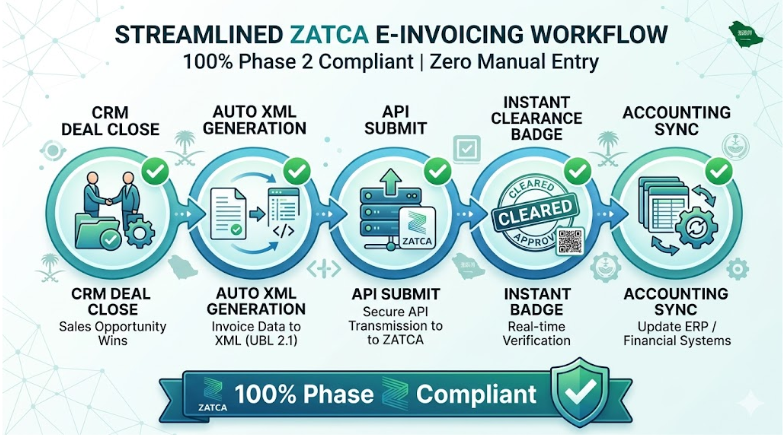
For VAT-registered Saudi businesses under the Phase 2 e-invoicing mandate, every invoice must be cleared through the ZATCA portal via an API connection. This is not optional. The accounting or ERP system must generate an invoice in the required XML format and submit it to ZATCA through their API.
Businesses that have not implemented this integration are either not complying with the mandate or are submitting invoices manually through a workaround that will not scale. Proper ZATCA API integration handles clearance automatically for every invoice generated.
Payment Gateway to Accounting
When a payment is received through Mada, Visa, STC Pay, or any other payment gateway, a corresponding entry should be created in the accounting system automatically. Without this integration, payment records are manually reconciled against accounting records at intervals, creating timing differences and reconciliation effort.
HR System to Payroll and WPS
When employee data changes (a new hire, a salary change, a termination), the payroll system should reflect this automatically. When the payroll run is completed, the output should flow automatically to the WPS bank file format for submission. These two integrations together eliminate the manual data handling that creates both payroll errors and WPS compliance risk.
How to Approach an API Integration Project
A structured approach to API integration avoids the common pitfalls that create expensive rework:
Map your data flows first. Before looking at technical solutions, document which data currently moves between which systems, how it moves (manually, by scheduled export, or through an existing integration), and what errors or delays the current approach creates. This mapping exercise identifies the highest-priority integration points.
Confirm API availability and documentation quality. Not all APIs are created equal. Before committing to an integration approach, confirm that both systems have APIs, that the relevant APIs are documented, and that the API provides access to the specific data and actions the integration requires.
Decide between point-to-point and middleware integration. A point-to-point integration connects two specific systems directly. This is appropriate for a single, stable connection between two well-documented systems. When multiple systems need to connect to each other, a middleware integration platform sits in the middle and manages all the connections from one place.
Build with error handling. API integrations fail. Systems go down, data formats change, authentication tokens expire. A well-built integration handles these failures gracefully: logging the error, retrying automatically where appropriate, and alerting the relevant team when manual intervention is needed.
Test with real data before go-live. Testing API integrations with sample data misses errors that only appear with real business data volumes, edge cases in actual customer records, and timing-related issues that do not appear in isolated tests.
Key Takeaways
An API is the mechanism that allows two software applications to share data and trigger actions automatically. Most modern business software has APIs that have not yet been connected.
Manual data transfer between systems consumes measurable staff time, introduces errors, and delays the availability of business information. All three are eliminated by proper API integration.
The highest-value API integrations for Saudi businesses are: website to CRM, CRM to accounting, e-commerce to inventory, ZATCA e-invoicing clearance, payment gateway to accounting, and HR to WPS payroll.
ZATCA Phase 2 e-invoicing is an API integration requirement, not just a software requirement. The accounting or ERP system must submit invoices to ZATCA through their API for clearance.
A middleware integration platform is more scalable than point-to-point connections when multiple systems need to share data. It manages all connections from one place and simplifies maintenance.
Well-built API integrations include error handling that logs failures, retries automatically where appropriate, and alerts the right person when human intervention is needed.
Frequently Asked Questions
Q: Does my software need to be from the same vendor for systems to connect via API?
A: No. API integration is specifically designed to connect software from different vendors. A Zoho CRM can be connected to QuickBooks accounting. A WooCommerce online store can be connected to a Fishbowl inventory system. A Salesforce CRM can be connected to SAP ERP. The technical requirements are that both systems have documented APIs and that the data formats can be mapped between them. In most cases, standard business software from reputable vendors can be connected regardless of whether they are from the same company.
Q: How long does it take to build an API integration between two Saudi business systems?
A: A single, well-documented API integration between two systems (CRM to accounting, for example) typically takes two to four weeks including design, development, testing, and go-live. More complex multi-system integrations involving custom data transformation, error handling, and middleware configuration take four to twelve weeks. The timeline is strongly influenced by the quality of API documentation for both systems and the complexity of the data mapping required.
Q: What happens to the integration if one of our software vendors changes their API?
A: API changes are one of the most common sources of integration maintenance work. Reputable vendors version their APIs and provide advance notice of breaking changes, typically six to twelve months. When an API changes, the integration code needs to be updated to match the new API version. This is a maintenance requirement that should be included in the post-launch support arrangement with your integration partner. Monitoring the API connections for failures and receiving alerts when they break is the practical approach to managing this ongoing risk.
Q: Is no-code integration (Zapier, Make, Zoho Flow) appropriate for Saudi business use?
A: No-code integration platforms like Zapier, Make, and Zoho Flow are appropriate for simpler integrations with low data volumes and standard data formats. They are faster and less expensive to set up than custom API integration. Their limitations are: they introduce a dependency on a third-party platform, they can be slower than custom integrations for high-volume data flows, they handle complex data transformation less flexibly, and their reliability depends on the third-party platform's uptime. For business-critical integrations involving financial data, ZATCA compliance, or high transaction volumes, custom API integration is more appropriate.
Q: How does API integration relate to digital transformation for a Saudi business?
A: API integration is the connective tissue of digital transformation. Individual software applications (CRM, ERP, accounting, e-commerce, HR) each provide their own functionality. API integration is what turns them from isolated tools into a connected system where data flows automatically, processes happen without manual intervention, and management has consistent, current information across all parts of the business. Digital transformation without API integration produces businesses that have invested in better individual tools but still connect them manually.
Conclusion
Disconnected business systems are one of the most consistent and underrecognised operational costs in Saudi businesses.
The hours spent copying data between applications, the errors that manual transfer introduces, and the delayed information that results from systems that update on a schedule rather than in real time all have a financial cost that is real but rarely measured.
API integration is the practical solution. It converts manual, error-prone, delayed data transfer into automatic, accurate, real-time data flow between the applications your business already uses. It is not a transformation of your software. It is a transformation of how your software works together.
Softriva designs and builds API integrations for Saudi businesses across all sectors. Our experience covers CRM and accounting integrations, ZATCA Phase 2 e-invoicing API implementation, payment gateway connections, e-commerce and inventory synchronisation, and the multi-system middleware architectures that growing businesses need.
A free integration consultation gives you a clear picture of which of your disconnected systems could be connected, what the integration would involve, and what operational improvement it would produce.

Book a Free Systems Integration Consultation at softriva.com


