Arabic and English Digital Presence for Saudi Businesses: Why Both Languages Are Essential
Introduction
A Saudi business that operates only in English online is making a choice about which customers it wants to reach.
That choice excludes a substantial portion of the Saudi market. Arabic is the primary research language for a significant share of Saudi B2B and B2C buyers. Arabic-language Google searches in Saudi Arabia represent billions of monthly queries. A business that does not appear in those searches, or that appears with poor-quality Arabic content, is invisible to a large part of its potential audience.
At the same time, English-only businesses in Saudi Arabia are also missing a competitive advantage. Arabic SEO is less competitive than English SEO across most Saudi industry categories. A well-built Arabic web presence can rank faster and with less effort than an equivalent English one, because fewer businesses have invested in it properly.
This guide explains what a genuine bilingual digital presence requires, where most Saudi businesses fall short, and how to build Arabic and English capability that works for both human visitors and search engines.
The Scale of Arabic-Language Search in Saudi Arabia
Saudi Arabia has one of the highest internet penetration rates in the Arab world. As of 2024, more than 95 percent of Saudi residents use the internet, and the majority conduct at least part of their online research in Arabic.
Search behaviour varies significantly by industry and by buyer type. In B2B technology procurement, English-language searches are common among senior decision-makers and IT professionals who work in English. In consumer retail, SME services, healthcare, real estate, and education, Arabic-language search is dominant.
For a Jeddah-based IT company, a real estate agent, a private school, or a medical clinic, the Arabic-language searcher is a significant share of the potential client base. A digital presence that does not engage this audience is not just leaving opportunity on the table. It is actively signaling to Arabic-speaking prospects that the business is not for them.
What Most Saudi Businesses Get Wrong About Bilingual Digital Presence
Machine Translation Is Not Arabic Content
The most common bilingual mistake is running English website content through Google Translate or a similar tool and calling it an Arabic version.
Machine translation of marketing and business content produces text that is grammatically imperfect, culturally flat, and often genuinely confusing in the specific ways that matter for business communication. Arabic has significant regional variation, formal register requirements for professional content, and idiomatic patterns that machine translation handles poorly.
A prospect who arrives at your Arabic page and encounters machine-translated content draws an immediate conclusion about your attention to detail and your respect for Arabic-speaking clients. That conclusion is damaging regardless of how good your English content is.
A Translation Is Not a Localisation
Even a high-quality word-for-word translation of English content into Arabic is not the same as genuinely localised Arabic content. Arabic-speaking business audiences have different content preferences: they tend to favour more formal register in B2B communications, different paragraph length norms, different expectations around authority signals, and different cultural references.
Arabic content that reads like a translation of English content does not feel native to Arabic-speaking readers. It performs less well in terms of engagement and conversion than content written originally in Arabic.
This does not mean every word on your site needs to be written separately in each language from scratch. It means that key conversion-oriented content (homepage headlines, service descriptions, calls to action, testimonials) should be written with Arabic-speaking audiences in mind, not just translated from English.
RTL Layout Is a Technical Requirement, Not Just a Design Preference
Arabic is written right-to-left. A website built without RTL (right-to-left) support does not just look wrong in Arabic. It is functionally broken. Navigation elements, buttons, form fields, and text alignment all behave incorrectly when RTL is not properly implemented in the website's code.
Many Saudi business websites have an Arabic language toggle that switches the text but does not switch the layout. The result is Arabic text in a left-to-right layout: the text reads correctly within each line, but the overall page structure (header alignment, navigation order, button placement, image positioning) remains designed for left-to-right reading patterns.
Proper RTL implementation requires a CSS stylesheet specifically written for the Arabic version, or a framework that handles RTL natively. It is a development requirement, not a design one.
Separate URLs for Arabic and English Content
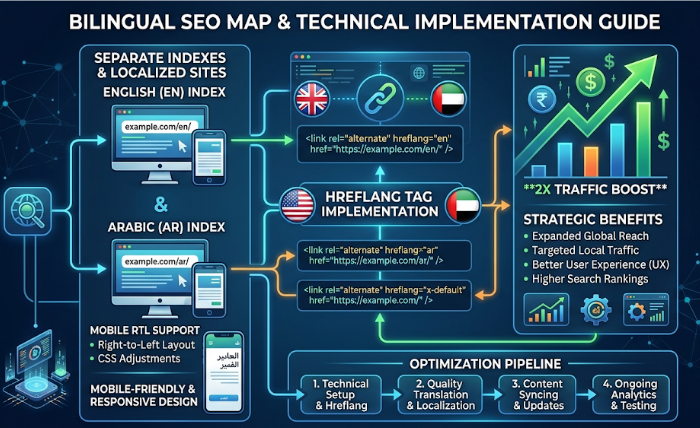
Google indexes languages separately. An Arabic page and an English page covering the same content need separate URLs to be indexed and ranked independently.
The common approach is to use subdirectories: yourdomain.com/en/ for English content and yourdomain.com/ar/ for Arabic content. Alternatively, subdomains (ar.yourdomain.com) or separate domains (yourdomain.com.sa for Arabic) can be used, though subdirectories are generally preferred for SEO.
Without separate URLs, Google cannot distinguish between the two versions and will typically index only one, losing the ranking opportunity from the other language entirely.
Arabic SEO: A Significant Opportunity for Saudi Businesses
Arabic SEO differs from English SEO in several important ways that create specific opportunities for Saudi businesses willing to invest in it properly.
Lower Competition
For most Saudi industry categories, the volume of high-quality Arabic web content optimised for search is lower than the equivalent English content. This means that a well-optimised Arabic page can rank in positions that an equivalent English page would need significantly more authority to achieve.
A business that invests in properly researched, well-written Arabic content for its core service pages can build organic search visibility in Arabic faster than in English, and often with less effort. This is a genuine competitive advantage that very few Saudi businesses have systematically exploited.
Arabic Keyword Research Is Different
Arabic keyword research cannot be done by translating English keywords into Arabic and assuming the search volume follows. Arabic users search differently from English users, use different terminology for the same concepts, and use colloquial Gulf Arabic in some contexts and Modern Standard Arabic in others.
Effective Arabic keyword research requires tools that capture Saudi-specific Arabic search data (Google Keyword Planner with Saudi Arabic settings, Ahrefs or Semrush with Arabic language filtering) and knowledge of how Saudi users actually phrase their searches in each industry category.
Many apparently equivalent Arabic keywords have very different search volumes. The Arabic translation of 'IT solutions' has a different search volume and competition profile than the Arabic equivalent of 'digital solutions' or 'technology company.' Getting this research right before creating Arabic content makes a significant difference to the organic visibility that content achieves.
Arabic Schema Markup
Schema markup (structured data) that tells search engines what type of business you are, where you are located, and what services you offer should be implemented in both Arabic and English. For a Saudi business, this means separate schema entries for each language version, with the Arabic version using Arabic text for business name, service descriptions, and geographic information.
This is a technical detail that most Saudi websites have not addressed, which makes it a low-effort competitive advantage for businesses that do.
What a Proper Bilingual Saudi Website Requires
Building a bilingual website that works properly for both human visitors and search engines requires specific technical and content decisions:
Technical Requirements
Separate URL structure for Arabic and English versions with hreflang tags pointing each language version at the other
Full RTL stylesheet for the Arabic version, not just text direction CSS
Correct Arabic font loading: system fonts or web fonts that render Arabic characters correctly at all sizes
Language detection and redirect logic that serves the correct version based on browser language settings, with a visible language toggle for users who want to switch
Separate SEO metadata (title tags, meta descriptions, heading tags) in each language, independently optimised for each language's target keywords
Image alt text in both languages on all images
Content Requirements
Homepage and core service page content written for Arabic-speaking audiences, not translated from English
Arabic-language blog content targeting Arabic search queries in your industry
Testimonials from Arabic-speaking clients displayed in Arabic on the Arabic version
Arabic versions of all downloadable materials: brochures, guides, case studies
Contact forms and chat tools that work correctly in Arabic, including right-to-left text input
WhatsApp and Social Media: The Arabic Engagement Layer
Your website is not the only digital channel where language matters. For Saudi businesses, WhatsApp is the dominant B2B and B2C communication channel, and social media platforms including Instagram, Snapchat, and LinkedIn are primary discovery channels.
WhatsApp communication with Arabic-speaking clients should happen in Arabic. Automated WhatsApp messages, chatbot responses, and broadcast campaigns should have Arabic versions configured for contacts whose language preference is Arabic.
Social media content performs significantly better in the language that matches the audience. An Instagram post in Arabic reaching a Saudi Arabic-speaking audience will typically achieve higher engagement than the same content in English, because it feels native rather than foreign.
A bilingual digital presence is not just a website decision. It is a communication strategy that extends across every channel through which your business reaches its audience.
Key Takeaways
A significant share of Saudi B2B and B2C search happens in Arabic. A business without credible Arabic content is invisible to this audience and missing a genuine competitive advantage.
Machine translation is not Arabic content. It produces text that is grammatically imperfect and signals to Arabic-speaking prospects that the business has not invested in serving them properly.
RTL layout is a technical development requirement, not a design preference. Pages that switch text direction without switching layout are functionally broken for Arabic readers.
Arabic SEO has lower competition than English SEO in most Saudi industry categories. Well-optimised Arabic content can rank faster and with less effort than equivalent English content.
Separate URLs for Arabic and English with hreflang tags are required for Google to index and rank each language version independently.
✓ Bilingual capability extends beyond the website to WhatsApp automation, social media content, and all client-facing communication materials.
Frequently Asked Questions
Q: Is it necessary for a Saudi B2B technology company to have Arabic content?
A: Yes, for most Saudi B2B technology companies. While English is used in technical documentation and by international buyers, Arabic is the preferred language for initial research and relationship-building for a significant share of Saudi B2B buyers. A company that presents only in English signals that it primarily serves international or English-first clients, which can create unnecessary barriers with Saudi decision-makers who would otherwise be strong prospects.
Q: How much more expensive is building a bilingual website compared to an English-only one?
A: A bilingual website built correctly (with proper RTL implementation, separate URL structure, hreflang tags, and independently optimised SEO metadata) typically costs 40 to 60 percent more than an equivalent single-language site. This reflects the additional development work for RTL styling, the content work for the Arabic version, and the technical SEO configuration for bilingual indexing. The cost is almost always justified by the expanded audience reach and the Arabic organic search opportunity that a single-language site cannot access.
Q: Can we add Arabic to our existing English website without rebuilding it?
A: It depends on how the existing site is built. Sites built on platforms like WordPress with proper multilingual plugins (WPML, Polylang) can add Arabic versions without a full rebuild, though the RTL styling and content work still needs to be done properly. Sites built on custom frameworks or older CMS platforms may require more significant development work to add proper RTL support. A technical audit of the existing site is the right starting point before committing to either an addition or a rebuild.
Q: How do we handle bilingual SEO for a Saudi business targeting both Saudi and international clients?
A: Target your Arabic content at Saudi Arabic-speaking audiences with Gulf-specific keywords and cultural references. Target your English content at English-speaking buyers, whether Saudi or international. Use hreflang tags to tell Google which version is intended for which audience. Produce separate Arabic and English blog content targeting the search queries relevant to each audience. Over time, this approach builds organic visibility in both languages independently, without one version cannibalising the rankings of the other.
Q: Does Softriva provide Arabic content creation as part of web development projects?
A: Yes. Softriva's web development projects for Saudi clients include Arabic content creation as a core deliverable, not an afterthought. This includes Arabic copywriting for key pages, Arabic SEO metadata, RTL stylesheet implementation, and bilingual technical configuration including hreflang tags and language-based routing. Clients who have existing Arabic content can provide it; clients who need Arabic content produced have it written as part of the project scope.
Conclusion
A bilingual digital presence is not a feature. For Saudi businesses serving the Saudi market, it is a basic requirement for reaching the full potential audience.
The businesses that have invested in proper Arabic web content, technically correct RTL implementation, and independent Arabic SEO are benefiting from an organic search channel that most of their competitors have not developed. The businesses that have not made this investment are systematically missing Arabic-speaking prospects who search, do not find them, and find a competitor instead.
Softriva builds bilingual web presences for Saudi businesses with full Arabic content, proper RTL implementation, independent SEO for each language, and the technical configuration required for correct bilingual indexing. Our team includes Arabic-language content specialists who write for Saudi business audiences, not translation tools that process English text.
A free website language audit takes 30 minutes and gives you a clear picture of where your current digital presence is failing Arabic-speaking visitors and what the most impactful improvements are.

Book a Free Website Language Audit at softriva.com


