
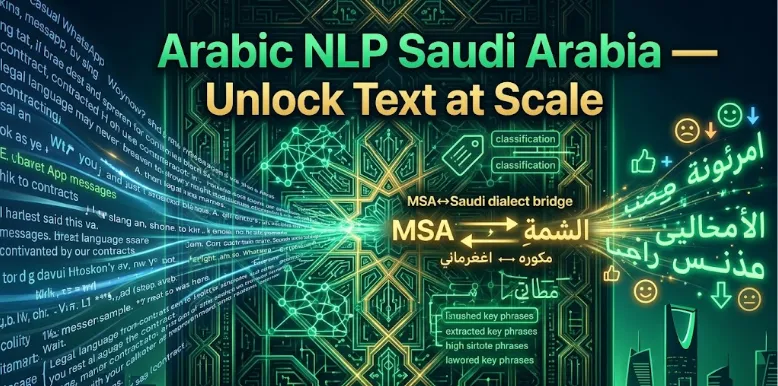
Natural Language Processing for Saudi Businesses: Practical Arabic NLP Applications
Introduction
Most of the data a Saudi business generates every day is text.
Customer enquiries arrive as WhatsApp messages. Contracts and proposals are Word documents. Support tickets are written descriptions of problems. Employee feedback forms contain open-ended answers. Social media mentions contain opinions about the brand. Invoices and purchase orders contain structured text that someone has to read and act on.
Processing all of this text manually takes significant staff time. It is slow, subject to human error, and impossible to do at scale without adding headcount.
Natural Language Processing (NLP) is the field of technology that allows computers to read, interpret, and act on text and speech in human language. Applied to Arabic, it enables Saudi businesses to automate text-heavy tasks that currently require human reading and judgment.
This guide explains what Arabic NLP actually does in a business context, which applications deliver the most value for Saudi companies, what the Arabic-specific technical challenges are, and what a business needs to start using it effectively.
What Natural Language Processing Does
Natural Language Processing is a branch of data science that gives computers the ability to work with human language as data. It covers several distinct capabilities:
Text classification: reading a piece of text and assigning it to a predefined category. A customer support ticket is classified as a billing query, a technical issue, or a complaint. An incoming email is classified as urgent or routine. A job application is classified by the role applied for.
Information extraction: reading a document and pulling out specific pieces of information. An invoice is read and the supplier name, invoice number, line items, and total amount are extracted automatically. A contract is read and the party names, dates, and key obligations are identified.
Sentiment analysis: reading text and identifying whether the overall tone is positive, negative, or neutral. Customer reviews are analysed at scale to identify satisfaction trends. Social media mentions are monitored for shifts in brand perception.
Named entity recognition: identifying and categorising specific entities in text, such as people, organisations, locations, dates, and monetary amounts. A large volume of legal documents is processed to extract all party names and dates automatically.
Machine translation: converting text from one language to another. Arabic content is translated to English for international reporting. English technical documentation is translated to Arabic for Saudi staff.
Conversational AI: understanding the meaning of a user's typed or spoken message and generating a relevant response. Arabic-language chatbots and voice interfaces are built on this capability.
Why Arabic NLP Is Different from English NLP
Arabic is one of the most technically complex languages for NLP. Saudi businesses and their technology partners need to understand why, because it directly affects which tools work and how much customisation is required.
Morphological Complexity
Arabic is a morphologically rich language. A single Arabic root produces many different surface forms through prefixes, suffixes, and internal vowel changes. The Arabic equivalent of the English concept 'write' can appear in dozens of distinct written forms depending on tense, gender, number, and person.
English NLP tools that count or compare words directly do not work well for Arabic because the same concept appears in too many surface forms. Arabic NLP requires stemming or lemmatisation tools specifically designed for Arabic morphology.
Dialect Variation
Modern Standard Arabic (MSA) is the formal written language used in news, official documents, and formal business communication. Saudi Arabic, Egyptian Arabic, Levantine Arabic, and Maghrebi Arabic are distinct spoken dialects with significant vocabulary differences.
A Saudi customer sending a WhatsApp message is likely to write in Saudi colloquial Arabic, not MSA. An NLP model trained only on MSA text will perform poorly on colloquial Saudi Arabic input. This means that NLP systems for customer-facing Saudi applications need to handle Gulf Arabic dialect in addition to MSA.
Right-to-Left Script and Encoding
Arabic text is written right-to-left. Text processing pipelines that were built for left-to-right languages need specific modification to handle Arabic correctly, including text direction, character encoding, and tokenisation (the process of splitting text into words or sub-word units).
Mixed Arabic-English text, which is common in Saudi business communication, adds further complexity. A customer message that contains Arabic sentences with embedded English technical terms or brand names requires a pipeline that handles both scripts correctly within the same text.
The Highest-Value Arabic NLP Applications for Saudi Businesses
Arabic Document Processing and Information Extraction
Saudi businesses in financial services, legal, real estate, and government contracting process large volumes of Arabic-language documents. Contracts, agreements, tenders, and compliance filings all contain structured information that someone currently reads manually to extract.
An Arabic NLP information extraction system reads these documents automatically and pulls specified fields into structured data. A financial services company processes hundreds of Arabic credit applications per week. An NLP system extracts applicant name, ID number, income, employment details, and declared assets from each form automatically, reducing manual processing time by 60 to 80 percent.
For ZATCA compliance, NLP can assist in reading and classifying Arabic-language invoices received from suppliers, extracting line items and VAT amounts, and matching them against purchase orders in the ERP system.
Arabic Customer Support Classification and Routing
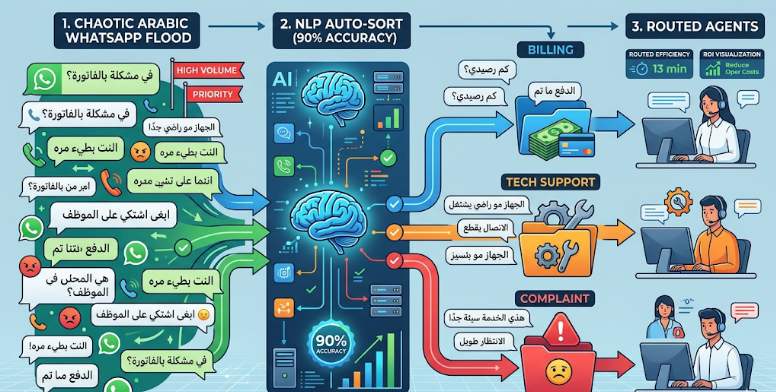
When customer support enquiries arrive in volume, the first human task is reading each one to understand what it is about and routing it to the right team. For a Saudi business receiving 200 Arabic WhatsApp or email messages per day, this triage task alone requires significant staff time.
An Arabic NLP classification system reads each incoming message, identifies the topic (billing, technical support, delivery enquiry, complaint, general information), assigns a priority level, and routes it to the correct team or agent automatically.
The human agents receive pre-classified, pre-routed tickets and focus on resolving them rather than on reading and sorting. Response times improve. Routing errors are reduced. And the classification data builds a body of evidence about which issue types are most common, which is useful for operational planning.
Arabic Sentiment Analysis for Saudi Market Research
Saudi consumers are vocal on social media, particularly on X (formerly Twitter), Instagram, and Snapchat. Product reviews, brand mentions, and service feedback appear in Arabic text at a volume that no human team can read systematically.
Arabic sentiment analysis tools read these mentions at scale, classify them as positive, negative, or neutral, identify the specific topics being discussed, and produce summary reports that give marketing and product teams a current picture of brand perception.
For a Saudi retailer launching a new product or a hospitality business monitoring its reputation, automated Arabic sentiment analysis provides market intelligence that manual monitoring cannot deliver at any reasonable cost.
Arabic Voice Interface and Transcription
Saudi call centres handle high volumes of Arabic voice calls. Transcribing and analysing these calls manually is not feasible at scale. Arabic speech-to-text transcription converts call recordings to text automatically, which can then be analysed for topic distribution, compliance monitoring, and quality assessment.
Arabic voice interfaces (voice search, Arabic-language IVR systems, Arabic voice assistants in mobile apps) all depend on Arabic NLP for understanding spoken language. Saudi users are increasingly comfortable with voice interfaces when they work correctly in Arabic, and the expectation that digital products support Arabic voice input is growing.
Arabic Contract Review Assistance
Saudi legal teams and procurement departments review large numbers of contracts, many in Arabic, to identify key clauses, obligations, termination conditions, and risk factors. NLP contract review tools flag specific clause types, extract key dates and monetary values, and identify clauses that differ from standard templates.
This does not replace legal review. It reduces the time a qualified reviewer spends on routine contract reading by surfacing the relevant sections before the human reviewer starts. A process that previously took four hours of lawyer time is reduced to 90 minutes of focused review of flagged sections.
What a Saudi Business Needs to Start with Arabic NLP
Relevant Arabic Text Data
NLP systems learn from examples. A customer support classification system needs examples of past support tickets labelled with their correct categories. A contract review system needs examples of contracts with the relevant clauses identified. The more representative and correctly labelled the training data is, the better the resulting system performs.
For Saudi businesses, this means collecting and preparing Arabic text data from existing business records. In many cases, the data already exists (past customer messages, processed documents, classified tickets) but has not been organised into a form that can be used for training.
The Right Implementation Partner
Arabic NLP requires technical knowledge that is not available in generic machine learning teams. The morphological complexity of Arabic, the dialect variation across Gulf, Levantine, and North African Arabic, and the encoding requirements for Arabic text all require specialists with direct experience in Arabic NLP.
Before engaging an NLP implementation partner, ask specifically about their experience with Arabic text processing, which Arabic NLP libraries and models they use, and whether they have built systems for Gulf Arabic dialect (not just MSA). A team with no Arabic NLP track record will discover the technical challenges during your project.
A Focused Starting Use Case
The most successful Arabic NLP deployments start with one well-defined use case: classifying one type of document, analysing sentiment from one source, or routing one category of customer enquiry. This focus produces a working system quickly, generates evidence of value, and builds internal confidence for broader deployment.
Starting with a broad 'process all our Arabic text' objective produces a project that is expensive to scope, slow to deliver, and difficult to measure.
Key Takeaways
Natural Language Processing allows computers to read, classify, extract information from, and respond to Arabic text at a scale and speed that human teams cannot match.
Arabic NLP is technically more complex than English NLP due to morphological richness, dialect variation between MSA and Gulf Arabic, and right-to-left script requirements.
The highest-value Arabic NLP applications for Saudi businesses are document processing, customer support classification, sentiment analysis, voice transcription, and contract review assistance.
NLP systems require labelled Arabic text data from real business operations for training. The quality of the training data is the primary determinant of system performance.
Implementation partners for Arabic NLP must have specific experience with Arabic morphology, Gulf dialect variation, and Arabic text encoding. Generic machine learning teams encounter these challenges mid-project.
The most successful Arabic NLP deployments start with one focused use case. A well-defined starting project delivers evidence of value faster than a broad, multi-application programme.
Frequently Asked Questions
Q: What is the difference between Arabic NLP and a standard Arabic chatbot?
A: A standard Arabic chatbot typically follows a scripted decision tree: if the user says X, respond with Y. It handles only the specific scenarios it was programmed for and fails on anything outside that set. An NLP-powered Arabic chatbot understands the intent of a message in natural Arabic language, handles variations in phrasing, and can manage a much wider range of queries. NLP is the underlying technology that makes a chatbot genuinely capable of understanding Arabic, rather than just matching keywords to pre-written responses.
Q: Does Arabic NLP work with Saudi Gulf dialect or only Modern Standard Arabic?
A: Both, but the capability varies by tool and by use case. Pre-trained Arabic NLP models are typically trained primarily on MSA text (news, books, formal documents). They perform less well on Gulf dialect text without additional fine-tuning on Gulf Arabic examples. For customer-facing Saudi applications where the input will be in Saudi colloquial Arabic (WhatsApp messages, social media posts, customer reviews), fine-tuning on Gulf Arabic data is important for acceptable performance. Ask any NLP vendor specifically about their Gulf Arabic dialect handling before engaging them.
Q: How long does it take to build an Arabic NLP system for a Saudi business?
A: A focused Arabic NLP project, covering one use case such as customer support classification or document information extraction, typically takes six to twelve weeks from data preparation to live deployment. The timeline depends on the volume and quality of labelled training data available, the complexity of the classification or extraction task, and the integration requirements with existing business systems. Projects with significant data preparation requirements take longer than those with clean, already-labelled data.
Q: What accuracy level should we expect from an Arabic NLP system?
A: Accuracy depends on the task complexity, the quality of training data, and the specificity of the categories or entities being identified. For well-defined classification tasks (routing a customer ticket to one of five departments) with sufficient training data, Arabic NLP systems typically achieve 85 to 95 percent accuracy. For more complex tasks such as extracting variable information from unstructured Arabic contract text, accuracy may be lower initially and improves with additional training data and model refinement. Human review of a sample of outputs is recommended in all production deployments.
Q: Can Arabic NLP be applied to handwritten Arabic text in scanned documents?
A: Yes, through a combination of Optical Character Recognition (OCR) and NLP. Arabic OCR converts scanned or photographed Arabic text into digital text. NLP then processes that digital text for classification, extraction, or analysis. The accuracy of the full pipeline depends primarily on the quality of the Arabic OCR step, which varies significantly based on handwriting quality, scanning resolution, and the OCR tool's training on Arabic script. Printed Arabic text in standard fonts is handled accurately by current Arabic OCR tools. Handwritten Arabic is more challenging and typically achieves lower accuracy.
Conclusion
Arabic text is the primary form of communication in most Saudi business operations. Customer messages, contracts, support tickets, documents, and feedback forms are all generated and received in Arabic every day.
NLP is the technology that makes this text processable at machine speed and scale. It turns documents that previously required human reading into structured data. It turns customer message queues that previously required triage by staff into automatically classified and routed tickets. It turns Arabic social media at a volume nobody can read manually into systematic market intelligence.
The Arabic-specific technical challenges are real but manageable with the right partner. Saudi businesses that invest in Arabic NLP capability are building a competitive advantage in the efficiency of their text-dependent operations that grows as the volume of Arabic data they process increases.
Softriva develops Arabic NLP solutions for Saudi businesses, with specific experience in Gulf Arabic dialect handling, Arabic document processing, and the integration of NLP systems with existing Saudi business software environments.
A free consultation gives you a specific assessment of which text-heavy processes in your business are best suited to NLP automation and what a focused starting project would involve.

Book a Free NLP Consultation at softriva.com


