
Digital Transformation Roadmap for Saudi Businesses: Where to Start and What to Prioritize
Introduction
Digital transformation has become one of the most discussed business topics in Saudi Arabia. It appears in boardroom discussions, government initiatives, technology conferences, and strategic planning sessions across nearly every industry. Yet despite the attention it receives, many business leaders still struggle to answer a simple question:
Where should we actually start?
The challenge is understandable. The digital transformation landscape is filled with technologies promising dramatic improvements—artificial intelligence, automation, cloud computing, data analytics, enterprise software, cybersecurity platforms, customer experience tools, and more. For businesses attempting to modernize, the sheer number of options can create confusion rather than clarity.
As a result, many organizations make a common mistake: they begin with technology instead of business objectives. They purchase software, launch initiatives, and invest in platforms without first defining the operational problems they are trying to solve.
Successful digital transformation works in the opposite direction.
It starts by identifying business challenges, operational bottlenecks, growth objectives, and customer expectations. Technology then becomes the tool used to address those priorities.
For Saudi businesses operating in an increasingly competitive market shaped by Vision 2030, digital transformation is no longer a future consideration. It is a practical requirement for improving efficiency, maintaining competitiveness, and supporting long-term growth.
This guide provides a clear roadmap for digital transformation, helping Saudi businesses understand where to start, what to prioritize, and how to build a transformation strategy that delivers measurable results.
What Digital Transformation Actually Means
Digital transformation is often misunderstood as the process of adopting new technology.
In reality, digital transformation is the process of using technology to improve how a business operates, serves customers, and creates value.
Technology is the enabler—not the goal.
A successful transformation initiative typically involves improvements across several areas:
Business process automation
Data-driven decision making
Customer experience enhancement
Workforce productivity
Operational efficiency
System integration
Digital service delivery
Security and compliance
For some businesses, transformation may involve replacing manual processes with automated workflows.
For others, it may involve connecting disconnected systems, improving reporting capabilities, or enabling remote collaboration.
The specific technologies matter less than the outcomes they produce.
The goal is not to become more digital.
The goal is to become more effective.
Why Digital Transformation Matters More Than Ever in Saudi Arabia
Several factors are accelerating transformation initiatives across the Kingdom.
Vision 2030
Saudi Arabia's Vision 2030 program places significant emphasis on digital innovation, operational efficiency, economic diversification, and technology adoption.
Organizations that embrace modernization are often better positioned to participate in government projects, strategic partnerships, and emerging opportunities.
Rising Customer Expectations
Modern customers expect faster service, digital communication channels, self-service options, and personalized experiences.
Businesses relying on outdated processes struggle to meet these expectations consistently.
Increased Competition
Digital-first organizations can often:
Respond faster to customers
Reduce operating costs
Make decisions more quickly
Scale operations efficiently
This creates a competitive advantage that compounds over time.
Workforce Efficiency
As businesses grow, manual processes become increasingly difficult to manage.
Digital transformation enables organizations to increase productivity without increasing headcount at the same rate.
The Most Common Mistake: Transforming Everything at Once
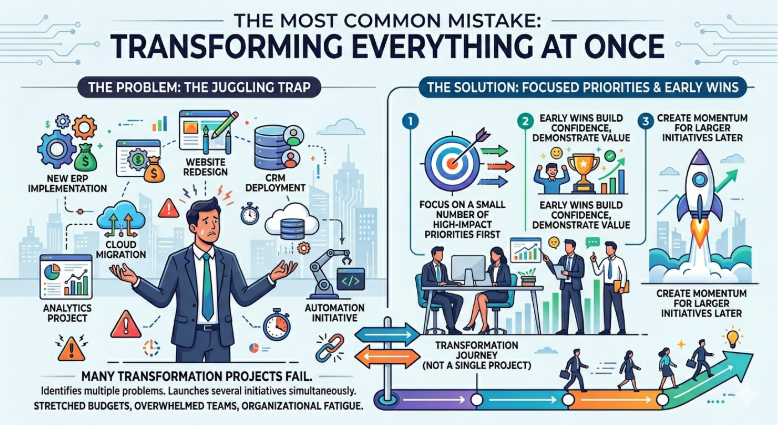
Many transformation projects fail because organizations attempt too much, too quickly.
A business identifies multiple problems and launches several initiatives simultaneously:
New ERP implementation
Website redesign
CRM deployment
Cloud migration
Analytics project
Automation initiative
Individually, each project may have merit.
Collectively, they overwhelm teams, stretch budgets, and create organizational fatigue.
The most successful digital transformation programs focus on a small number of high-impact priorities first.
Early wins build confidence, demonstrate value, and create momentum for larger initiatives later.
Transformation should be approached as a journey rather than a single project.
Phase 1: Assess Your Current Digital Maturity
Before making any investment, businesses must understand their current state.
A digital maturity assessment evaluates:
Processes
Which business processes are currently manual?
Examples include:
Invoice processing
Lead management
HR onboarding
Procurement approvals
Customer service workflows
Systems
How many systems are currently in use?
Are they integrated?
Can information flow automatically between them?
Or does staff manually transfer data between platforms?
Data
How accessible is your business data?
Can leadership access real-time insights?
Or are reports still generated manually through spreadsheets?
Security
Are security controls, backups, and compliance measures adequate?
How vulnerable is the organization to cyber threats or operational disruption?
A clear understanding of the current environment provides the foundation for every subsequent decision.
Phase 2: Identify High-Impact Business Challenges
Digital transformation should focus on solving meaningful business problems.
Ask the following questions:
Where do employees spend the most time?
Tasks involving repetitive manual work often represent strong automation opportunities.
What frustrates customers most?
Slow response times, poor communication, and inconsistent service are common transformation targets.
Which processes create bottlenecks?
Operational delays often reveal areas where technology can create immediate value.
Where are decisions being made without sufficient data?
Limited visibility often leads to slower and less effective decision-making.
The objective is to identify challenges that have measurable financial or operational impact.
Phase 3: Prioritize Quick Wins
Not every transformation initiative delivers value at the same speed.
The most successful organizations begin with projects that offer:
High business impact
Low implementation complexity
Fast return on investment
Examples include:
Workflow Automation
Automating repetitive processes such as:
Lead routing
Approval workflows
Invoice processing
Employee onboarding
These projects often produce visible efficiency gains within weeks.
Business Intelligence Dashboards
Replacing manual reporting with real-time dashboards provides immediate visibility into business performance.
Leadership gains faster access to critical information without waiting for monthly reports.
Customer Service Automation
Chatbots, self-service portals, and automated support workflows improve responsiveness while reducing workload.
Cloud Collaboration Tools
Cloud-based productivity platforms improve communication, accessibility, and collaboration across teams.
Quick wins demonstrate value and help secure organizational support for larger transformation initiatives.
Phase 4: Build a Strong Technology Foundation
Once initial improvements are delivering results, attention should shift toward infrastructure and scalability.
Cloud Adoption
Cloud platforms provide flexibility, scalability, and accessibility.
Benefits include:
Reduced infrastructure costs
Improved reliability
Better disaster recovery
Enhanced collaboration
System Integration
Disconnected systems create inefficiencies.
Integration allows information to flow automatically between:
CRM platforms
Accounting software
ERP systems
HR platforms
Customer support systems
A connected technology environment eliminates duplication and improves data accuracy.
Cybersecurity Enhancement
Transformation increases digital dependency.
Security must evolve alongside technology.
Areas requiring attention include:
Endpoint security
Multi-factor authentication
Backup systems
Access controls
Security monitoring
Without adequate protection, digital growth introduces new risks.
Phase 5: Build a Data-Driven Organization
Many businesses collect significant amounts of data but use only a small portion of it.
A mature digital organization uses data to support decision-making at every level.
This includes:
Operational Reporting
Monitoring daily performance metrics.
Executive Dashboards
Providing leadership with real-time visibility.
Predictive Analytics
Identifying future trends, risks, and opportunities.
Customer Insights
Understanding behavior, preferences, and purchasing patterns.
Organizations that make decisions using reliable data consistently outperform those relying primarily on intuition.
Phase 6: Scale Through Automation and Artificial Intelligence
Once foundational systems are established, advanced technologies can create additional value.
Artificial intelligence and automation are most effective when implemented on top of structured processes and reliable data.
Examples include:
AI-Powered Customer Service
Automated support channels operating around the clock.
Predictive Maintenance
Identifying equipment issues before failures occur.
Sales Forecasting
Improving revenue planning and resource allocation.
Intelligent Document Processing
Automatically extracting information from invoices, contracts, and forms.
AI should enhance existing operations rather than replace strategic human decision-making.
How to Measure Digital Transformation Success
Many organizations struggle because they fail to define success criteria.
Transformation should be measured against business outcomes.
Common metrics include:
Operational Efficiency
Reduced processing times
Fewer manual tasks
Increased productivity
Financial Performance
Cost reductions
Revenue growth
Improved profitability
Customer Experience
Faster response times
Higher satisfaction scores
Improved retention rates
Employee Productivity
Reduced administrative workload
Faster access to information
Improved collaboration
Risk Reduction
Stronger cybersecurity posture
Improved compliance
Reduced downtime
Transformation initiatives should always be tied to measurable outcomes.
Key Takeaways
Digital transformation is a business initiative, not a technology project.
The most successful organizations begin by solving business problems rather than purchasing software.
A digital maturity assessment provides the foundation for effective planning.
Quick-win projects create momentum and demonstrate value early.
Cloud adoption, system integration, and cybersecurity form the core technology foundation.
Data-driven decision-making is a critical capability for modern businesses.
Artificial intelligence delivers the greatest value when built on reliable systems and quality data.
Digital transformation should be measured through business outcomes rather than technology adoption alone.
Frequently Asked Questions
Q: What is the first step in a digital transformation project?
A: The first step is assessing your current digital maturity. Businesses need to understand their processes, systems, data environment, and operational challenges before investing in new technology.
Q: How long does digital transformation take?
A: Digital transformation is an ongoing journey rather than a fixed project. Initial improvements may be delivered within weeks or months, while broader transformation programs often evolve over several years.
Q: Is digital transformation only for large enterprises?
A: No. Small and mid-sized businesses often achieve significant benefits because they can modernize processes more quickly and with fewer organizational complexities than large enterprises.
Q: How much should a Saudi business budget for digital transformation?
A: Investment levels vary depending on objectives, existing systems, and project scope. The most effective approach is to prioritize high-impact initiatives with measurable ROI before expanding into larger transformation programs.
Q: What role does Vision 2030 play in digital transformation?
A: Vision 2030 encourages technology adoption, innovation, operational efficiency, and digital modernization across the Saudi economy. Businesses aligning with these objectives are often better positioned for future opportunities and growth.
Conclusion
Digital transformation is no longer a competitive advantage reserved for technology leaders. It is rapidly becoming the operational standard for businesses across Saudi Arabia.
The organizations achieving the strongest results are not necessarily those investing the most in technology. They are the ones approaching transformation strategically—starting with business objectives, prioritizing high-impact opportunities, building strong foundations, and scaling based on measurable outcomes.
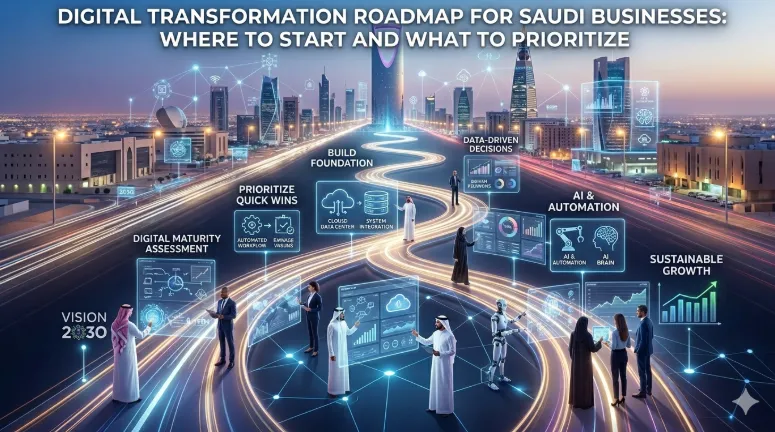
The roadmap is straightforward:
Assess your current environment.
Identify your most important challenges.
Prioritize quick wins.
Build scalable foundations.
Use data to drive decisions.
Expand through automation and artificial intelligence.
When approached this way, digital transformation becomes far less intimidating and far more achievable.
Softriva has been helping businesses across Saudi Arabia modernize their operations, implement technology solutions, improve efficiency, and build sustainable competitive advantages since 2006.
If you're ready to build a practical digital transformation roadmap tailored to your business, start with a conversation.
Book Your Free Digital Transformation Consultation at softriva.com.


