
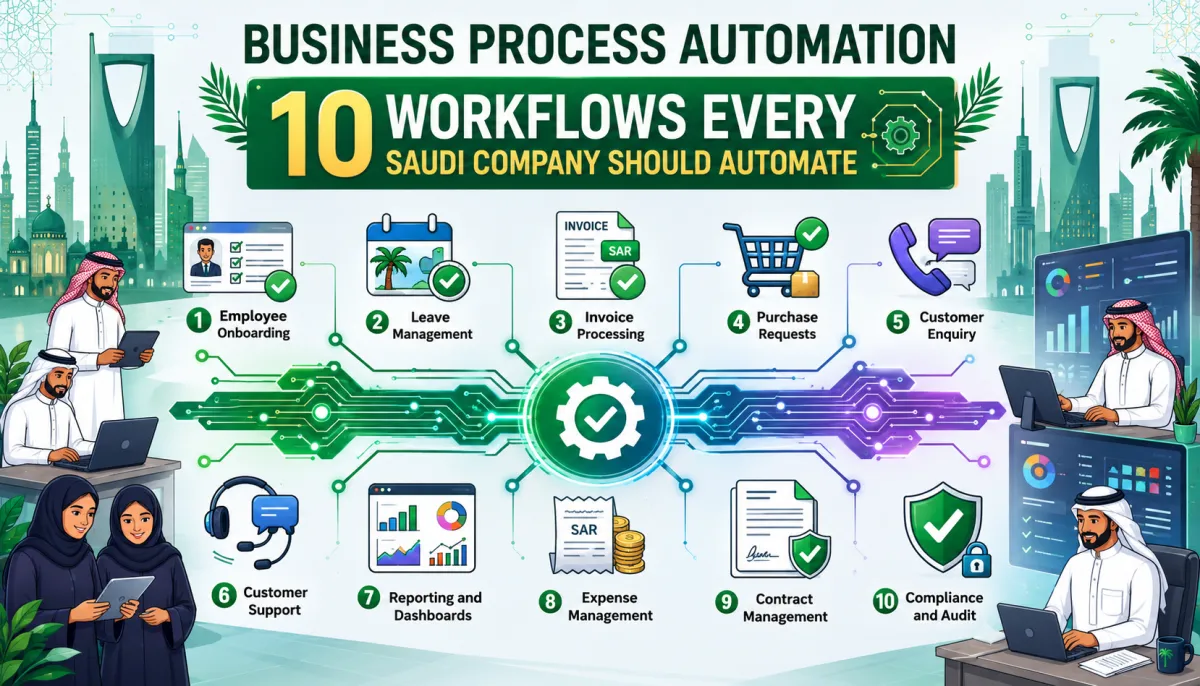
Business Process Automation: 10 Workflows Every Saudi Company Should Automate
Introduction
Every business has processes.
Some are visible to customers, such as responding to enquiries, processing orders, and delivering services. Others operate behind the scenes, including approvals, reporting, procurement, invoicing, onboarding, and compliance management.
As businesses grow, these processes become increasingly complex. Tasks that were once manageable through email, spreadsheets, and manual coordination begin consuming more time, creating more errors, and limiting scalability.
The result is familiar to many organizations:
Employees spend hours on repetitive administrative tasks.
Managers chase approvals through email chains.
Reports require manual compilation.
Customer requests wait longer than they should.
Operational bottlenecks become part of everyday business.
Business process automation addresses these challenges by replacing manual workflows with technology-driven processes that operate faster, more accurately, and with greater consistency.
For Saudi businesses pursuing growth, efficiency, and digital transformation, automation is no longer simply a productivity tool. It has become a strategic capability that enables organizations to scale operations without proportionally increasing administrative overhead.
This guide explores the ten workflows that typically deliver the highest return on investment when automated and explains how organizations can prioritize automation initiatives effectively.
What Is Business Process Automation?
Business Process Automation (BPA) refers to the use of technology to execute repetitive tasks and workflows with minimal human intervention.
Automation can:
Eliminate manual data entry
Reduce processing time
Improve accuracy
Enhance visibility
Strengthen compliance
Increase productivity
Importantly, automation is not about replacing people.
It is about allowing employees to focus on higher-value activities by reducing time spent on repetitive administrative work.
The most successful automation projects improve both operational performance and employee experience simultaneously.
Why Automation Has Become a Priority for Saudi Businesses
Several factors are driving automation adoption across Saudi Arabia.
Increasing Operational Complexity
Growing organizations often struggle to maintain efficiency using manual processes.
What worked for 10 employees rarely works for 100.
Rising Customer Expectations
Customers expect:
Faster responses
Faster approvals
Faster service delivery
Manual workflows often struggle to meet these expectations consistently.
Digital Transformation Initiatives
Organizations pursuing digital transformation frequently discover automation opportunities throughout their operations.
Cost Optimization
Automation enables businesses to increase output without proportionally increasing administrative staffing costs.
Improved Compliance
Automated workflows provide better tracking, documentation, and accountability than manual processes.
Workflow #1: Employee Onboarding
Many businesses still onboard new employees through emails, paper forms, and manual coordination.
HR sends documents.
IT creates accounts.
Managers arrange training.
Facilities prepare workstations.
Without automation, delays are common.
Benefits of Automation
Automated onboarding can:
Assign tasks automatically
Track completion status
Generate documents
Notify stakeholders
Create user accounts
This ensures every employee experiences a consistent onboarding process.
Workflow #2: Leave and Attendance Management
Manual leave requests often involve:
Email approvals
Spreadsheet updates
HR follow-ups
Payroll coordination
This creates unnecessary administrative workload.
Benefits of Automation
Automated leave management enables:
Self-service requests
Approval routing
Leave balance tracking
Calendar integration
Payroll synchronization
Employees receive faster responses while HR gains better visibility.
Workflow #3: Invoice Processing
Invoice management remains highly manual in many organizations.
Invoices are received.
Data is entered manually.
Approvals are requested.
Payments are scheduled.
Errors and delays are common.
Benefits of Automation
Automated invoice workflows can:
Extract invoice data automatically
Route approvals
Track status
Trigger payment processing
Maintain audit trails
Processing times can often be reduced dramatically.
Workflow #4: Purchase Request Approvals
Procurement frequently involves multiple approval levels.
Without automation, requests can become stuck in inboxes or forgotten entirely.
Benefits of Automation
Automated procurement workflows:
Route requests automatically
Apply approval rules
Track status in real time
Notify approvers
Escalate delays
Organizations gain better control over spending while reducing approval times.
Workflow #5: Customer Enquiry Management
Many businesses still manage enquiries manually.
Website forms.
Emails.
WhatsApp messages.
Phone calls.
Without structure, opportunities can be missed.
Benefits of Automation
Automated lead management can:
Capture enquiries instantly
Assign leads automatically
Trigger follow-ups
Track conversion status
Generate reporting
Sales teams spend less time managing leads and more time engaging prospects.
Workflow #6: Customer Support Requests
Customer service teams often receive requests through multiple channels.
Managing them manually creates delays and inconsistencies.
Benefits of Automation
Support automation can:
Create tickets automatically
Assign requests
Prioritize issues
Trigger escalations
Track resolution times
This improves both efficiency and customer satisfaction.
Workflow #7: Reporting and Dashboard Generation
Many organizations still create reports manually.
Employees spend hours gathering data from multiple systems.
By the time reports are completed, information may already be outdated.
Benefits of Automation
Automated reporting provides:
Real-time dashboards
Scheduled reporting
Data consolidation
Improved accuracy
Faster decision-making
Leadership gains immediate access to current business information.
Workflow #8: Employee Expense Management
Expense reimbursement processes are often inefficient.
Receipts are submitted manually.
Approvals are delayed.
Finance teams spend time validating information.
Benefits of Automation
Automated expense workflows:
Capture receipts digitally
Route approvals automatically
Validate policy compliance
Track reimbursement status
Employees receive faster reimbursements while finance teams reduce administrative effort.
Workflow #9: Contract Management
Contract administration often involves numerous manual activities.
Documents must be reviewed, approved, renewed, and archived.
Without structure, important deadlines can be missed.
Benefits of Automation
Contract automation can:
Track contract status
Trigger renewal reminders
Route approvals
Maintain document repositories
Improve compliance
Organizations reduce legal and operational risk.
Workflow #10: Compliance and Audit Processes
Compliance activities frequently involve repetitive documentation and tracking requirements.
Manual processes increase risk and administrative burden.
Benefits of Automation
Compliance automation enables:
Automated evidence collection
Policy tracking
Audit preparation
Documentation management
Regulatory reporting
Organizations improve governance while reducing workload.
How to Prioritize Automation Projects
Not every process should be automated immediately.
The best candidates typically share several characteristics.
High Volume
Processes performed frequently deliver larger productivity gains.
Repetitive Activities
Routine tasks are easier to automate successfully.
Rule-Based Decisions
Workflows with clear decision criteria are ideal automation candidates.
Significant Time Consumption
Processes consuming substantial employee effort often produce the strongest ROI.
Error-Prone Activities
Automation improves consistency and reduces human error.
Common Automation Mistakes
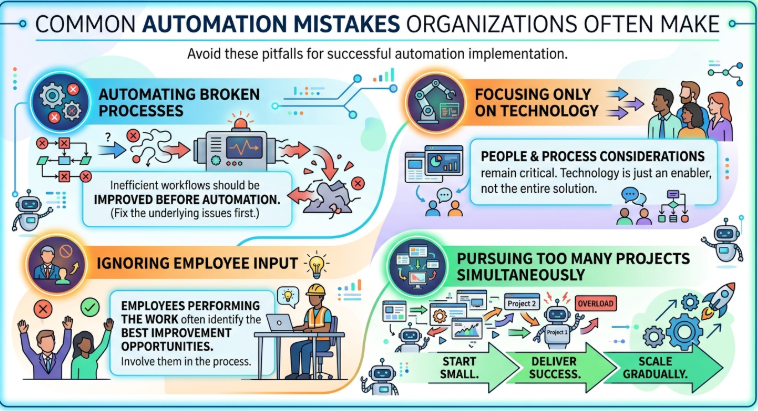
Organizations sometimes approach automation incorrectly.
Common mistakes include:
Automating Broken Processes
Inefficient workflows should be improved before automation.
Focusing Only on Technology
People and process considerations remain critical.
Ignoring Employee Input
Employees performing the work often identify the best improvement opportunities.
Pursuing Too Many Projects Simultaneously
Start small.
Deliver success.
Scale gradually.
Measuring Automation Success
Automation initiatives should be measured through business outcomes.
Examples include:
Operational Metrics
Processing time reduction
Task completion speed
Workflow throughput
Financial Metrics
Cost savings
Reduced overtime
Increased productivity
Quality Metrics
Error reduction
Compliance improvement
Data accuracy
Customer Metrics
Faster response times
Improved satisfaction
Increased retention
Success should be tied directly to business value rather than technology deployment.
The Role of Automation in Digital Transformation
Automation is often one of the first visible successes within a broader digital transformation strategy.
It helps organizations:
Improve efficiency
Increase scalability
Reduce costs
Enhance customer experiences
Build digital maturity
As automation capabilities mature, businesses can expand into advanced technologies such as artificial intelligence, predictive analytics, and intelligent process optimization.
Automation creates the foundation for these future initiatives.
Key Takeaways
Business process automation reduces manual work, improves efficiency, and supports business growth.
The highest-value automation opportunities often involve repetitive, high-volume workflows.
Employee onboarding, invoice processing, procurement, customer service, and reporting are among the best automation candidates.
Automation improves accuracy, visibility, compliance, and productivity simultaneously.
Successful automation begins with process improvement, not just technology implementation.
Automation initiatives should be prioritized based on business impact and ROI.
Measuring business outcomes is essential for demonstrating automation success.
Automation serves as a foundational component of broader digital transformation initiatives.
Frequently Asked Questions
Q: What is business process automation?
A: Business process automation uses technology to execute repetitive workflows with minimal manual intervention, improving efficiency, consistency, and productivity.
Q: Which processes should businesses automate first?
A: High-volume, repetitive, rule-based processes such as onboarding, invoice processing, approvals, customer service, and reporting typically deliver the fastest ROI.
Q: Does automation replace employees?
A: No. Automation is designed to eliminate repetitive administrative work, allowing employees to focus on higher-value activities that require judgment, creativity, and customer interaction.
Q: How long does an automation project take?
A: Simple workflows can often be automated within weeks, while larger enterprise automation initiatives may take several months depending on complexity and integration requirements.
Q: How do we measure automation ROI?
A: ROI is typically measured through time savings, productivity improvements, reduced errors, faster processing times, cost reductions, and improved customer experiences.
Conclusion
Business growth inevitably increases operational complexity.
Without automation, organizations often respond by adding more administrative effort, more manual processes, and more overhead.
This approach becomes increasingly difficult to sustain.
Business process automation offers a better path.
By identifying repetitive workflows and applying the right technologies, organizations can improve efficiency, reduce costs, strengthen compliance, and create better experiences for both employees and customers.
The key is not to automate everything at once.
Start with high-impact opportunities.
Deliver measurable results.
Build momentum.
Then expand strategically.
Softriva has helped organizations across Saudi Arabia modernize operations through workflow automation, business process optimization, digital transformation consulting, and technology implementation since 2006.
If you're ready to identify automation opportunities within your organization, begin with a structured assessment of your current processes and priorities.


