
Cloud Migration Strategy: A Step-by-Step Guide for Businesses
Introduction
Cloud computing has evolved from an emerging technology trend into a fundamental business capability.
Today, organizations across industries rely on cloud platforms to improve operational efficiency, enhance scalability, support remote work, strengthen disaster recovery capabilities, and accelerate innovation.
As businesses grow, traditional on-premises infrastructure often becomes increasingly difficult to manage.
Organizations face challenges such as:
Rising infrastructure costs
Hardware maintenance requirements
Limited scalability
Complex upgrades
Disaster recovery concerns
Increasing cybersecurity demands
Cloud computing addresses many of these challenges by providing flexible, scalable, and cost-effective technology resources that can be accessed on demand.
However, moving to the cloud is not simply a technical project.
Successful cloud adoption requires careful planning, risk management, and alignment with business objectives.
Organizations that approach migration strategically often achieve significant improvements in agility, performance, and operational efficiency.
Those that migrate without proper planning frequently encounter unexpected costs, security concerns, and operational disruptions.
For businesses in Saudi Arabia pursuing digital transformation and modernization initiatives, cloud migration has become a critical component of long-term technology strategy.
This guide explores cloud migration fundamentals, benefits, challenges, and a practical step-by-step approach for building a successful migration strategy.
What Is Cloud Migration?
Cloud migration refers to the process of moving applications, data, workloads, and IT resources from on-premises environments to cloud-based infrastructure.
Migration may involve:
Applications
Databases
Storage systems
Business platforms
Development environments
Disaster recovery solutions
The objective is to leverage cloud technologies to improve performance, flexibility, scalability, and operational efficiency.
Cloud migration is often part of a broader digital transformation initiative.
Why Businesses Are Moving to the Cloud
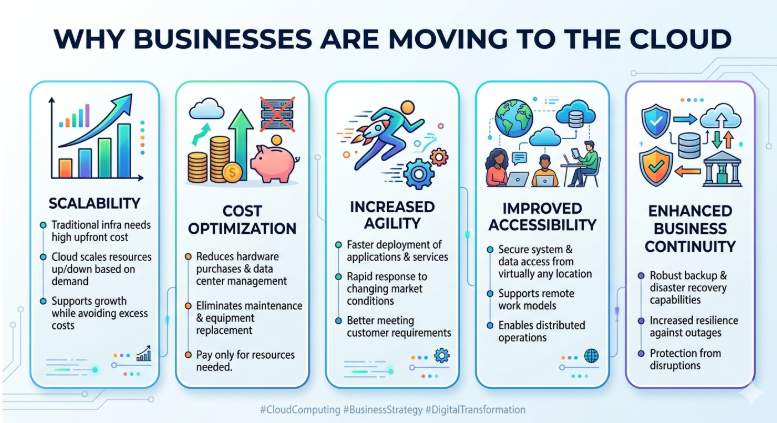
Organizations adopt cloud technologies for several strategic reasons.
Scalability
Traditional infrastructure often requires significant upfront investment.
Cloud platforms allow businesses to scale resources up or down based on demand.
This flexibility supports growth while avoiding unnecessary costs.
Cost Optimization
Cloud services reduce the need for:
Hardware purchases
Data center management
Infrastructure maintenance
Equipment replacement
Organizations pay for resources as needed.
Increased Agility
Cloud environments enable faster deployment of applications and services.
Businesses can respond more quickly to changing market conditions and customer requirements.
Improved Accessibility
Employees can access systems and data securely from virtually any location.
This supports remote work and distributed operations.
Enhanced Business Continuity
Cloud providers typically offer robust backup and disaster recovery capabilities.
Organizations gain greater resilience against outages and disruptions.
Understanding Cloud Deployment Models
Before migration begins, organizations should understand available deployment options.
Public Cloud
Infrastructure is provided by third-party cloud providers.
Benefits include:
Lower upfront costs
Scalability
Rapid deployment
Public cloud environments are commonly used for a wide range of workloads.
Private Cloud
Infrastructure is dedicated to a single organization.
Benefits include:
Greater control
Enhanced customization
Specific compliance requirements
Private cloud environments may be preferred for highly sensitive workloads.
Hybrid Cloud
Hybrid cloud combines on-premises systems with cloud infrastructure.
Organizations can maintain critical workloads internally while leveraging cloud services where appropriate.
Multi-Cloud
Multi-cloud strategies involve using services from multiple cloud providers.
Benefits include:
Flexibility
Reduced vendor dependency
Workload optimization
Key Benefits of Cloud Migration
Greater Operational Efficiency
Cloud platforms automate many infrastructure management activities.
IT teams spend less time maintaining hardware and more time supporting business initiatives.
Improved Scalability
Organizations can quickly adjust resources to meet changing business requirements.
This supports both growth and seasonal demand fluctuations.
Faster Innovation
Cloud platforms provide access to advanced capabilities such as:
Artificial Intelligence
Machine Learning
Analytics
Automation
Businesses can adopt new technologies more rapidly.
Enhanced Security
Leading cloud providers invest heavily in security capabilities.
Organizations benefit from:
Encryption
Monitoring
Access controls
Threat detection
Security remains a shared responsibility but often improves through cloud adoption.
Better Disaster Recovery
Cloud-based backup and recovery solutions help organizations recover more quickly from disruptions.
This reduces downtime and business risk.
Common Cloud Migration Challenges
Although cloud migration offers significant advantages, organizations must address several challenges.
Legacy Applications
Older applications may not be compatible with modern cloud environments.
Some workloads may require modernization before migration.
Data Migration Complexity
Moving large volumes of data can be time-consuming and technically challenging.
Organizations must ensure data integrity throughout the process.
Security and Compliance Requirements
Cloud environments must meet organizational security policies and regulatory requirements.
Planning is essential.
Cost Management
Without proper governance, cloud costs can grow unexpectedly.
Organizations should establish monitoring and optimization practices.
Change Management
Employees and stakeholders may require training and support during the transition.
Successful migration involves both technology and people.
The 6 Rs of Cloud Migration
Organizations typically use one of several migration approaches.
Rehost ("Lift and Shift")
Applications are moved to the cloud with minimal modifications.
Advantages:
Faster migration
Lower complexity
Replatform
Applications undergo limited optimization before migration.
This approach balances speed and modernization.
Refactor
Applications are redesigned to fully leverage cloud capabilities.
Benefits include:
Improved performance
Greater scalability
Enhanced efficiency
Repurchase
Organizations replace existing applications with cloud-based alternatives.
Example:
Migrating from on-premises software to Software-as-a-Service (SaaS).
Retain
Some applications remain on-premises due to technical or business considerations.
Retire
Obsolete systems are decommissioned rather than migrated.
Step-by-Step Cloud Migration Strategy
Step 1: Define Business Objectives
Begin by identifying desired outcomes.
Examples include:
Cost reduction
Scalability improvements
Security enhancement
Operational efficiency
Digital transformation
Technology decisions should support business goals.
Step 2: Assess Current Environment
Evaluate:
Applications
Infrastructure
Data
Dependencies
Security requirements
Understanding the existing environment helps identify migration priorities.
Step 3: Categorize Workloads
Not all systems require the same migration approach.
Organizations should classify workloads based on:
Complexity
Criticality
Business value
Technical requirements
Step 4: Choose the Right Cloud Model
Select the deployment model that best aligns with business requirements.
Options include:
Public cloud
Private cloud
Hybrid cloud
Multi-cloud
Step 5: Develop a Migration Roadmap
Create a phased implementation plan.
Prioritize workloads that deliver strong business value with manageable complexity.
Step 6: Establish Security Controls
Security planning should include:
Identity management
Encryption
Access controls
Monitoring
Compliance requirements
Security must be integrated throughout the migration process.
Step 7: Execute Pilot Projects
Pilot migrations allow organizations to validate approaches before large-scale deployment.
Lessons learned can improve future phases.
Step 8: Monitor and Optimize
Cloud migration is not the end of the journey.
Organizations should continuously optimize:
Performance
Costs
Security
Resource utilization
Cloud Migration Best Practices
Start with Business Priorities
Migration should support business outcomes rather than purely technical objectives.
Avoid Migrating Everything at Once
Phased approaches reduce risk and improve control.
Build Governance Early
Establish policies for:
Resource management
Security
Cost optimization
Compliance
Train Employees
Cloud adoption often requires new skills and processes.
Investing in training improves success rates.
Measure Results
Track metrics such as:
Cost savings
Performance improvements
Scalability gains
Operational efficiency
Cloud Migration and Digital Transformation
Cloud migration often serves as a foundation for broader digital transformation initiatives.
Cloud environments support technologies such as:
Artificial Intelligence
Automation
Analytics
Internet of Things (IoT)
Organizations gain the flexibility needed to pursue future innovation opportunities.
The Future of Cloud Computing
Cloud adoption continues to accelerate globally.
Several trends are shaping the future:
Hybrid cloud growth
AI-powered cloud services
Edge computing integration
Advanced security capabilities
Greater automation
Cloud platforms will increasingly serve as the foundation for business innovation and operational excellence.
Organizations investing in cloud capabilities today are positioning themselves for future success.
Key Takeaways
✓ Cloud migration improves scalability, flexibility, and operational efficiency.
✓ Successful migration requires alignment with business objectives.
✓ Public, private, hybrid, and multi-cloud models address different organizational requirements.
✓ Security and governance should be integrated into every phase of migration.
✓ The 6 Rs framework helps organizations select appropriate migration strategies.
✓ Pilot projects reduce risk and improve migration outcomes.
✓ Cloud migration is an ongoing journey rather than a one-time project.
✓ Cloud adoption supports broader digital transformation and innovation initiatives.
Frequently Asked Questions
Q: What is cloud migration?
A: Cloud migration is the process of moving applications, data, workloads, and IT resources from on-premises environments to cloud-based infrastructure.
Q: What are the main benefits of cloud migration?
A: Benefits include scalability, cost optimization, operational efficiency, improved security, enhanced disaster recovery, and faster innovation.
Q: How long does cloud migration take?
A: Timelines vary depending on complexity, workload size, dependencies, and migration strategy. Most organizations adopt phased approaches.
Q: Is cloud migration secure?
A: Yes, when implemented properly. Security planning should include encryption, access controls, monitoring, governance, and compliance requirements.
Q: What is the best cloud migration approach?
A: The best approach depends on business objectives, application requirements, technical complexity, and organizational priorities.
Conclusion
Cloud migration has become a strategic business initiative rather than simply a technology upgrade.
Organizations that successfully migrate to the cloud gain greater agility, scalability, resilience, and access to innovative technologies that support growth and competitiveness.
However, successful migration requires more than moving systems from one environment to another.
It demands careful planning, strong governance, effective security practices, and alignment with broader business objectives.
The organizations achieving the greatest success are those that view cloud adoption as part of a long-term digital transformation strategy.
Softriva helps businesses across Saudi Arabia plan, execute, and optimize cloud migration initiatives that deliver measurable business outcomes while minimizing risk.
Book Your Free Cloud Migration Assessment at softriva.com and discover how a strategic cloud journey can accelerate growth, improve efficiency, and support long-term business success.


