
Conversion Rate Optimisation for Saudi Business Websites: Turn More Visitors into Leads
Introduction
Most Saudi business websites have a traffic problem and a conversion problem. The traffic problem gets the attention. The conversion problem is usually larger.
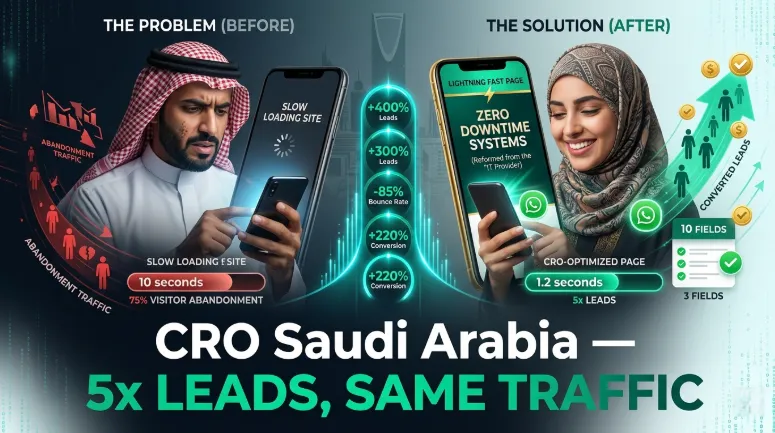
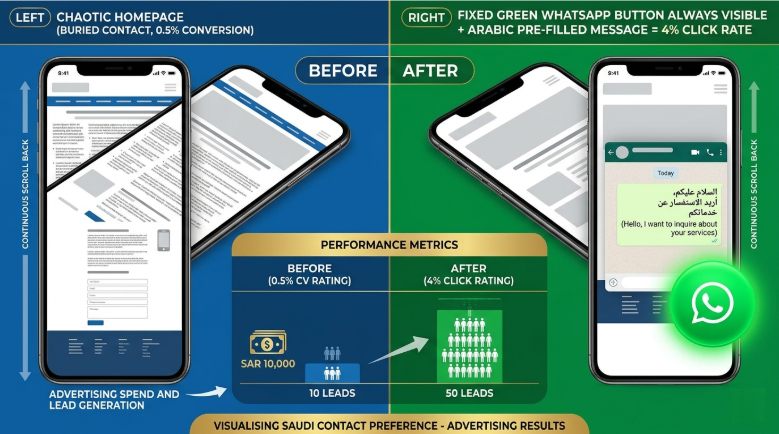
A business spending SAR 10,000 per month on Google Ads and Instagram promotion to drive 2,000 visitors to its website, and converting 0.5 percent of them into enquiries, gets 10 leads per month. The same business converting 2.5 percent of the same traffic gets 50 leads. The five times improvement in leads comes entirely from the website, not from the advertising budget.
Conversion Rate Optimisation (CRO) is the discipline of increasing the percentage of website visitors who take the action you want them to take: filling in a contact form, clicking a WhatsApp button, booking a consultation, or making a purchase.
This guide explains why Saudi business websites lose visitors before converting them, what the most impactful conversion improvements are, how to measure conversion performance correctly, and how to prioritise CRO changes for the fastest return.
What Conversion Rate Is and How to Calculate It
Your website conversion rate is the percentage of visitors who complete a desired action.
If your website receives 1,000 visitors in a month and 15 of them submit a contact form, your contact form conversion rate is 1.5 percent. If 40 visitors click your WhatsApp button, your WhatsApp click rate is 4 percent.
For Saudi B2B service websites, a contact form conversion rate of 1 to 3 percent is typical. A well-optimised B2B service site can achieve 3 to 8 percent. For Saudi e-commerce sites, an overall purchase conversion rate of 1 to 3 percent is common, with well-optimised stores reaching 4 to 6 percent.
These benchmarks are starting points, not targets. The right target for your site depends on your industry, your traffic quality, and your current baseline. The most important metric is whether your conversion rate is improving over time, not whether it matches an industry average.
Why Saudi Business Websites Lose Visitors Without Converting
The most common reasons Saudi business website visitors leave without converting are consistent across industries:
The Website Does Not Communicate Its Value in the First Five Seconds
A visitor who lands on your homepage has roughly five seconds to understand what your business does, who it serves, and why it is worth staying. If those five seconds are filled with a generic headline, a stock photo, and animation that takes time to load, the visitor leaves.
The most common homepage headline failure in Saudi business websites is describing what the company is rather than what it delivers. 'A Leading IT Solutions Provider in Saudi Arabia' tells the visitor nothing they could not have guessed. 'IT Systems That Help Jeddah Businesses Operate Without Downtime' tells them something specific and relevant.
The Next Step Is Not Clear
A visitor who is interested in your services needs to know what to do next. If the next step is not immediately obvious, many visitors will not search for it. They will leave.
The next step on a Saudi business website needs to be visible without scrolling, described in action language ('Book a Free Consultation,' 'Get a Quote,' 'Chat on WhatsApp'), and repeated at multiple points on every key page.
Many Saudi business websites have a contact link buried in the navigation bar and no other conversion mechanism anywhere on the page. This is a structural conversion failure that no amount of content improvement will fix.
The Website Is Slow on Mobile
More than 75 percent of Saudi website traffic arrives on mobile devices. A website that loads in six seconds on a mobile connection loses the majority of its mobile visitors before they have seen anything.
Page load speed on mobile is the single most measurable and impactful technical conversion factor for Saudi business websites. A one-second improvement in mobile load time consistently produces a measurable improvement in conversion rate. Tools including Google PageSpeed Insights and GTmetrix provide free, specific diagnoses of load speed problems.
The Contact Form Has Too Many Fields
Saudi B2B enquiry forms with more than five or six fields consistently convert at lower rates than shorter forms. Each additional field is a reason not to complete the form. A form asking for name, company, phone number, email, service interest, and message is six fields. Adding budget range, company size, timeline, and how you heard about us produces a form that many potential clients will abandon.
The information you genuinely need to qualify a lead is almost always less than the information you would ideally want. Start with the minimum required to make a follow-up call useful: name, phone number, and what they are looking for.
Trust Signals Are Absent or Unconvincing
A Saudi business website visitor who does not know your company is assessing whether to trust you based on what they can see on the page. If what they see is a generic template with stock photos, no client references, no indication of how long the business has been operating, and no visible evidence of real clients, they have no basis for trust.
Trust signals that consistently improve conversion rates for Saudi B2B websites include client logos from recognisable Saudi companies, specific client testimonials with the client's name and company (not anonymous quotes), years of operation displayed clearly, certifications and accreditations, and real photographs of the team and office rather than stock imagery.
The Highest-Impact CRO Changes for Saudi Business Websites
Not all CRO changes deliver equal return. These are the improvements that consistently produce the largest conversion rate increases for Saudi business websites:
Add a WhatsApp Button That Is Always Visible
WhatsApp is the preferred contact channel for a significant share of Saudi business enquiries. A fixed WhatsApp button that stays visible as the visitor scrolls down the page removes the friction of finding contact information and converts visitors who would not complete a form but will send a WhatsApp message.
The button should link directly to a WhatsApp conversation with a pre-filled message (for example: 'Hi, I visited your website and would like to discuss [service area]'). This pre-filling reduces the effort required from the visitor and produces higher click-through rates than a blank chat opening.
For Arabic-speaking visitors, the pre-filled message should be in Arabic. For English-speaking visitors, in English. Language detection and appropriate pre-filling is a straightforward implementation that improves WhatsApp conversion rates meaningfully.
Rewrite Homepage and Service Page Headlines
Headlines should describe what the business delivers for the client, not what the business is. They should be specific to the Saudi market where relevant. And they should address a problem the target client actually has.
A single headline rewrite test consistently produces conversion rate changes of 10 to 30 percent, because the headline determines whether the visitor reads further or leaves immediately. No other element on the page has this much leverage.
Add Social Proof at the Point of Decision
Social proof (client testimonials, case study summaries, client logos) is most effective when placed near the conversion mechanism, not on a separate testimonials page that many visitors never visit.
A contact form with a genuine client testimonial directly above it consistently converts at a higher rate than the same form without it. The testimonial provides the final reassurance that moves an interested visitor to action.
Reduce Form Fields to the Minimum Required
Review every field on your enquiry form and ask: is this information genuinely required before we can make a follow-up call? Remove every field where the answer is no. Add any removed fields as questions during the follow-up call instead.
For most Saudi B2B websites, the minimum viable enquiry form is three fields: name, phone number, and a brief description of what they need. Test removing fields one at a time and measure the conversion rate impact of each removal.
Create Dedicated Landing Pages for Specific Campaigns
Sending paid advertising traffic (Google Ads, Instagram, Snapchat) to your homepage is a common and costly mistake. A visitor who clicks an ad for 'IT Support for Saudi Clinics' and arrives at a general IT company homepage faces a mismatch between what they clicked and what they see.
A dedicated landing page that matches the ad content exactly, with a clear headline that reflects the ad promise, specific information about the service being advertised, and a single focused conversion mechanism, consistently converts paid traffic at two to four times the rate of the homepage.
How to Measure and Test CRO Changes
CRO changes should be measured, not guessed at. The measurement approach depends on your traffic volume:
For sites with fewer than 500 monthly visitors: implement changes one at a time, measure conversion rate over 30-day periods before and after, and look for directional improvement. Statistical certainty is not achievable at low traffic volumes, so direction of change is the useful metric.
For sites with 500 to 5,000 monthly visitors: A/B testing (showing version A to half of visitors and version B to the other half simultaneously) becomes feasible. Google Optimize (free), VWO, or Optimizely can run these tests and calculate statistical significance.
For sites with more than 5,000 monthly visitors: full A/B and multivariate testing is appropriate, and conversion optimisation should be a continuous, structured programme rather than occasional changes.
The most important measurement is establishing a baseline before any changes are made. A business that does not know its current conversion rate cannot know whether a change has improved it.
Key Takeaways
Conversion rate improvement produces more leads from the same traffic without increasing advertising spend. A five times improvement in conversion rate is worth more than a five times increase in traffic budget.
The five most common Saudi website conversion failures are: unclear value in the first five seconds, no visible next step, slow mobile load speed, too many form fields, and absent or unconvincing trust signals.
A WhatsApp button that stays visible as the visitor scrolls is the single easiest conversion improvement for most Saudi business websites. It captures visitors who will not complete a form.
Headlines that describe what the business delivers for the client, rather than what the business is, consistently produce 10 to 30 percent conversion rate improvements. No other single element has this leverage.
Dedicated landing pages for paid advertising campaigns convert at two to four times the rate of homepage traffic from the same campaigns. Sending ad traffic to the homepage is a measurable revenue loss.
Establish a baseline conversion rate before making any CRO changes. Without a baseline, there is no way to know whether a change has improved performance.
Frequently Asked Questions
Q: What is a good website conversion rate for a Saudi B2B business?
A: For Saudi B2B service websites, a contact form conversion rate of 1 to 3 percent from organic traffic is typical for an average site. A well-optimised site can achieve 3 to 8 percent. These ranges vary significantly by industry: a high-value professional service (legal, financial advisory, management consulting) typically converts at lower rates because the decision to enquire requires more research. A lower-cost, higher-frequency service (IT support, cleaning services, printing) may convert at higher rates. The most useful benchmark is your own historical rate and the direction of change over time.
Q: How long does it take to see results from CRO changes?
A: Simple changes (adding a WhatsApp button, reducing form fields, rewriting a headline) produce measurable results within two to four weeks for sites with reasonable traffic. More complex changes (redesigning a page layout, adding social proof elements, creating dedicated landing pages) take four to eight weeks to show measurable conversion impact. Testing multiple changes simultaneously without measuring each independently makes it impossible to know which change produced which result. Change one element at a time and measure for at least two weeks before making the next change.
Q: Is CRO different for Arabic-language pages compared to English-language pages on the same Saudi website?
A: Yes. Arabic-speaking Saudi visitors have different behaviour patterns, content expectations, and conversion preferences than English-speaking visitors. Page layouts must be mirrored for right-to-left reading. WhatsApp is even more dominant as a preferred contact channel for Arabic-speaking visitors. Formal language register is generally expected in Arabic B2B content. And trust signals that work for English-speaking visitors (international certifications, English-language client testimonials) may be less persuasive than Arabic-language testimonials from Saudi clients. Test conversion elements separately for Arabic and English page versions rather than assuming what works in one language works equally in the other.
Q: Should we redesign our website or optimise the existing one?
A: Start by optimising the existing site before committing to a full redesign. Many Saudi business websites that appear to need a redesign actually need targeted improvements: a faster hosting environment, rewritten headlines, added social proof, and a visible WhatsApp button. These changes can often be made in days and produce significant conversion improvement at a fraction of the cost of a redesign. A redesign becomes the right investment when the existing site has structural problems that cannot be fixed by optimisation: fundamentally poor information architecture, a platform that does not support mobile properly, or code quality that makes changes too slow and expensive to implement iteratively.
Q: How does Softriva measure the conversion performance of websites it builds?
A: Every website Softriva builds for Saudi clients includes Google Analytics 4 implementation with conversion event tracking configured before launch. This provides baseline conversion data from day one: contact form submissions tracked as conversion events, WhatsApp button clicks tracked, call-to-action button clicks tracked, and session duration and page depth metrics available. Monthly conversion performance is included in Softriva's website management reporting for clients on ongoing support arrangements, with specific recommendations for improvements when conversion rates fall below the target range for the client's industry.
Conclusion
Traffic without conversion is an expensive activity. Every visitor who arrives at your Saudi business website and leaves without contacting you represents a cost: the advertising spend that brought them, the hosting and content investment that maintains the site, and the opportunity cost of a qualified prospect who found a competitor instead.
Conversion Rate Optimisation is the discipline that changes this ratio. It is not about tricks or manipulation. It is about removing the specific frictions that prevent interested visitors from taking the next step: the unclear headline, the buried contact button, the slow mobile load, the form that asks too much, the page with no evidence of credibility.
Each of these frictions is identifiable, fixable, and measurable. Fixing them produces more leads from the same traffic, which is consistently a higher return on investment than increasing the traffic budget without addressing why so much of it is being wasted.
Softriva builds and optimises websites for Saudi businesses with conversion performance built into the design from the start. For existing websites, our free conversion audit identifies the specific changes that would produce the largest improvement in your current lead generation rate.
Get a Free Website Conversion Audit at softriva.com


