
Cybersecurity for Saudi SMEs: What You Must Protect and How to Do It
Introduction
There is a common belief among Saudi small business owners that cybercriminals only target large companies.
This is wrong, and it is a belief that costs businesses money every year.
Saudi Arabia's National Cybersecurity Authority (NCA) has reported consistent growth in the volume and sophistication of attacks on Saudi organisations. A large share of those attacks target small and mid-sized businesses, precisely because attackers know that smaller businesses typically have weaker defences.
The consequences of a successful attack include financial loss, data loss, operational shutdown, regulatory penalties under the Personal Data Protection Law (PDPL), and reputational damage that is very hard to recover from in a market where trust is a primary business currency.
This guide explains the most common threats to Saudi SMEs, what the NCA requires, and the specific steps any business can take to significantly reduce its risk exposure without a large IT budget.
The Threat Landscape for Saudi Businesses
Understanding what you are defending against makes the defensive steps easier to justify and prioritise.
Phishing Attacks
Phishing is the most common attack method used against Saudi businesses. An employee receives an email that looks like it is from a supplier, a bank, a government body, or a trusted colleague. The email contains a link or an attachment. Clicking either installs malware on the device or collects the employee's login credentials.
Phishing attacks have become more convincing over time. Modern phishing emails use correct logos, professional language, and personal details gathered from social media or previous data breaches. Staff who were trained to spot bad grammar and suspicious links now face attacks that do not contain either.
Ransomware
Ransomware is software that encrypts your business data and demands a payment to restore access. It typically enters a business through a phishing email or through an unpatched vulnerability in your software.
The average downtime from a ransomware attack for a small business is six to ten days. During that time, operations stop, staff cannot work, and customers cannot be served. Many businesses pay the ransom and find their data only partially restored. Some businesses do not recover at all.
Saudi Arabia has seen a significant rise in ransomware targeting businesses in retail, healthcare, and construction. These sectors are targeted because they often have high operational dependency on their IT systems and limited security investment.
Business Email Compromise (BEC)
Business email compromise is a targeted attack where a criminal impersonates a senior executive or a supplier to trick an employee into transferring money or sharing sensitive information.
A typical scenario: an employee in the finance department receives an email appearing to be from the CEO, asking for an urgent bank transfer to a new supplier account. The email address is slightly different from the real one but looks correct at a glance.
BEC attacks have cost Saudi businesses significant sums. They succeed because they exploit trust and urgency rather than technical vulnerabilities. No amount of antivirus software stops them.
Credential Theft
Many Saudi businesses use the same passwords across multiple systems, do not use two-factor authentication, and do not change passwords regularly. When login credentials are stolen (through phishing, through data breaches at third-party services, or through weak passwords that are guessed), attackers can access your email, your CRM, your cloud storage, and your financial systems.
Credential theft is often a precursor to larger attacks. Attackers sit quietly inside a business's systems for weeks or months before taking action, observing email patterns and identifying valuable targets.
What the NCA Requires: The Essential Cybersecurity Controls
Saudi Arabia's National Cybersecurity Authority has published the Essential Cybersecurity Controls (ECC), a framework that defines minimum cybersecurity standards for organisations operating in the Kingdom.
While the ECC is mandatory only for government entities and critical national infrastructure, it represents the recognised baseline for any Saudi business that wants to demonstrate security maturity to clients, partners, and regulators.
The ECC covers five main domains:
Cybersecurity Governance: Policies, responsibilities, and management oversight for cybersecurity across the organisation.
Cybersecurity Defense: Technical controls protecting networks, endpoints, applications, and data.
Cybersecurity Resilience: Backup, disaster recovery, and the ability to continue operating during a security incident.
Third-Party and Cloud Cybersecurity: Managing security risk from suppliers, cloud services, and external access.
Industrial Control System Security: Relevant for businesses with operational technology and connected equipment.
For most Saudi SMEs, the most immediately actionable domains are Cybersecurity Defense and Resilience. These are where the most common attack vectors are addressed and where the fastest risk reduction is achievable.
The 8 Security Controls Every Saudi SME Should Have
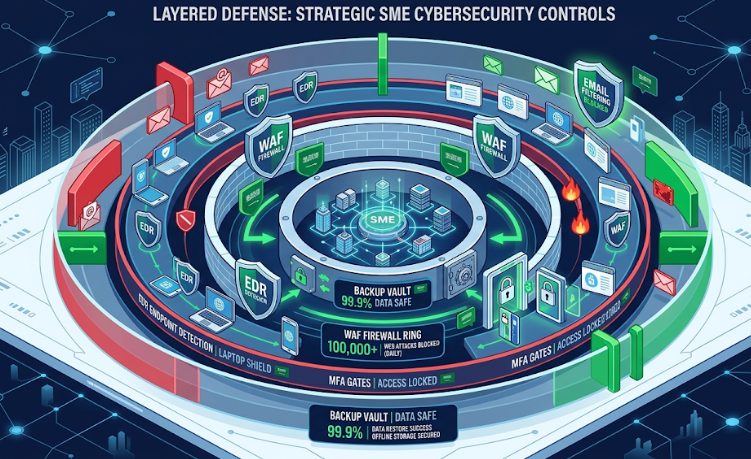
You do not need an enterprise security budget to significantly improve your protection. These eight controls address the most common attack vectors for Saudi small and mid-sized businesses:
1. Multi-Factor Authentication (MFA)
MFA requires a second verification step (usually a code from an app on your phone) in addition to a password when logging into accounts. Even if an attacker steals a password, they cannot log in without the second factor.
Enable MFA on your email accounts, your cloud storage, your CRM, your accounting software, and any other system that holds business or customer data. Most of these platforms offer MFA at no extra cost.
2. Endpoint Detection and Response (EDR)
Traditional antivirus catches known threats. EDR monitors the behaviour of software on your devices and catches unknown threats based on what they do, not just what they are. For a business without a dedicated IT security team, EDR managed by your IT provider offers a meaningful step up in detection capability.
3. Email Security Filtering
An email security gateway filters inbound emails before they reach your team's inboxes, blocking known phishing senders, scanning attachments for malware, and flagging suspicious links. It does not catch everything, but it significantly reduces the volume of dangerous emails that reach staff who need to judge them.
4. Regular Security Patching
The majority of successful cyberattacks exploit known software vulnerabilities that had patches available months or years before the attack. Applying updates to your operating systems and applications regularly (ideally automatically via a managed IT service) removes these vulnerabilities.
This is one of the highest-return security investments available because the cost is low and the attack surface reduction is significant.
5. Access Control and Least Privilege
Every staff member should have access only to the systems and data they need to do their job. An accounts assistant does not need access to HR records. A sales team member does not need access to financial system settings.
Review access permissions regularly, especially after staff changes. Remove access for employees who have left. This is a simple, low-cost control that significantly limits the damage an attacker can do if they compromise a single account.
6. Verified, Tested Backups
Backups that are never tested are backups of unknown quality. Run backups daily. Store them in a separate location from your primary systems (an offsite or cloud backup is fine, but it must be on a different infrastructure from what it is backing up). Test a restore from backup at least quarterly.
7. Security Awareness Training
Your staff are both your biggest security vulnerability and your most scalable defence. Short, regular training sessions (15 to 20 minutes, monthly or quarterly) on how to recognise phishing, how to verify unusual payment requests, and what to do when something looks suspicious produce a measurable reduction in successful social engineering attacks.
Training should be practical and scenario-based, not compliance box-ticking.
8. Incident Response Plan
When a security incident occurs (and at some point, one will), the worst time to decide what to do is in the middle of it. A simple incident response plan defines who is responsible for managing the response, who to call (your IT provider, your legal team, potentially the NCA), what systems to disconnect to contain the damage, and how to communicate with affected customers and partners.
A one-page incident response plan is better than no plan. Update it annually.
PDPL and Cybersecurity
Saudi Arabia's Personal Data Protection Law creates a direct legal link between cybersecurity and data protection.
If your business experiences a data breach that exposes personal data about Saudi residents, you have a legal obligation to notify the Saudi Data and AI Authority (SDAIA) within 72 hours of discovering the breach. Failure to notify carries penalties.
Businesses that have invested in proper security controls (access management, encryption, monitoring, tested backups) are better positioned in three ways. First, they are less likely to experience a breach. Second, if a breach does occur, they can identify it faster and contain it before more data is exposed. Third, they can demonstrate to regulators that they took reasonable precautions, which is a relevant factor in how penalties are assessed.
PDPL compliance and cybersecurity are not two separate programmes. They require the same controls and should be managed together.
Key Takeaways
Saudi SMEs are actively targeted by cybercriminals. Smaller businesses are targeted specifically because their defences are typically weaker than larger organisations.
Phishing, ransomware, business email compromise, and credential theft are the most common attacks against Saudi businesses. All four are preventable with the right controls.
The NCA's Essential Cybersecurity Controls define the recognised baseline for security in Saudi Arabia. Even for businesses not legally required to comply, the ECC is the right benchmark.
Eight controls address the most common attack vectors: MFA, EDR, email filtering, regular patching, access control, tested backups, staff training, and an incident response plan.
Saudi PDPL creates a legal obligation to notify SDAIA within 72 hours of a data breach. Good security controls reduce breach likelihood and demonstrate due diligence if one occurs.
Security patching is one of the highest-return security investments available. Most successful attacks exploit known vulnerabilities that had patches available before the attack.
Frequently Asked Questions
Q: How much should a Saudi SME budget for cybersecurity?
A: A common benchmark is 5 to 10 percent of the IT budget allocated to security. For a small business spending SAR 60,000 per year on IT (software, hardware, support), that is SAR 3,000 to SAR 6,000 per year. Managed security services that include EDR, email filtering, and patching management typically cost SAR 150 to SAR 400 per user per month. This is significantly less than the average cost of a security incident, which for an SME includes downtime, data recovery, and any regulatory penalties.
Q: Is a small Saudi business legally required to comply with the NCA Essential Cybersecurity Controls?
A: The ECC is currently mandatory for government entities and critical infrastructure operators. It is not formally mandatory for all private sector businesses. However, businesses in sectors including finance, healthcare, and education have sector-specific security requirements from their regulators. And all businesses holding personal data about Saudi residents have PDPL obligations that require appropriate security measures. The ECC is the most practical framework for defining what 'appropriate' means.
Q: What should we do immediately after discovering a cyber attack?
A: Contain first: disconnect affected devices from the network to prevent the attack from spreading. Do not turn devices off, as this can destroy forensic evidence. Call your IT provider or managed security team immediately. Document everything you observe, including timestamps. Notify your senior leadership. Do not pay any ransom without taking legal advice first. If personal data may have been accessed, begin the clock on your 72-hour PDPL notification assessment.
Q: Does cybersecurity insurance exist in Saudi Arabia and is it worth it?
A: Cyber insurance products are available in Saudi Arabia through several local and international insurers. Coverage typically includes incident response costs, data recovery, legal fees, and third-party liability for data breaches. The value depends on your risk profile, your data sensitivity, and your existing security controls. Insurers increasingly require evidence of basic security controls (MFA, patching, backups) as a condition of coverage, so investing in security and investing in insurance are complementary rather than alternative approaches.
Q: How do we know if our business has already been compromised?
A: Many businesses operate with an attacker already inside their systems for weeks or months before detecting it. Signs that warrant investigation include unusual account login times or locations, unexpected changes to email rules or forwarding settings, slower-than-usual system performance, unexpected data access by user accounts, and unusual outbound network traffic. A cybersecurity assessment from a qualified provider includes a review for indicators of compromise. If you have not had one in the past 12 months, the risk of an undetected compromise is real.
Conclusion
Cybersecurity is not a technology problem. It is a business risk that happens to be managed through technology.
Saudi SMEs face a genuine and growing threat from attackers who specifically target businesses with limited security investment. The good news is that the most common attack types are also the most preventable. The eight controls in this guide address the attacks that cause the most damage to Saudi businesses, at a cost that is accessible for almost any organisation.
The PDPL adds a legal dimension. A breach that exposes customer data is not just an operational crisis. It is a regulatory event with notification obligations and potential penalties. The businesses that have invested in proper security controls handle these events better in every dimension.
Softriva provides cybersecurity services to Saudi businesses including security assessments, managed endpoint protection, email security, staff training, and incident response planning. Our team is based in Jeddah and works in Arabic and English.
A free cybersecurity assessment gives you a clear, prioritised picture of where your business is exposed and what to fix first.
Get Your Free Cybersecurity Assessment at softriva.com


