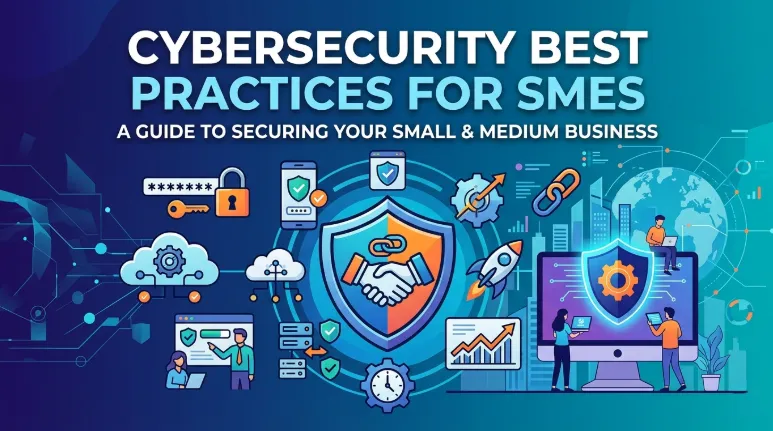
Cybersecurity Best Practices for Small and Medium Businesses
Introduction
Cybersecurity has become one of the most important priorities for modern businesses.
As organizations increasingly rely on digital systems, cloud platforms, remote work technologies, and online services, they also face growing cybersecurity risks.
Many small and medium businesses mistakenly believe cybercriminals only target large enterprises.
In reality, SMEs are often attractive targets because they may have fewer security resources, limited cybersecurity expertise, and less mature security controls.
A successful cyberattack can lead to:
Financial losses
Operational disruptions
Data breaches
Reputational damage
Regulatory penalties
Loss of customer trust
The good news is that many cyber risks can be significantly reduced through proper planning, employee awareness, and implementation of proven security practices.
For businesses across Saudi Arabia undergoing digital transformation, cybersecurity is not just an IT responsibility—it is a business responsibility.
This guide explores the most important cybersecurity best practices every SME should implement to strengthen protection and improve resilience.
Why Cybersecurity Matters for SMEs
Small businesses often underestimate their cyber risk exposure.
However, cybercriminals frequently target SMEs because they may have:
Limited security budgets
Smaller IT teams
Outdated systems
Weak security controls
Lower cybersecurity awareness
Attackers are typically looking for:
Financial information
Customer data
Employee records
Login credentials
Business emails
Protecting these assets is essential for business continuity and customer confidence.
Understanding Common Cyber Threats
Before implementing security measures, businesses should understand common threats.
Phishing Attacks
Phishing remains one of the most common attack methods.
Cybercriminals send fraudulent emails, messages, or websites designed to steal:
Passwords
Financial information
Sensitive business data
These attacks often appear legitimate and target employees directly.
Ransomware
Ransomware encrypts business data and demands payment for restoration.
A successful ransomware attack can disrupt operations for days or even weeks.
Malware
Malicious software can:
Steal information
Monitor activity
Damage systems
Create unauthorized access
Malware is often delivered through email attachments or compromised websites.
Credential Theft
Weak passwords and compromised accounts remain major security risks.
Attackers frequently attempt to gain access using stolen login credentials.
Insider Threats
Security incidents can also originate from within the organization, whether intentional or accidental.
Employee awareness plays an important role in reducing these risks.
Cybersecurity Best Practice #1: Use Strong Password Policies
Passwords remain one of the most important security controls.
Weak passwords are easy targets for attackers.
Organizations should require:
Unique passwords
Complex passwords
Regular password updates
Password managers when appropriate
Employees should avoid reusing passwords across multiple systems.
Cybersecurity Best Practice #2: Enable Multi-Factor Authentication (MFA)
Multi-Factor Authentication adds an additional layer of protection.
Even if a password is compromised, attackers still require a second verification factor.
MFA should be enabled for:
Email accounts
Cloud platforms
Financial systems
Administrative accounts
Business applications
This simple measure significantly improves account security.
Cybersecurity Best Practice #3: Train Employees Regularly
Technology alone cannot prevent every cyber threat.
Employees are often the first line of defense.
Training should cover:
Phishing awareness
Safe internet usage
Password security
Data protection
Incident reporting
Regular awareness programs help employees recognize and avoid threats.
Cybersecurity Best Practice #4: Keep Systems Updated
Outdated software often contains known vulnerabilities.
Cybercriminals frequently exploit systems that have not been updated.
Organizations should regularly update:
Operating systems
Applications
Security software
Network devices
Automated patch management can simplify this process.
Cybersecurity Best Practice #5: Protect Endpoints
Every connected device represents a potential entry point for attackers.
Examples include:
Laptops
Desktops
Smartphones
Tablets
Endpoint protection solutions help detect and prevent threats before they spread across the network.
Cybersecurity Best Practice #6: Secure Business Email
Email remains a primary attack vector.
Organizations should implement:
Spam filtering
Anti-phishing controls
Email authentication
User awareness training
Protecting email systems reduces the likelihood of successful attacks.
Cybersecurity Best Practice #7: Back Up Critical Data
Backups are essential for business continuity.
Organizations should maintain:
Regular backups
Secure storage
Backup testing
Recovery procedures
A strong backup strategy can significantly reduce the impact of ransomware and other disruptions.
Cybersecurity Best Practice #8: Control User Access
Not every employee requires access to every system.
Organizations should follow the principle of least privilege.
Users should only have access to information necessary for their roles.
Benefits include:
Reduced attack surface
Improved security
Better compliance
Cybersecurity Best Practice #9: Secure Cloud Applications
Many businesses rely on cloud services for daily operations.
Security measures should include:
Strong authentication
Access controls
Configuration reviews
Monitoring
Cloud security should be integrated into broader cybersecurity programs.
Cybersecurity Best Practice #10: Develop an Incident Response Plan
No organization can eliminate risk entirely.
Businesses should prepare for potential incidents before they occur.
An incident response plan should define:
Roles and responsibilities
Communication procedures
Containment actions
Recovery processes
Prepared organizations often recover more quickly from security events.
The Role of Cybersecurity Governance
Cybersecurity should not be treated solely as a technical issue.
Strong governance helps organizations establish:
Security policies
Risk management processes
Compliance requirements
Accountability structures
Leadership involvement is essential.
Security initiatives should align with broader business objectives.
Building a Security-First Culture
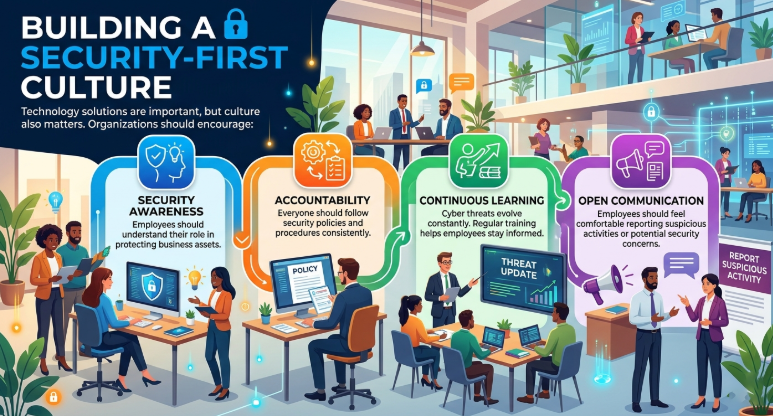
Technology solutions are important, but culture also matters.
Organizations should encourage:
Security Awareness
Employees should understand their role in protecting business assets.
Accountability
Everyone should follow security policies and procedures consistently.
Continuous Learning
Cyber threats evolve constantly.
Regular training helps employees stay informed.
Open Communication
Employees should feel comfortable reporting suspicious activities or potential security concerns.
Common Cybersecurity Mistakes SMEs Make
Many organizations unknowingly increase their risk exposure.
Common mistakes include:
Using Weak Passwords
Simple passwords remain a leading cause of account compromise.
Ignoring Software Updates
Delayed updates leave systems vulnerable to known exploits.
Lack of Employee Training
Even advanced security tools cannot compensate for poor security awareness.
Insufficient Backups
Organizations without reliable backups may struggle to recover from incidents.
Overlooking Third-Party Risks
Vendors and partners can introduce additional security risks.
Businesses should assess third-party security practices when appropriate.
Cybersecurity and Digital Transformation
As organizations adopt technologies such as:
Cloud computing
Artificial Intelligence
Automation
Remote work platforms
Cybersecurity becomes increasingly important.
Security should be integrated into digital transformation initiatives from the beginning rather than added later.
This approach helps organizations balance innovation with risk management.
The Future of Cybersecurity
Cybersecurity continues to evolve as threats become more sophisticated.
Emerging trends include:
AI-powered threat detection
Zero Trust security models
Advanced endpoint protection
Cloud-native security
Automated incident response
Organizations that invest in cybersecurity today will be better prepared for future challenges.
Cybersecurity is no longer a reactive activity—it is a strategic business capability.
Key Takeaways
✓ Cybersecurity is essential for businesses of all sizes, including SMEs.
✓ Phishing, ransomware, malware, and credential theft remain major threats.
✓ Strong passwords and Multi-Factor Authentication significantly improve security.
✓ Employee awareness is one of the most effective cybersecurity defenses.
✓ Regular updates and endpoint protection reduce vulnerability exposure.
✓ Backups are critical for business continuity and recovery.
✓ Access control helps minimize security risks.
✓ Cybersecurity should be integrated into overall business strategy and digital transformation initiatives.
Frequently Asked Questions
Q: Why are SMEs targeted by cybercriminals?
A: SMEs often have fewer security resources and less mature security programs, making them attractive targets for attackers.
Q: What is the most common cyber threat for businesses?
A: Phishing attacks remain one of the most common and successful attack methods affecting organizations worldwide.
Q: Is Multi-Factor Authentication really necessary?
A: Yes. MFA significantly reduces the risk of unauthorized access even if passwords become compromised.
Q: How often should employees receive cybersecurity training?
A: Organizations should provide ongoing awareness training, with updates conducted regularly throughout the year.
Q: What should businesses do first to improve cybersecurity?
A: Start with strong password policies, MFA, employee awareness training, regular updates, and reliable backup procedures.
Conclusion
Cybersecurity is no longer optional for modern businesses.
As organizations become more connected and increasingly dependent on digital technologies, cyber risks continue to grow.
The most effective cybersecurity programs are not necessarily the most expensive.
They are the ones built on strong fundamentals, employee awareness, proactive planning, and continuous improvement.
By implementing essential security best practices, SMEs can significantly reduce risk, improve resilience, protect customer trust, and support long-term business success.
Softriva helps organizations strengthen cybersecurity through risk assessments, security solutions, awareness programs, cloud security strategies, and digital transformation initiatives designed with security in mind.
Book Your Free Cybersecurity Assessment at softriva.com and discover how your business can strengthen protection against today's evolving cyber threats.


