

Data Analytics for Saudi Businesses: A Complete Guide to Smarter Decisions
Introduction
Every business leader in Saudi Arabia has experienced some version of this scenario: an important decision is due, the available information is a monthly report someone assembled manually three weeks ago, and the choices being made are effectively educated guesses with a data label attached.
This is not a niche problem. It is the operating reality for the majority of small and mid-sized businesses across the Kingdom ,and for more large enterprises than most would care to admit. The consequence is not a single visible failure. It is a persistent drag on decision quality that compounds over time: slower responses to market changes, resources allocated based on outdated patterns, problems discovered after they have become expensive, and opportunities missed because no one had visibility into the signals.
Data analytics is the discipline that closes this gap. Not the academic version of data science covered in university programmes, but the practical, applied capability to take the data your business already generates and turn it into current, reliable, usable intelligence for the people who need to act on it.
This guide covers what data analytics actually means in a Saudi business context, the specific tools and capabilities it encompasses, how it applies across the industries that define the Saudi economy, what implementation looks like in practice, and how to build a data capability that grows with your business.
The Real Cost of Operating Without Data Visibility
Measuring the cost of good technology is straightforward ,you have an invoice. Measuring the cost of absent or inadequate technology is harder, because it shows up in the decisions you did not make, the problems you did not see coming, and the efficiency you never achieved.
Consider a retail business in Jeddah managing inventory across three locations. Without real-time data visibility, stock-outs at the highest-performing location happen regularly because reorder decisions are based on weekly manual counts. Overstock accumulates at the slower location because the pattern is not visible until month-end. The finance team spends four days each month building a consolidated report that is immediately out of date by the time it reaches leadership.
Now consider the same business with a connected data environment: inventory levels update in real time across all locations, automated alerts trigger reorder workflows when stock reaches defined thresholds, and the monthly report generates automatically each morning with yesterday's data already included. The staff hours freed up, the stockouts avoided, and the decisions made faster collectively represent a measurable improvement in business performance ,typically 30 to 60 percent in the specific processes affected.
Multiply this pattern across sales, customer service, HR, finance, and procurement, and the cumulative value of data visibility becomes one of the most significant levers available to a Saudi business.
What Data Analytics Actually Encompasses
Data analytics is not a single product or a single tool. It is a connected set of capabilities, each addressing a different part of the journey from raw data to actionable intelligence:
Business Intelligence Dashboards
A BI dashboard is a live, visual display of your key performance indicators ,updated automatically from your data sources without any manual intervention. Revenue by product line, customer acquisition cost by channel, team productivity by department, sales pipeline status, inventory levels by location ,all visible on a single screen, as current as your last transaction.
The value of a well-designed dashboard is not just the data it shows ,it is the conversations it changes. Leadership meetings that previously spent an hour reviewing data and asking questions can now begin from a shared, current picture and move directly to decisions. The information layer of your management process becomes a given rather than a burden.
Advanced Analytics
Beyond the descriptive picture of what is happening right now, advanced analytics addresses the analytical question of why it is happening and how different variables relate to each other. Cohort analysis to understand customer behavior over time, segmentation to identify your most and least valuable customer groups, correlation analysis to understand which operational inputs drive which outputs ,these are the capabilities that turn a BI deployment from a reporting tool into a genuine business intelligence system.
Predictive Modeling
Predictive modeling uses your historical data to generate forecasts about future outcomes. Which customers are most likely to purchase in the next 30 days? Which accounts are showing the behavioral patterns that typically precede churn? Which months have historically been slow, and what inventory level should you carry into them? Which project estimates have tended to understate actual costs, and by how much?
None of these questions can be answered perfectly. But a well-built predictive model consistently outperforms gut-feel forecasting ,and in a competitive market, the difference between a business that anticipates and one that reacts is often the difference between a profitable quarter and a difficult one.
Data Engineering
Data engineering is the foundational layer that makes everything else possible. It refers to the systems and processes that collect, transform, and deliver your data to the places where it will be used ,connecting your CRM, your accounting system, your website, your inventory platform, and any other data sources into a coherent, reliable data environment.
Without sound data engineering, analytics projects are built on unstable ground. Data quality problems ,duplicates, inconsistencies, gaps ,produce misleading outputs. Systems that work in isolation produce insights that cannot be compared or combined. Data engineering solves this by creating a single, governed data layer that all your analytics tools can rely on.
Data Visualization
Data visualization is the discipline of presenting data in formats that drive faster comprehension and better decisions. A well-designed chart communicates in seconds what a table of numbers communicates in minutes ,and reduces the risk of misinterpretation that comes with presenting raw data to non-technical decision-makers.
For Saudi businesses with leadership teams that include both technical and non-technical members, and that often need to present data to clients or partners, visualization quality is a meaningful factor in how effectively data intelligence actually influences decisions.
Industry Applications Across the Saudi Economy
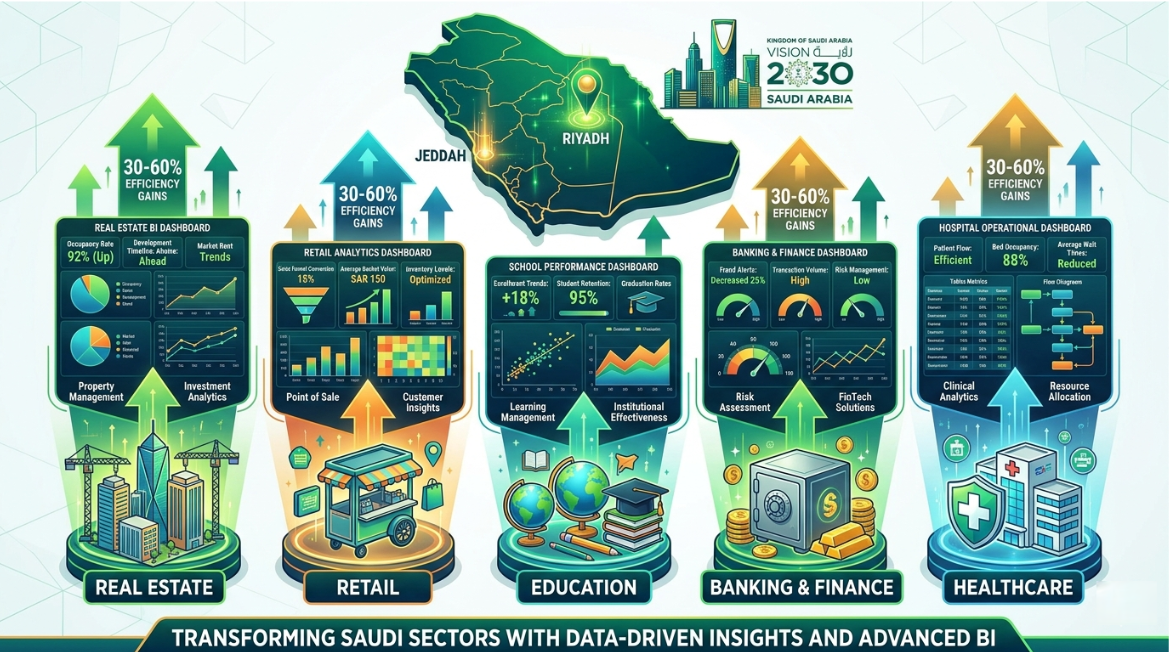
Data analytics delivers its value differently across industries, and the most useful illustrations are sector-specific:
Real Estate and Property Development
Saudi Arabia's real estate sector is one of the most active in the region, with major development projects and a growing residential market driven by Vision 2030 housing targets. For real estate companies, data analytics applications include lead-to-sale conversion tracking by source and sales agent, project absorption rate forecasting based on historical sales velocity, rental portfolio performance monitoring with automatic occupancy alerts, and pricing optimization based on comparable transaction data and demand signals.
Retail and E-Commerce
Saudi Arabia's retail sector is experiencing a structural shift toward online channels, accelerated by the growth of Saudi-based e-commerce platforms and changing consumer behavior. Data analytics enables basket composition analysis to understand what drives purchase decisions, customer lifetime value segmentation to identify and protect your most valuable customers, demand forecasting to optimize inventory investment, and marketing attribution to understand which channels are actually driving revenue rather than just traffic.
Education
From universities to private school groups, educational institutions in Saudi Arabia face increasing pressure to demonstrate outcomes and optimize operations. Data analytics supports enrollment trend analysis to inform capacity planning, student performance monitoring with early intervention triggers, resource allocation modeling across campuses or faculties, and alumni engagement tracking for fundraising and brand development.
Financial Services
The Saudi financial sector ,including banks, investment funds, and insurance companies ,operates in one of the most data-intensive environments in the economy. Applications include fraud pattern detection using behavioral analytics, automated compliance reporting against SAMA and CMA requirements, portfolio risk modeling under different market scenarios, and customer segmentation for product development and cross-sell strategies.
Healthcare
Saudi Arabia's healthcare system is undergoing significant expansion as part of Vision 2030's health sector targets. For hospitals, clinics, and healthcare groups, data analytics covers patient flow analysis to reduce waiting times and optimize staffing, medical supply inventory optimization, outcome tracking across treatment protocols, and operational efficiency benchmarking across facilities.
Building a Data Capability: A Practical Roadmap
Most Saudi businesses should not attempt to build a comprehensive data analytics capability in a single project. The most successful approaches follow a staged roadmap that delivers value at each phase:
1. Foundation: Connect your data sources. Start by identifying where your most important data lives ,your CRM, accounting system, website analytics, inventory platform ,and establish reliable connections between these sources. This is the data engineering layer that everything else depends on.
2. Visibility: Build your core dashboard. Define the 10 to 15 metrics that matter most to your leadership team and build a BI dashboard that shows them in real time. Launch this, train your team to use it, and let it drive the behavioral change of data-first decision making before adding complexity.
3. Analysis: Add depth and context. Once the core dashboard is established and used regularly, add the analytical layers that explain the patterns you are seeing ,cohort analysis, segmentation, trend analysis, comparative benchmarking.
4. Prediction: Build forward-looking models. Use your historical data to build forecasting models for the decisions where prediction matters most ,demand, churn, resource requirements, financial performance. Start with one well-scoped model and expand from there.
5. Automation: Close the loop. Connect your analytics outputs to your operational systems so that insights trigger actions automatically ,reorder requests, customer alerts, performance escalations ,without requiring a human to read a report and make a decision.
Key Takeaways
✓ Data visibility is not a luxury ,the operational cost of running on stale or manual data is measurable and compounds over time.
✓ Data analytics encompasses five connected capabilities: BI dashboards, advanced analytics, predictive modeling, data engineering, and visualization.
✓ Each Saudi industry sector has specific, high-value analytics applications ,sector context matters as much as technical capability.
✓ The most successful data analytics deployments follow a staged roadmap: foundation, visibility, analysis, prediction, and automation.
✓ Data engineering ,the infrastructure layer ,is the most important investment in any analytics programme. Without it, insights are unreliable.
✓ A trusted local implementation partner with Saudi market knowledge significantly improves both speed to value and data quality outcomes.
Frequently Asked Questions
Q: Do we need a data warehouse before we can start with analytics?
A: Not necessarily. Many Saudi businesses can begin with a BI dashboard connecting directly to their existing systems ,accounting software, CRM, website ,without building a full data warehouse. As your data volume and analytical complexity grow, a more structured data engineering layer becomes valuable. The right architecture depends on your current systems, your data volume, and your analytics ambitions. Softriva assesses this as part of every initial engagement.
Q: How do we handle Arabic-language data in analytics systems?
A: Arabic-language data ,customer names, addresses, product descriptions, transaction notes ,requires specific handling in analytics systems to ensure correct text processing, sorting, and search. This is an area where a Saudi-based implementation partner with experience in bilingual data environments provides significant value over generic analytics vendors. Softriva has built analytics solutions handling Arabic and English data across multiple client environments.
Q: What is the difference between a BI dashboard and a regular Excel report?
A: An Excel report is a static document that reflects data at the moment it was built and requires someone to build it manually every time. A BI dashboard connects directly to your data sources and updates automatically ,typically in real time or near-real time. It is always current, requires no manual effort to maintain, and can be accessed by multiple users simultaneously from any device. The analytical capability is also significantly richer: filters, drill-downs, cross-dataset comparisons, and visualizations that are impractical in a spreadsheet.
Q: How do we ensure data security in a cloud-based analytics environment?
A: Data security in analytics requires attention at multiple layers: access controls that limit which users can see which data, encryption of data in transit and at rest, audit logging of data access and export, compliance with Saudi PDPL requirements for personal data, and regular security audits of the analytics environment. Softriva builds security controls into every analytics deployment from the design stage ,it is not something added after the fact.
Q: What ongoing commitment is required to maintain an analytics system?
A: A well-built analytics system requires relatively modest ongoing maintenance ,primarily monitoring data quality, updating dashboards when business metrics change, and retraining predictive models periodically as new data accumulates. Softriva provides managed support packages for analytics deployments so clients have expert coverage without needing to build internal data engineering capacity.
Conclusion
The shift from intuition-based to evidence-based decision-making is not a trend ,it is the operating standard of every high-performing business in Saudi Arabia and globally. The tools to make that shift are accessible, the implementation timelines are shorter than most businesses expect, and the return on investment is demonstrable within months of deployment.
What separates the businesses that successfully build data intelligence from those that invest in analytics tools without realizing the value is almost always the quality of the implementation ,the data engineering foundation, the quality of the dashboard design, the change management that drives adoption, and the ongoing support that keeps the system accurate as the business evolves.
Softriva has delivered data analytics solutions across the Saudi market since 2006, serving clients in real estate, finance, education, and retail with BI systems that are genuinely used and genuinely useful. Our approach begins with your decisions ,the choices your leadership team needs to make every day and every quarter ,and works backward to the data infrastructure that makes better decisions possible.
A free analytics consultation is the fastest way to understand what a data investment could deliver for your specific business. In 30 minutes, we will review your current data environment, identify your highest-value analytics opportunities, and give you a clear picture of what implementation would look like and cost.


