
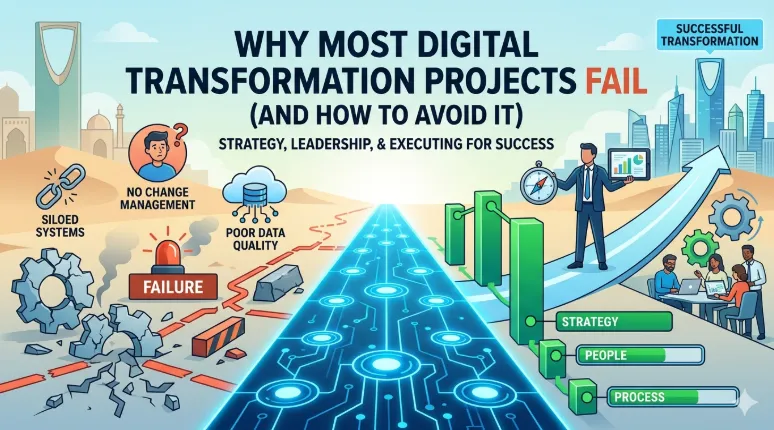
Why Most Digital Transformation Projects Fail (And How to Avoid It)
Introduction
Digital transformation has become a strategic priority for organizations across Saudi Arabia. Businesses are investing heavily in cloud platforms, automation systems, artificial intelligence, data analytics, cybersecurity solutions, enterprise software, and digital customer experiences.
Yet despite these investments, many organizations struggle to achieve the results they expected.
Budgets are exceeded.
Timelines are missed.
Employees resist change.
New systems go unused.
Expected efficiencies never materialize.
The problem is rarely the technology itself.
Modern business technology is more powerful and accessible than ever before. The real challenge lies in how transformation initiatives are planned, managed, and executed.
Digital transformation is often presented as a technology project, but successful organizations understand that it is fundamentally a business change initiative. Technology enables transformation, but people, processes, leadership, and strategy determine whether it succeeds.
For Saudi businesses navigating increasingly competitive markets, digital transformation failure represents more than wasted investment. It can delay growth, reduce competitiveness, and create organizational frustration that makes future initiatives more difficult.
This guide explores the most common reasons digital transformation projects fail and provides practical recommendations for building a transformation program that delivers measurable business value.
The Reality of Digital Transformation
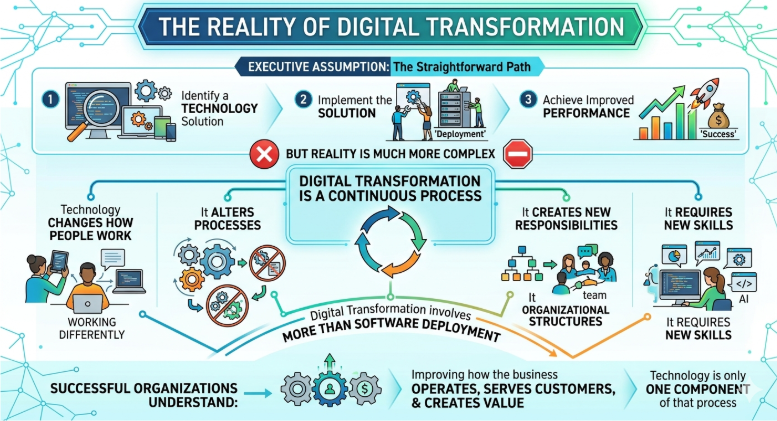
Many executives assume digital transformation follows a straightforward path:
Identify a technology solution.
Implement the solution.
Achieve improved performance.
In reality, transformation is significantly more complex.
Technology changes how people work.
It alters processes.
It affects organizational structures.
It creates new responsibilities.
It requires new skills.
Because of this, transformation involves much more than software deployment.
Successful organizations understand that digital transformation is a continuous process of improving how the business operates, serves customers, and creates value.
Technology is only one component of that process.
Failure Reason #1: Starting with Technology Instead of Business Objectives
One of the most common mistakes organizations make is purchasing technology before clearly defining business goals.
A company decides it needs:
Artificial intelligence
Automation
Cloud migration
ERP software
Data analytics
The investment proceeds before leadership answers a critical question:
What specific business problem are we trying to solve?
Without clearly defined objectives, technology becomes a solution searching for a problem.
This creates confusion throughout the organization.
Employees struggle to understand why changes are occurring.
Projects lose focus.
Success becomes difficult to measure.
How to Avoid It
Start with business outcomes.
Examples include:
Reduce invoice processing time by 50%
Improve customer response times
Increase sales conversion rates
Eliminate duplicate data entry
Improve reporting accuracy
Technology should support these objectives rather than drive them.
Failure Reason #2: Lack of Executive Leadership
Digital transformation cannot be delegated entirely to IT departments.
When transformation is viewed as an IT project, organizational adoption often suffers.
Employees may see changes as technical initiatives rather than strategic business priorities.
Successful transformation requires active executive involvement.
Leadership must:
Define vision
Communicate priorities
Remove obstacles
Allocate resources
Reinforce accountability
Without visible executive support, transformation efforts often lose momentum.
How to Avoid It
Assign executive ownership.
Transformation should be sponsored by senior leadership and aligned directly with organizational goals.
Employees must understand that transformation is a business initiative, not simply a technology upgrade.
Failure Reason #3: Trying to Transform Everything at Once
Organizations often identify multiple opportunities for improvement and attempt to address them simultaneously.
Examples include:
ERP implementation
CRM deployment
Website redesign
Cloud migration
Data analytics platform
Cybersecurity enhancement
Each project may be valuable individually.
Together, they can overwhelm teams and budgets.
Large-scale simultaneous transformation increases complexity and risk.
How to Avoid It
Prioritize initiatives based on:
Business impact
Implementation complexity
Expected ROI
Focus on a small number of high-value projects first.
Early successes build confidence and support future initiatives.
Transformation should occur in manageable phases.
Failure Reason #4: Ignoring Change Management
Technology adoption depends on people.
Organizations often invest significant effort in selecting software while investing very little in preparing employees for change.
The result is predictable:
Resistance
Confusion
Low adoption
Reduced productivity
Employees naturally prefer familiar processes.
Without proper communication and training, new systems may be viewed as obstacles rather than improvements.
How to Avoid It
Develop a structured change management plan.
This should include:
Communication strategies
Employee engagement
Training programs
Ongoing support
Transformation succeeds when employees understand both how the change works and why it matters.
Failure Reason #5: Poor Data Quality
Many transformation initiatives depend on accurate data.
Unfortunately, organizations frequently discover data problems after implementation begins.
Common issues include:
Duplicate records
Inconsistent formats
Missing information
Inaccurate reporting
Poor data quality undermines:
Automation
Analytics
AI systems
Reporting platforms
The most advanced technology cannot compensate for unreliable data.
How to Avoid It
Assess data quality before implementation.
Establish:
Data governance standards
Validation processes
Ownership responsibilities
Data cleaning initiatives
Reliable data is one of the most valuable assets in any transformation program.
Failure Reason #6: Underestimating Integration Requirements
Many businesses operate multiple systems:
ERP
CRM
Accounting software
HR platforms
Customer service applications
Transformation initiatives often assume these systems will connect easily.
In reality, integration complexity is one of the most common causes of delays and budget overruns.
Disconnected systems create:
Manual work
Data inconsistencies
Reporting challenges
Operational inefficiencies
How to Avoid It
Evaluate integration requirements during planning.
Questions to ask include:
Which systems must exchange information?
What data needs to move between platforms?
How frequently should synchronization occur?
Are APIs available?
Integration should be treated as a core project requirement rather than an afterthought.
Failure Reason #7: Focusing on Technology Instead of Processes
Technology cannot fix broken processes.
Many organizations automate inefficient workflows without first improving them.
This simply allows bad processes to operate faster.
Consider a manual approval workflow containing unnecessary steps.
Automating the workflow does not eliminate inefficiency.
It automates inefficiency.
How to Avoid It
Review processes before implementing technology.
Ask:
Can steps be eliminated?
Can approvals be simplified?
Can responsibilities be clarified?
Optimize first.
Automate second.
This approach delivers significantly better outcomes.
Failure Reason #8: Unrealistic Expectations
Digital transformation is often marketed as a rapid solution to complex business challenges.
Organizations may expect:
Immediate cost savings
Instant productivity improvements
Rapid revenue growth
Transformation benefits are real, but they require time.
Systems must be implemented.
Employees must adapt.
Processes must mature.
Data must accumulate.
How to Avoid It
Establish realistic expectations.
Focus on long-term value creation rather than short-term results.
Define milestones that demonstrate progress while recognizing that transformation is a continuous journey.
Failure Reason #9: Weak Cybersecurity Planning
Digital transformation increases reliance on technology.
As digital dependency grows, security becomes increasingly important.
Unfortunately, cybersecurity is often considered after implementation.
This creates unnecessary risk.
Common issues include:
Weak access controls
Insufficient monitoring
Inadequate backups
Lack of employee awareness
Security vulnerabilities can undermine the entire transformation effort.
How to Avoid It
Incorporate cybersecurity from the beginning.
Security planning should include:
Risk assessments
Access management
Endpoint protection
Backup strategies
Security awareness training
Cybersecurity should be embedded into every transformation initiative.
Failure Reason #10: Measuring Activity Instead of Outcomes
Many organizations measure transformation progress using activity metrics.
Examples include:
Number of systems implemented
Number of users trained
Project milestones completed
While useful, these metrics do not measure business value.
The real question is:
Has the business improved?
How to Avoid It
Focus on outcome-based KPIs.
Examples include:
Reduced processing times
Increased customer satisfaction
Higher productivity
Lower operating costs
Revenue growth
Improved compliance
Technology implementation is not the goal.
Business improvement is.
What Successful Digital Transformation Looks Like
Organizations that consistently succeed share several characteristics.
They:
Begin with Strategy
Technology decisions are aligned with business objectives.
Prioritize High-Impact Initiatives
Resources focus on projects with measurable value.
Invest in People
Employees receive communication, training, and support.
Build Strong Foundations
Data quality, integration, and cybersecurity are addressed early.
Measure Business Outcomes
Success is evaluated through operational and financial improvements.
Commit to Continuous Improvement
Transformation is viewed as an ongoing process rather than a one-time project.
Key Takeaways
Most digital transformation failures result from strategy and execution challenges rather than technology limitations.
Business objectives should drive technology decisions.
Executive leadership is critical for organizational adoption.
Transformation should be implemented in phases rather than all at once.
Change management is essential for employee acceptance and long-term success.
Data quality and system integration significantly influence project outcomes.
Cybersecurity must be incorporated from the beginning of every transformation initiative.
Success should be measured through business outcomes, not technology deployment metrics.
Frequently Asked Questions
Q: Why do digital transformation projects fail?
A: The most common causes include unclear objectives, weak leadership support, poor change management, inadequate data quality, unrealistic expectations, and insufficient focus on business outcomes.
Q: What is the biggest mistake organizations make during digital transformation?
A: Many organizations begin with technology selection before defining the business problems they want to solve. Successful transformation starts with business objectives.
Q: How can businesses improve employee adoption of new technology?
A: Effective communication, structured training, leadership support, and ongoing assistance significantly improve user adoption and reduce resistance.
Q: Should digital transformation be led by IT departments?
A: IT plays a critical role, but transformation should be led by business leadership because it affects people, processes, and organizational strategy beyond technology alone.
Q: How do we measure transformation success?
A: Success should be measured through improvements in efficiency, productivity, customer satisfaction, revenue growth, cost reduction, compliance, and other business outcomes.
Conclusion
Digital transformation offers enormous opportunities for Saudi businesses, but success is not guaranteed.
The organizations achieving meaningful results are not necessarily investing the most in technology. They are investing intelligently—aligning technology with business goals, preparing employees for change, building strong foundations, and measuring outcomes that matter.
Transformation is not about implementing more systems.
It is about creating a more efficient, agile, and competitive organization.
By understanding the common causes of failure and addressing them proactively, businesses can dramatically improve their chances of success while maximizing the value of every technology investment.
Softriva has been helping organizations across Saudi Arabia navigate technology transformation, operational modernization, automation, data analytics, cloud adoption, and business technology strategy since 2006.
If you're planning a transformation initiative and want to avoid costly mistakes, start with a structured assessment of your current environment and future objectives.


