

How to Write a Digital Transformation Roadmap for a Saudi Business: A Step-by-Step Guide
Introduction
Most Saudi digital transformation efforts fail not because the technology is wrong but because there was never a clear plan.
The business decides to modernise. A technology vendor is engaged. Software is purchased. Months later, the system is live but adoption is low, the expected efficiency gains have not materialised, and the leadership team has lost confidence in the investment.
What was missing was a roadmap: a document that connects the technology investment to specific business outcomes, sequences the work in a logical order, assigns ownership and budget, and provides the measurement framework needed to know whether progress is happening.
A digital transformation roadmap is not a technology plan. It is a business improvement plan that technology enables. The distinction matters because it determines what drives the decisions: business problems and outcomes, not software features and vendor preferences.
This guide explains how to build a digital transformation roadmap for a Saudi business that is practical, realistic, and aligned with the specific compliance and market requirements of the Saudi operating environment.
Why Most Saudi Digital Transformation Plans Fail
Before covering how to build a roadmap, it is useful to understand the patterns that cause Saudi digital transformation efforts to produce poor results:
Starting with technology selection instead of problem definition. Choosing an ERP or CRM before clearly defining the business problems those systems need to solve consistently produces software that is implemented but not used effectively.
No clear ownership. Digital transformation projects that do not have a named internal owner with authority and accountability consistently drift. When something goes wrong, there is nobody whose job it is to resolve it.
Unrealistic scope. Attempting to transform all business functions simultaneously overwhelms the organisation, produces delays, and erodes confidence. Staged transformation with measurable milestones consistently outperforms big-bang approaches.
Insufficient budget for implementation and change management. The software licence is the most visible cost but rarely the largest. Implementation, training, data migration, and the management of staff through the change consistently cost two to three times the licence fee and are systematically underbudgeted.
No measurement framework. A transformation with no defined success metrics cannot be evaluated. Without measurement, the organisation cannot know whether it is succeeding, failing, or somewhere in between.
The Eight Steps to a Working Digital Transformation Roadmap
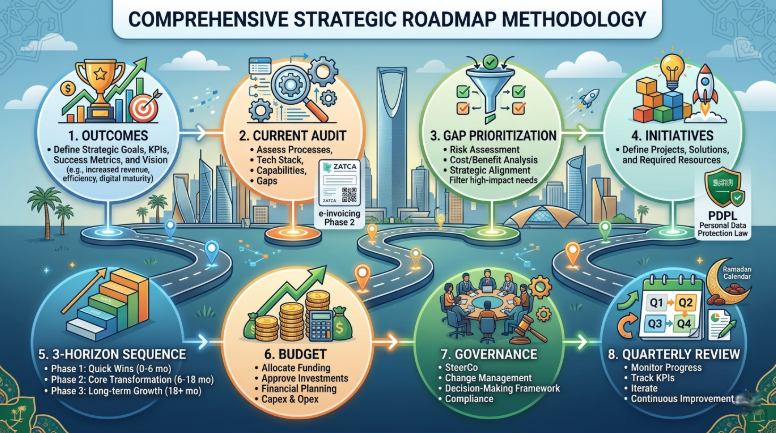
Step 1: Define the Business Outcomes You Need
The first step is not technology. It is a clear statement of the business outcomes the transformation is meant to achieve.
These outcomes should be specific and measurable. Not 'improve operational efficiency' but 'reduce the time to generate a monthly financial report from three days to three hours.' Not 'improve customer service' but 'reduce average customer query response time from 24 hours to two hours.'
Typically, three to five outcome statements are sufficient for a first roadmap phase. More than five makes prioritisation difficult. Fewer than three may not justify the investment in a formal transformation programme.
For Saudi businesses, Vision 2030 compliance requirements (ZATCA Phase 2, PDPL, WPS payroll compliance) should be captured as mandatory outcomes in the roadmap alongside the business improvement outcomes.
Step 2: Audit Your Current State
A current state audit documents what the business's technology and process landscape actually looks like today: which systems are in use, which processes are manual, where data lives and in what quality, which compliance requirements are already met and which are not.
This audit is often uncomfortable because it reveals a larger gap between the current state and the desired state than leadership assumed. But an honest current state assessment is the only foundation for a realistic roadmap. A roadmap built on an optimistic view of the current state consistently produces budget overruns and timeline failures.
The audit should cover: all business systems currently in use and their integration status, all manual processes that could be automated, data quality assessment for each major data source, current cybersecurity posture, and current compliance status against relevant Saudi regulations.
Step 3: Identify and Prioritise the Gaps
The gap between your current state (Step 2) and your desired outcomes (Step 1) is the scope of your transformation programme. The next task is prioritising which gaps to close first.
Gap prioritisation should be driven by two factors: business impact (which gaps, when closed, produce the most direct improvement in the outcome metrics from Step 1) and implementation feasibility (which gaps can be closed most reliably with available budget, timeline, and internal capacity).
The highest priority items are those that are both high impact and relatively feasible. Mandatory compliance gaps (ZATCA, PDPL, WPS) should be treated as highest priority regardless of impact assessment, because non-compliance carries regulatory risk that is not optional to accept.
Step 4: Define the Initiatives
Each prioritised gap translates into one or more specific initiatives: a CRM implementation, a website rebuild, a BI dashboard programme, a payroll system upgrade. Each initiative should have a clear objective (which gap it closes), a defined scope (what specifically will be built or changed), a realistic budget (including implementation and change management, not just licence costs), a timeline, a named internal owner, and a success metric.
Initiatives without named owners do not get completed. Initiatives without success metrics cannot be evaluated. Both are requirements, not optional elements.
Step 5: Sequence the Initiatives
Initiatives should be sequenced in an order that respects dependencies: a data analytics programme cannot deliver full value until the data infrastructure it depends on is in place. A customer portal cannot be built until the CRM it connects to is operational.
A typical Saudi business roadmap sequences initiatives across three horizons:
Horizon 1 (months 1 to 6): mandatory compliance, foundation infrastructure, and the one or two highest-impact quick wins that build internal confidence in the programme.
Horizon 2 (months 7 to 18): the core transformation initiatives that depend on the Horizon 1 foundations: CRM, ERP, or BI dashboard implementations.
Horizon 3 (months 19 to 36): advanced analytics, automation programmes, and the optimisation of systems implemented in Horizon 2.
Step 6: Build the Budget
Each initiative requires a budget that covers all genuine costs: software licences, implementation fees, data migration, training, change management support, and the first year of ongoing operational cost.
The total roadmap budget across all three horizons should be reviewed against the expected return from the outcome metrics defined in Step 1. A roadmap that costs SAR 500,000 over three years and produces SAR 200,000 per year in operational savings and revenue enablement has a 2.5-year payback. A roadmap that costs the same but cannot define the expected return should be revised until the return is clear or the scope is reduced until it is.
Step 7: Define the Governance
A digital transformation programme needs governance: who makes decisions, how progress is reported, how problems are escalated, and how the roadmap is adjusted as circumstances change.
At minimum, this means: a named transformation lead with decision-making authority and access to leadership, a monthly steering review with the leadership team that covers progress against milestones, budget versus actual spend, and any roadblocks requiring leadership attention, and a formal change process for modifying scope or timeline.
Programmes without governance drift. When a vendor is late, when a dependency is not ready, or when business conditions change, the governance structure is what determines whether the programme adapts effectively or stalls.
Step 8: Review and Update Quarterly
A roadmap built in January should not be treated as fixed for the full year. Business conditions change. Some initiatives complete faster than expected. Some encounter obstacles. New compliance requirements emerge.
A quarterly roadmap review updates progress against milestones, adjusts timelines based on actual delivery pace, revises budget allocation based on actual spend, and adds or reprioritises initiatives based on current business conditions. This keeps the roadmap a live management tool rather than a document that was relevant when it was written but drifts out of touch with reality.
Saudi-Specific Roadmap Considerations
A digital transformation roadmap for a Saudi business must account for several market-specific factors that generic roadmap frameworks do not address:
Vision 2030 compliance timeline: ZATCA Phase 2 rollout waves have specific deadlines. PDPL enforcement is increasing. The roadmap must include these compliance milestones as fixed points around which other initiatives are sequenced.
Arabic-language system requirements: every system implemented as part of the roadmap must work in Arabic from deployment. Retrofitting Arabic capability after a system is live is expensive and disruptive.
Saudi data residency: any cloud system implemented as part of the roadmap must meet PDPL data residency requirements. The hosting environment for each initiative should be confirmed before implementation begins.
Ramadan and holiday calendar: Saudi project timelines need to account for reduced working hours during Ramadan, Eid holiday periods, and National Day, which collectively represent significant blocks of reduced capacity in every Saudi working year.
Key Takeaways
A digital transformation roadmap is a business improvement plan that technology enables, not a technology plan. Business outcomes drive the decisions, not software features.
The eight steps are: define outcomes, audit current state, identify and prioritise gaps, define initiatives, sequence initiatives across three horizons, build the budget, define governance, and review quarterly.
Mandatory compliance gaps (ZATCA Phase 2, PDPL, WPS) should be treated as Horizon 1 priorities regardless of other impact assessment, because non-compliance risk is not optional to accept.
Each initiative requires a named internal owner and a measurable success metric. Initiatives without owners do not get completed. Initiatives without metrics cannot be evaluated.
Saudi-specific roadmap factors include Vision 2030 compliance timelines, Arabic-language system requirements, PDPL data residency, and the Saudi working calendar including Ramadan and national holidays.
A quarterly roadmap review keeps the plan a live management tool. A roadmap treated as fixed from the start of the year consistently drifts out of contact with business reality by month six.
Frequently Asked Questions
Q: How long should a Saudi business digital transformation roadmap cover?
A: A three-year roadmap is the most useful planning horizon for most Saudi businesses. It is long enough to plan meaningful transformation across multiple business functions and short enough that the later phases can still be planned with reasonable accuracy. Annual updates to the three-year plan, rolling the horizon forward each year based on what was actually achieved, keep the roadmap relevant. A five-year technology roadmap in a market evolving as rapidly as Saudi Arabia's is largely speculative beyond year three.
Q: Who should be involved in building the digital transformation roadmap?
A: The roadmap should be built by a core team that includes senior leadership (to define and validate the business outcomes), operational managers from the functions being transformed (to provide honest current state input and validate feasibility), IT or technology advisors (to assess technical options and dependencies), and the finance function (to validate budget assumptions). External technology partners who will implement the initiatives should be consulted on technical feasibility and timeline estimates but should not drive the outcome definition. Business outcomes come first.
Q: How do we get leadership buy-in for a digital transformation roadmap in a Saudi business?
A: The most effective approach is financial. Present the roadmap as an investment with a defined return: current cost of the status quo (manual process cost, error cost, compliance risk), expected cost of the roadmap (total over three years), and expected return (operational savings, revenue enablement, compliance risk reduction). Saudi business leaders who are sceptical of technology investment respond to financial logic. A roadmap presented as a technology agenda rather than a return-on-investment plan consistently faces more resistance than one framed as a business improvement programme with a specific payback period.
Q: Can a Saudi SME with a small team build and execute a digital transformation roadmap?
A: Yes, with the right approach. A small business does not need a formal transformation programme with governance committees. It needs a clear list of prioritised technology improvements, a budget for each, a realistic timeline, and one person who is responsible for driving progress. A written one-page roadmap covering the next 12 months with three to five specific initiatives, each with a defined outcome, budget, and owner, is more useful for a 15-person Saudi business than a formal multi-year programme document. The principle of starting with outcomes and sequencing work by impact and feasibility applies at every scale.
Q: What is Softriva's role in building a digital transformation roadmap for a Saudi client?
A: Softriva facilitates the roadmap building process, contributes technical expertise on system options and implementation feasibility, and provides the implementation resource for the technology initiatives in the roadmap. We do not impose a vendor-preferred technology direction. We start from the client's business outcomes and recommend the technology options that best address those outcomes within the client's budget and operational constraints. The roadmap remains the client's document. Our role is to help build it honestly and to deliver the initiatives it contains reliably.
Conclusion
A digital transformation roadmap is not a deliverable. It is the management discipline that determines whether a Saudi business's technology investments produce the business outcomes they were meant to deliver.
Without a roadmap, technology decisions are made reactively and in isolation. With one, they are made as part of a coherent plan that connects each investment to a specific business outcome, sequences the work in a logical order, and provides the governance needed to keep progress on track.
The eight steps in this guide can be completed by any Saudi business willing to invest the time in honest current state assessment and clear outcome definition. The resulting roadmap does not need to be a complex document. It needs to be specific, owned, funded, and reviewed regularly.
Softriva facilitates digital transformation roadmap sessions for Saudi businesses, producing a prioritised, budgeted plan that your leadership team can act on. A free roadmap session gives you a structured half-day facilitation that produces the first version of your roadmap as a direct output.

Book a Free Digital Roadmap Session at softriva.com


