

Digital Transformation in Saudi Arabia: A Practical Business Guide for Vision 2030
Introduction
The phrase 'digital transformation' gets used so often that it has started to lose meaning.
For some Saudi business owners, it means launching a website. For others, it means buying new software. For government bodies running Vision 2030 programmes, it refers to something much larger.
This guide gives you a clear, working definition. It explains what digital transformation actually requires for a Saudi business, what Vision 2030 specifically demands, where most businesses go wrong, and how to build a plan that delivers real results rather than just a technology spend.
What Digital Transformation Really Means
Digital transformation is the process of replacing manual or paper-based business processes with technology that makes those processes faster, more accurate, and more visible.
It is not a single project. It happens in stages across every part of your business.
A business that has gone through genuine digital transformation can answer yes to these questions:
Do your leaders have live visibility into key numbers without waiting for a report?
Can your team do their core work from any location without losing access to systems?
Do your customer-facing processes (enquiries, service delivery, invoicing) happen digitally without manual handoffs?
Are your core data sources connected, so you are not copying information between systems by hand?
Can you scale your operations without proportionally scaling your headcount?
Most Saudi businesses today can answer yes to one or two of these questions. A fully transformed business can answer yes to all of them.
Where Vision 2030 Fits In
Vision 2030 is Saudi Arabia's national plan to reduce dependence on oil and build a diversified, modern economy. Digital transformation is one of its core tools.
The Saudi Data and Artificial Intelligence Authority (SDAIA) leads the country's national data and AI strategy. The National Programme for Digital Transformation sets targets for government services, private sector digitisation, and the development of a digital economy.
For businesses, Vision 2030 creates both pressure and opportunity:
The Pressure
Government procurement increasingly favours suppliers that can demonstrate digital capability. Tenders in sectors including healthcare, education, logistics, and construction now require evidence of digitalised processes, e-invoicing compliance, and data reporting capability.
ZATCA's phased e-invoicing (Fatoorah) mandate has already reached most VAT-registered businesses. Manual invoice processes are no longer an option for businesses doing significant volumes.
The Opportunity
The Saudi government is investing heavily in digital infrastructure. Cloud connectivity, government data platforms, and national identity verification systems create the foundations on which private sector digital services can be built faster and at lower cost than in earlier years.
Businesses that build digital capability now position themselves to access government contracts, serve a growing digital consumer base, and partner with international companies that use digital maturity as a supplier qualification criterion.
The Four Stages of Digital Transformation
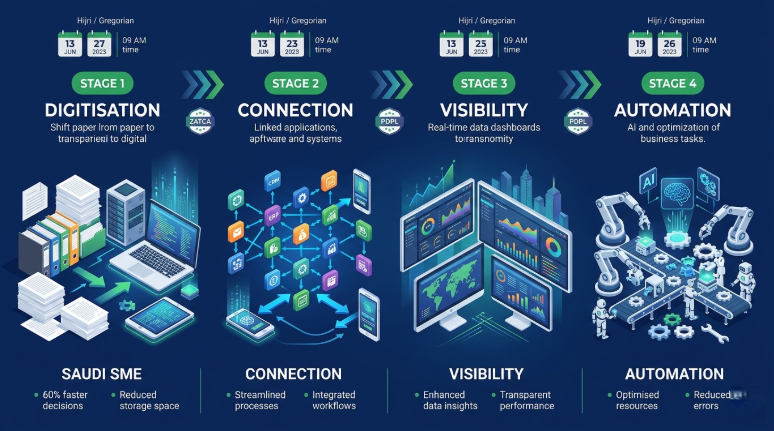
Digital transformation does not happen all at once. Most businesses move through four recognisable stages:
Stage 1: Digitisation
Digitisation means converting paper-based records and manual processes into digital formats. Scanning documents, moving from paper timesheets to a digital HR system, replacing handwritten order forms with an online system.
This is the foundation. Without it, the later stages are not possible.
Many Saudi SMEs are still at this stage for parts of their business. That is fine. The important thing is to identify which processes are still paper-based and have a plan to move them.
Stage 2: Connection
Once processes are digital, the next step is connecting them. A CRM that talks to your accounting system. A website that feeds enquiries directly into a sales pipeline. An HR system that connects to payroll.
This stage eliminates the manual data transfer between systems that consumes so much staff time in businesses that have gone digital but not connected.
A useful diagnostic: if your staff are regularly copying information from one system and pasting it into another, you are in Stage 1 dressed up as Stage 2.
Stage 3: Visibility
With connected systems, you can build visibility. This means dashboards that show you what is happening in your business in real time.
Leaders stop waiting for weekly or monthly reports. They see current data and make faster decisions. Problems are identified while they are still small.
This stage is where most of the management efficiency gains come from. It is also where many Saudi businesses stall, because building proper data visibility requires both technical capability and a willingness to change how decisions are made.
Stage 4: Automation and Optimisation
The final stage uses your connected, visible systems to automate processes and continuously improve them.
Routine tasks happen without human input. Machine learning models identify patterns and make predictions. Processes that were optimised manually are now optimised by the system itself.
This stage is where the largest productivity gains occur. It is also the stage that most clearly differentiates digitally mature businesses from those still catching up.
Where Saudi Businesses Most Often Go Wrong
Saudi businesses that struggle with digital transformation tend to make one or more of these mistakes:
Treating Technology as the Starting Point
The most common mistake is buying software before defining the problem it is supposed to solve.
A new ERP system does not solve disorganised processes. It digitises them, which can actually make disorganised processes harder to fix because they are now built into a system.
The right starting point is always the process. Define what you want the process to look like. Then find the technology that enables that process.
Underestimating Change Management
Technology changes are also people changes. If your team does not understand why a new system is being introduced, how it benefits them, and how to use it properly, adoption will be low and the investment will underperform.
Successful digital transformation projects in Saudi Arabia include structured training, clear communication about why the change is happening, and a period of monitored adoption with support available.
Starting Too Big
Large, simultaneous transformation projects across multiple departments almost always run over budget, over time, and under expectations.
The businesses that transform most successfully do it in stages. They pick one process, improve it well, measure the result, and use that result to build confidence and budget for the next stage.
Ignoring Data Quality
Connecting systems that contain bad data produces bad outputs faster. Garbage in, garbage out is a cliche because it is consistently true.
Before any digital transformation project, audit the quality of your core data: your customer records, your product catalogue, your financial data. Cleaning data before the project starts saves significant pain during it.
A Practical Starting Framework for Saudi Businesses
If you are not sure where to begin, this five-step framework gives you a clear starting point:
Audit your current processes. Write down the ten most important processes in your business. For each one, note whether it is paper-based, digital, or connected. This gives you a baseline.
Identify your biggest friction points. Where does your team spend the most time on manual tasks? Where do errors most often occur? Where do things fall through the cracks? These are your highest-priority digitisation targets.
Set a specific, measurable goal. Not 'improve our digital capability.' Something like: 'Reduce the time it takes to generate a monthly financial report from two days to two hours within six months.' Specific goals produce specific results.
Choose a partner, not a vendor. Digital transformation requires ongoing guidance, not a one-time product sale. Choose a technology partner who will help you plan, implement, measure, and adjust.
Measure, report, and build on results. After each stage, measure what changed and share the result with your team. This builds the internal case for continued investment and helps you prioritise the next stage intelligently.
Saudi-Specific Considerations
Digital transformation in Saudi Arabia has specific requirements that generic advice from international sources does not fully address:
Arabic language interfaces: Any customer-facing or staff-facing digital system needs to work properly in Arabic, including right-to-left text rendering and appropriate Arabic-language UX design.
Hijri calendar support: Some internal and customer-facing systems need to support Hijri dates alongside Gregorian, particularly in HR, legal, and government-adjacent processes.
PDPL compliance: Any digital system that stores personal data about Saudi residents must comply with the Personal Data Protection Law. This affects CRM systems, HR platforms, e-commerce databases, and more.
ZATCA e-invoicing: VAT-registered businesses must issue invoices through ZATCA-compliant systems. This is a mandatory technical requirement, not optional.
National Address and ID integration: Government service integrations increasingly use Absher and the National Address system. Digital platforms that connect to these require specific technical compliance.
Key Takeaways
Digital transformation is not a single project. It happens in four stages: digitisation, connection, visibility, and automation.
Vision 2030 creates both a compliance requirement (e-invoicing, data reporting) and a commercial opportunity (government procurement, digital consumer base) for Saudi businesses.
The most common mistake is buying technology before defining the process it is meant to improve. Start with the process, then find the right technology.
Change management is as important as technology selection. Low adoption kills transformation projects that were technically well-executed.
Saudi-specific requirements including PDPL, ZATCA e-invoicing, Arabic interfaces, and Hijri calendar support must be built into any digital system from the start.
The businesses that transform most successfully do it in stages, measuring results at each step before moving to the next.
Frequently Asked Questions
Q: How long does digital transformation take for a Saudi SME?
A: There is no single answer, because transformation happens in stages and the timeline depends on the size of the business and the complexity of its processes. A useful target for an SME is to achieve meaningful progress on one significant process improvement every quarter. Over two years, this approach delivers a substantially more capable business without the disruption and risk of trying to change everything at once.
Q: How much does digital transformation cost?
A: It depends entirely on scope. A business starting with basic digitisation (moving from paper to digital records and simple connected tools) can achieve meaningful progress for SAR 20,000 to SAR 80,000 in the first year. Full digital transformation across all business functions, including custom software and data systems, can run into the hundreds of thousands over three to five years. The right question is not what it costs in total but what each stage costs and what return it delivers, because transformation done in stages is both lower risk and easier to justify financially.
Q: What is the difference between digitisation and digitalisation?
A: Digitisation is converting something from analogue to digital: scanning a paper form, entering a handwritten record into a spreadsheet. Digitalisation is using digital tools to change how a process works: replacing a paper form with an online form that feeds directly into a database and triggers an automated workflow. Digitisation is a step. Digitalisation is the goal. Many businesses achieve digitisation but stop short of the automation and connection that digitalisation delivers.
Q: Does every Saudi business need to adopt AI as part of digital transformation?
A: No. AI is useful for specific problems: pattern recognition in large datasets, natural language processing, prediction from historical data. Many Saudi businesses can achieve substantial transformation gains through digitisation, connection, and basic automation without any AI at all. AI becomes relevant when you have clean, connected data at a volume and complexity that human analysis cannot efficiently handle. Starting with AI before the foundational stages are complete is a common and expensive mistake.
Q: How do we get staff to actually use new digital systems?
A: Staff resistance to new systems almost always comes from one of three sources: they do not understand why the change is happening, they were not involved in selecting or testing the system, or the system does not actually make their job easier in practice. Address all three before launch. Communicate the reason clearly, involve key users in testing, and be honest about what the system does and does not do well. A 90-day adoption support period after launch, with a dedicated point of contact for questions, dramatically improves long-term adoption rates.
Conclusion
Digital transformation is not a technology project. It is a business improvement programme that uses technology as its main tool.
Saudi businesses that approach it this way, with clear process goals, staged implementation, proper change management, and the right technology partner, consistently achieve results that businesses chasing 'digital transformation' as an abstract goal do not.
Vision 2030 has created the conditions for this to happen faster and at lower cost than ever before. The national digital infrastructure, the growing digital consumer base, and the government procurement preference for digitally capable suppliers all point in the same direction.
The businesses that act clearly and consistently today will have a three to five year head start on those that wait.
Softriva has been guiding Saudi businesses through technology improvement projects since 2006. Our approach starts with your processes and your goals, not with a product catalogue. A free consultation is the fastest way to understand what your specific business needs and where the highest-return starting points are.
Book a Free Digital Transformation Consultation at softriva.com


