

How AI Automation Is Reshaping Business Operations in Saudi Arabia
Introduction
For most of the past two decades, conversations about artificial intelligence in business happened at international conferences, not in boardrooms in Jeddah or Riyadh. That has changed completely.
Saudi Arabia's Vision 2030 programmed has accelerated digital adoption across every sector of the economy. The National Strategy for Data and AI, backed by billions in government investment, has created the infrastructure and the incentives for businesses to modernize their operations. And the businesses that have moved first are seeing results that are difficult to ignore.
Yet many small and mid-sized enterprises across the Kingdom are still running core operations the same way they did ten years ago: manual data entry, disconnected systems, Excel-based reporting, and decisions made on gut feel rather than evidence. The gap between these businesses and their technology-forward competitors is widening, not because the laggards lack ambition, but because they lack a clear picture of where to start.
This guide is that starting point. It explains what AI automation actually means in a Saudi business context, which workflows deliver the fastest return, what realistic outcomes look like, and how a business of any size can begin building operational advantages today.
What AI Automation Actually Means for a Business in Saudi Arabia
AI automation is not a single technology or a single product. It is a category of tools and approaches that share one goal: removing human effort from tasks that can be performed reliably by a machine ,and directing that human effort toward work that genuinely requires judgment, creativity, and relationships.
In practical terms, this means several overlapping capabilities working together:
• Robotic Process Automation (RPA): Software that mimics repetitive human actions ,copying data between systems, generating reports, processing invoices ,with speed and zero error.
• Machine Learning Pipelines: Systems that learn from your historical data to identify patterns and make predictions ,which customers are likely to churn, which equipment is likely to fail, which month will have low cash flow.
• Natural Language Processing: AI that reads, interprets, and responds to human language ,powering chatbots, email triage, contract analysis, and Arabic-language interfaces.
• Workflow Orchestration: The connecting layer that ties your existing tools together ,CRM, ERP, email, messaging, databases, so that data flows automatically between them without manual intervention.
Each of these technologies has become significantly more accessible and affordable over the past three years. What previously required a dedicated data science team can now be deployed through configurable platforms by any competent IT partner. The barrier is no longer technical capability ,it is organizational readiness and the right implementation partner.
Why 2026 Is a Pivotal Year for Saudi Businesses
The timing of the AI automation opportunity in Saudi Arabia is not incidental. Three converging forces are making this the most important year for businesses to act:
First, Vision 2030 is entering its implementation phase. The programme's targets for digital transformation, government service digitization, and private sector productivity are creating real procurement preferences and tender requirements. Companies that cannot demonstrate digital maturity are already finding themselves at a disadvantage in competitive processes.
Second, the cost of AI tooling has dropped dramatically. Cloud-based AI platforms, pre-trained language models, and no-code automation tools have made implementation costs a fraction of what they were five years ago. A workflow automation project that once required six months and a large budget can now be scoped, built, and deployed in weeks.
Third, the competitive pressure is accelerating. Softriva's own client data shows that businesses deploying AI automation are reporting 40% improvements in operational efficiency within the first year. When your competitor achieves that and you have not, the gap compounds ,faster response times, lower overhead, and better decision-making all feed into pricing power, customer retention, and growth.
Waiting to see how this plays out is no longer a neutral position. It is a decision to fall behind.
The Five Highest-Impact Automation Opportunities for Saudi Businesses
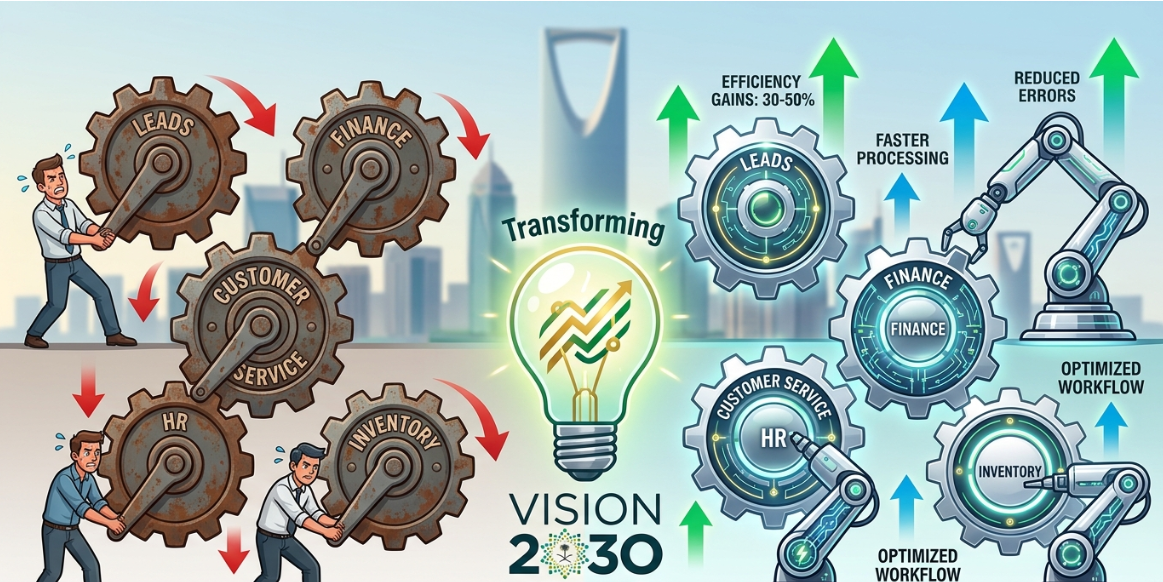
Not all automation is equal. The businesses that see the fastest return focus first on the workflows with the highest volume of manual effort and the most direct connection to revenue or cost. Based on Softriva's work across industries in Saudi Arabia and MENA, these are the five areas that consistently deliver the strongest results:
1. Lead Qualification and Sales Pipeline Automation
Every business that generates inbound enquiries ,through a website, WhatsApp, social media, or referrals ,is spending human time sorting, qualifying, and routing those leads. When a potential client fills in a contact form at 11pm on a Thursday, the response time in a manual system is measured in hours or days. In an automated system, it is measured in seconds.
Automated lead management connects your enquiry sources to your CRM, scores leads based on defined criteria, sends immediate acknowledgment messages (in Arabic or English, depending on the contact's preference), and routes qualified leads to the right member of your sales team with full context. The result is faster follow-up, fewer leads falling through the cracks, and sales teams spending their time on conversations rather than administration.
2. Financial Reporting and Invoice Processing
Manual financial reporting is one of the most common operational bottlenecks in Saudi businesses. Finance teams spend days each month extracting data from multiple systems, formatting it into reports, and distributing it to leadership. Errors are common. Timing is always late. Decisions get made on data that is already a week old.
Automated reporting connects directly to your accounting system, ERP, or bank feed to produce live dashboards and scheduled reports with zero manual effort. Invoice processing automation handles the extraction of line items, matching against purchase orders, approval routing, and payment scheduling ,reducing processing time by up to 80% and virtually eliminating data entry errors.
3. Customer Service and WhatsApp Automation
WhatsApp is the dominant business communication channel in Saudi Arabia. Most companies manage their WhatsApp enquiries manually, which means response times are inconsistent and the burden on customer service staff grows with every new client. An intelligent chatbot deployed on WhatsApp Business API can handle common enquiries ,pricing questions, appointment booking, service status updates, product information ,automatically, in Arabic and English, at any hour of the day.
The human team receives only the conversations that genuinely require judgment or escalation. Customer satisfaction improves because responses are immediate. Staff capacity increases because they are no longer handling questions that a well-built system can answer better and faster than any individual.
4. HR and Onboarding Workflows
Employee onboarding in a manual environment involves dozens of individual tasks: collecting documents, creating system accounts, scheduling induction sessions, distributing policies, completing government registrations, and tracking completion. Each step requires someone to remember to do it, chase the relevant people, and update a tracker. It is exactly the kind of work that automation eliminates entirely.
A well-designed HR automation workflow triggers on a new hire decision, sends digital document requests, creates accounts in relevant systems, schedules sessions automatically, and tracks every step to completion without any coordinator involvement. The same logic applies to offboarding, leave management, and performance review cycles.
5. Inventory and Procurement Reordering
For businesses managing physical inventory ,retail, manufacturing, healthcare, food service ,manual reordering based on periodic stock checks is both inefficient and error-prone. Items run out unexpectedly. Overstock ties up capital. Supplier negotiations happen without visibility into actual consumption patterns.
Automated inventory management systems track stock levels in real time, trigger reorder requests when defined thresholds are reached, compare supplier pricing automatically, and route approval workflows to the right decision-maker. The outcome is fewer stockouts, lower average inventory levels, and procurement teams that spend their time on strategy rather than data entry.
What to Expect: Realistic Results from AI Automation
There is a significant amount of exaggerated messaging around AI in the market. Technology vendors make dramatic claims about transformation that bear little resemblance to what businesses actually experience. Here is an honest account of what well-implemented automation delivers:
• Operational efficiency improvements of 30 to 50 percent in targeted workflows are common and achievable within six to twelve months of deployment.
• Lead response times can drop from hours to minutes or seconds ,directly improving conversion rates from existing enquiry volumes without additional marketing spend.
• Reporting cycles that previously required days of manual effort can be compressed to real-time visibility, giving leadership teams the ability to act on current information rather than historical snapshots.
• Customer service capacity can increase by 40 to 60 percent without additional headcount, as AI handles the high-volume, low-complexity interactions that currently occupy most of a service team's time.
• Error rates in data-intensive processes such as invoicing, reporting, and data migration drop dramatically ,in many cases to near zero for well-defined workflows.
These are not speculative projections. They are outcomes reported by Softriva clients across the Saudi market. The caveat is that these results require proper implementation ,a clear workflow audit, a realistic scope, appropriate change management, and ongoing optimization after launch.
How to Begin: A Practical Starting Framework
The most common reason businesses delay AI automation is not cost or technology ,it is the feeling of not knowing where to start. The following framework reduces that uncertainty:
1. Audit your highest-volume, highest-friction workflows. Make a list of the ten processes your team spends the most time on. Identify which are repetitive and rule-based versus which genuinely require human judgment. The former are your automation candidates.
2. Calculate the cost of the status quo. For each candidate workflow, estimate the hours spent per week, multiply by the average hourly cost of the staff involved, and multiply by 52. This gives you a baseline cost figure to compare against automation investment.
3. Prioritize by impact and feasibility. Not every workflow is equally automatable. Some have complex exceptions that make automation expensive. Focus first on the workflows that are high-volume, relatively standardized, and directly connected to revenue or customer experience.
4. Choose the right implementation partner. AI automation is not a product you buy off a shelf. It is a system you build with a partner who understands your business, your technology environment, and your market. The quality of that partnership determines the quality of the outcome.
5. Launch, measure, and optimize. Begin with a defined pilot ,one or two workflows ,measure the results rigorously, and use those results to build the business case for broader deployment.
Key Takeaways
✓ AI automation is not about replacing people ,it removes repetitive, rule-based tasks so teams can focus on higher-value work.
✓ Vision 2030 is accelerating digital transformation timelines for Saudi businesses ,companies that delay face growing competitive disadvantage.
✓ The five highest-impact automation areas are: lead management, financial reporting, customer service, HR workflows, and inventory management.
✓ Realistic, well-implemented automation delivers 30-50% efficiency gains in targeted workflows within 6-12 months.
✓ The best starting point is a workflow audit ,identifying which processes are repetitive, high-volume, and directly connected to cost or revenue.
✓ Choosing a Saudi-based implementation partner with deep market understanding significantly reduces risk and accelerates time to value.
Frequently Asked Questions
Q: Is AI automation only suitable for large enterprises, or can Saudi SMEs benefit too?
A: SMEs often see the most proportional benefit from automation precisely because their teams are smaller and manual processes consume a larger share of total capacity. A 10-person business that eliminates five hours of daily manual work has transformed its operating leverage. Softriva builds solutions scaled to SME budgets and team sizes ,you do not need an enterprise IT department to deploy effective automation.
Q: How long does it take to implement AI automation for a typical business workflow?
A: A focused single-workflow automation project ,such as lead management or invoice processing ,typically takes four to eight weeks from initial scoping to live deployment. More complex multi-system automation projects can take three to six months. The timeline depends heavily on the quality of your existing data, the complexity of your current systems, and how clearly the workflow is defined at the outset.
Q: Does AI automation require replacing our existing software systems?
A: In the majority of cases, no. Well-designed automation works with your existing systems ,connecting them through integration layers rather than replacing them. Most businesses already have a CRM, an accounting system, and communication tools that can be connected and automated without switching platforms. The goal is to make your existing investments work together more effectively.
Q: What is the typical return on investment for an AI automation project?
A: ROI varies significantly depending on the workflow automated and the baseline cost of the manual process. However, for well-scoped projects, the investment typically pays back within six to twelve months through labor savings, error reduction, and speed improvements. Softriva provides a detailed ROI estimate as part of every initial consultation, based on your specific workflow data.
Q: How does AI automation align with Saudi Arabia's Vision 2030 objectives?
A: Vision 2030 explicitly targets productivity improvement, reduced dependence on manual labor for routine tasks, and the development of a knowledge-based economy. AI automation directly serves all three objectives. Businesses that adopt automation are better positioned for government procurement, international partnerships, and the regulatory environment that Vision 2030 is creating. Early adoption is an eligibility advantage, not just an operational one.
Conclusion
The question for Saudi businesses in 2026 is no longer whether to adopt AI automation. The question is how quickly you can build the operational advantages it delivers ,and whether you will build them before your competitors do.
The five workflow categories covered in this guide ,lead management, financial reporting, customer service, HR, and inventory ,represent the most accessible and highest-return starting points for most businesses. None requires a transformation of your existing technology stack. All of them can be scoped, built, and deployed within a realistic timeline and budget.
Softriva has been helping Saudi businesses build better digital systems since 2006. Our AI automation practice is built on the same principles that have guided every project we have delivered: understand the business first, design for real-world use, deliver outcomes rather than technology, and stay involved after launch.
If you are ready to see what AI automation could deliver for your specific operations, start with a conversation. Our team offers a free 30-minute strategy call, no commitment, no sales pressure, just a clear-eyed assessment of where your biggest opportunities are and what a realistic path forward looks like.


