
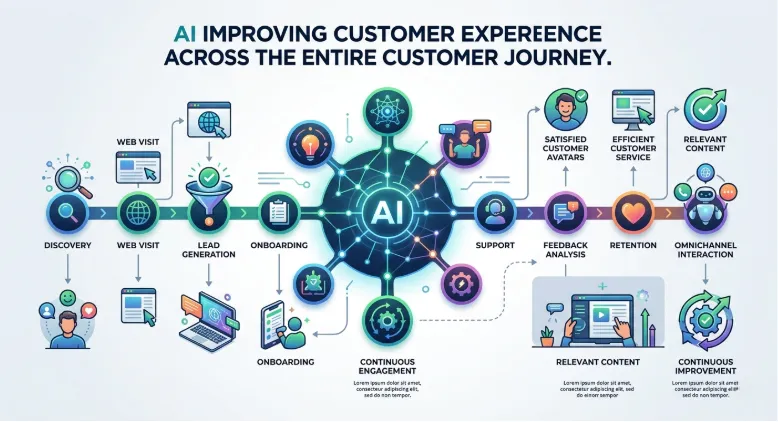
How AI Can Improve Customer Experience Across Every Touchpoint
Introduction
Customer experience has become one of the most important competitive differentiators in modern business.
Today’s customers are not only comparing products and prices. They are evaluating how easy it is to interact with a company, how quickly issues are resolved, how personalized communications feel, and whether businesses truly understand their needs.
A single negative interaction can influence purchasing decisions, brand perception, and customer loyalty.
At the same time, customer expectations continue to rise.
Customers expect:
Instant responses
Personalized experiences
Seamless interactions across channels
Consistent service quality
Proactive support
Meeting these expectations manually has become increasingly difficult.
Organizations interact with customers through websites, mobile apps, social media, email, phone calls, messaging platforms, and physical locations. Managing these touchpoints consistently requires significant resources and coordination.
Artificial Intelligence (AI) is helping businesses solve this challenge.
AI enables organizations to understand customers more effectively, automate repetitive interactions, personalize communications, predict customer needs, and improve service delivery across the entire customer journey.
For businesses in Saudi Arabia pursuing digital transformation and customer-centric growth strategies, AI is becoming a critical tool for delivering exceptional experiences at scale.
This guide explores how AI improves customer experience at every stage of the customer journey and how organizations can leverage these technologies effectively.
Understanding Modern Customer Experience
Customer experience encompasses every interaction a customer has with a business.
This includes:
Brand discovery
Research and evaluation
Purchasing
Onboarding
Support interactions
Ongoing engagement
Renewals and repeat purchases
Every touchpoint contributes to customer perceptions.
A positive experience builds trust and loyalty.
A poor experience can drive customers toward competitors.
Businesses must therefore focus on delivering consistency across the entire journey.
Why Customer Experience Matters More Than Ever
Several trends have increased the importance of customer experience.
Greater Competition
Customers have more choices than ever before.
Businesses can no longer rely solely on product quality or pricing advantages.
Experience increasingly influences purchasing decisions.
Digital Expectations
Digital-first interactions have become standard.
Customers expect businesses to provide:
Online self-service
Fast communication
Mobile accessibility
Personalized experiences
Organizations unable to meet these expectations risk losing customers.
Customer Retention Costs Less Than Acquisition
Acquiring new customers often costs significantly more than retaining existing ones.
Exceptional customer experiences strengthen loyalty and increase retention.
How AI Enhances Customer Experience
AI enables businesses to understand, predict, and respond to customer needs more effectively.
Rather than replacing human interactions, AI improves the speed, relevance, and consistency of customer engagement.
Touchpoint #1: Customer Discovery and Awareness
The customer journey often begins before direct contact occurs.
Potential customers discover businesses through:
Search engines
Social media
Advertising
Online content
AI improves visibility and relevance during this stage.
AI-Powered Personalization
AI helps businesses deliver personalized content based on:
User behavior
Preferences
Interests
Previous interactions
Customers are more likely to engage with relevant information.
Intelligent Advertising
AI optimizes advertising campaigns by:
Identifying target audiences
Improving campaign performance
Reducing advertising waste
Increasing conversion opportunities
Marketing becomes more efficient and customer-focused.
Touchpoint #2: Website Experience
A website is often the first direct interaction between a customer and a business.
AI helps create more engaging experiences.
AI Chatbots
AI-powered chatbots provide:
Instant responses
Product information
Navigation assistance
Lead capture
Visitors receive immediate support without waiting for human assistance.
Personalized Recommendations
AI analyzes visitor behavior and recommends:
Products
Services
Content
Resources
Personalized experiences increase engagement and conversion rates.
Touchpoint #3: Lead Generation and Sales
Customers evaluating products or services often require information before making decisions.
AI supports sales processes by improving responsiveness and personalization.
Intelligent Lead Qualification
AI can:
Analyze inquiries
Score leads
Identify intent
Prioritize opportunities
Sales teams focus their efforts on high-value prospects.
Automated Follow-Up
Many sales opportunities are lost because follow-up is delayed.
AI automates:
Emails
Notifications
Reminders
Engagement campaigns
Customers remain engaged throughout the buying process.
Touchpoint #4: Customer Onboarding
The first experience after a purchase often determines long-term satisfaction.
AI helps organizations create smoother onboarding experiences.
Automated Guidance
AI can provide:
Tutorials
Product recommendations
Personalized onboarding paths
Frequently asked information
Customers achieve value more quickly.
Proactive Support
AI identifies customers who may require additional assistance.
Organizations can intervene before problems escalate.
Touchpoint #5: Customer Support
Support interactions significantly influence customer perceptions.
Slow responses and unresolved issues create frustration.
AI helps improve support experiences.
24/7 Assistance
AI-powered support systems provide around-the-clock availability.
Customers receive help whenever they need it.
Faster Resolution Times
AI can instantly answer routine questions related to:
Orders
Services
Billing
Policies
Support teams handle complex issues while AI manages repetitive requests.
Smart Ticket Routing
AI automatically directs support requests to the appropriate team or specialist.
This reduces delays and improves efficiency.
Touchpoint #6: Personalized Customer Engagement
Customers increasingly expect businesses to understand their preferences.
AI enables personalization at scale.
Behavioral Analysis
AI analyzes:
Browsing activity
Purchase history
Service interactions
Engagement patterns
This information supports more relevant communications.
Personalized Recommendations
Examples include:
Product suggestions
Service upgrades
Educational resources
Promotional offers
Customers receive information aligned with their interests.
Touchpoint #7: Customer Feedback and Sentiment Analysis
Understanding customer opinions is essential for continuous improvement.
AI helps businesses process large volumes of feedback.
Sentiment Analysis
AI evaluates customer comments to identify:
Positive feedback
Negative feedback
Emerging concerns
Satisfaction trends
Organizations gain valuable insights without extensive manual review.
Voice of Customer Analysis
AI can analyze information from:
Surveys
Reviews
Social media
Support conversations
Leadership gains a deeper understanding of customer needs.
Touchpoint #8: Customer Retention and Loyalty
AI helps organizations strengthen long-term customer relationships.
Predictive Analytics
AI identifies patterns indicating:
Customer dissatisfaction
Reduced engagement
Potential churn
Businesses can act proactively to retain customers.
Loyalty Program Optimization
AI helps personalize loyalty initiatives by identifying rewards and incentives most relevant to individual customers.
This improves participation and engagement.
Touchpoint #9: Omnichannel Customer Experience
Customers interact through multiple channels.
They expect consistency regardless of where conversations occur.
AI helps unify customer experiences across:
Websites
Mobile applications
Email
WhatsApp
Social media
Contact centers
Organizations maintain continuity across every interaction.
Touchpoint #10: Continuous Improvement
Customer expectations evolve constantly.
AI supports ongoing optimization.
Real-Time Analytics
Businesses gain visibility into:
Customer behavior
Service performance
Engagement trends
Operational bottlenecks
Insights support continuous improvement initiatives.
Data-Driven Decision Making
AI helps leadership identify opportunities to enhance customer experiences based on evidence rather than assumptions.
Benefits of AI-Driven Customer Experience
Organizations implementing AI often achieve measurable improvements.
Faster Response Times
Customers receive assistance immediately rather than waiting for human availability.
Increased Customer Satisfaction
Personalized and efficient interactions improve overall experiences.
Improved Employee Productivity
Teams spend less time on repetitive activities and more time on complex customer needs.
Higher Retention Rates
Satisfied customers are more likely to remain loyal.
Greater Scalability
Businesses can serve larger customer bases without proportionally increasing support resources.
Common Challenges and How to Overcome Them
Data Quality
AI depends on accurate information.
Organizations should prioritize data management and governance.
Integration Complexity
Customer data often exists across multiple systems.
Successful implementations require integration planning.
Change Management
Employees should understand how AI supports rather than replaces their roles.
Training and communication are essential.
Maintaining Human Touch
Customers still value human interactions.
The most successful organizations combine AI efficiency with human empathy and expertise.
Building an AI Customer Experience Strategy
Successful initiatives follow a structured approach.
Step 1: Map the Customer Journey
Identify every customer touchpoint.
Step 2: Identify Friction Points
Determine where customers experience delays, confusion, or dissatisfaction.
Step 3: Prioritize AI Opportunities
Focus on areas with the greatest potential business impact.
Step 4: Implement Incrementally
Begin with high-value use cases and expand gradually.
Step 5: Measure Outcomes
Track metrics such as:
Customer satisfaction
Response times
Retention rates
Conversion rates
Operational efficiency
The Future of AI and Customer Experience
AI capabilities continue to advance rapidly.
Future developments will likely include:
Hyper-personalized experiences
Predictive customer engagement
Advanced conversational AI
Enhanced sentiment analysis
Autonomous service interactions
Organizations investing today are establishing the foundation for future customer experience innovation.
Key Takeaways
Customer experience has become a critical competitive differentiator.
AI improves customer interactions across every stage of the customer journey.
Personalization, automation, predictive analytics, and intelligent support drive better experiences.
AI helps businesses respond faster, operate more efficiently, and improve customer satisfaction.
Successful implementations balance automation with human expertise.
Customer retention and loyalty improve when experiences become more relevant and convenient.
Data quality and integration are essential for effective AI deployment.
AI-driven customer experience initiatives support broader digital transformation goals.
Frequently Asked Questions
Q: How does AI improve customer experience?
A: AI improves customer experience through personalization, automation, predictive analytics, faster support, and more relevant customer interactions.
Q: Can AI replace customer service representatives?
A: No. AI is most effective when handling routine interactions while human agents focus on complex issues, relationship-building, and problem resolution.
Q: What customer experience areas benefit most from AI?
A: Customer support, personalization, lead generation, onboarding, retention, feedback analysis, and omnichannel engagement often deliver the strongest results.
Q: Is AI customer experience technology suitable for small businesses?
A: Yes. Many AI tools are accessible to organizations of all sizes and can significantly improve efficiency and customer satisfaction.
Q: How do businesses measure AI customer experience success?
A: Common metrics include customer satisfaction scores, retention rates, response times, engagement levels, conversion rates, and operational efficiency improvements.
Conclusion
Customer expectations will continue to evolve as digital technologies become more advanced and accessible.
Organizations that rely solely on traditional customer engagement methods may struggle to keep pace with growing demands for speed, personalization, and convenience.
Artificial Intelligence provides businesses with powerful tools to improve every stage of the customer journey.
From discovery and lead generation to support, retention, and loyalty, AI enables organizations to deliver better experiences while improving operational efficiency.
The businesses that succeed in the coming years will be those that combine technology, data, and human expertise to create meaningful customer relationships at scale.
Softriva helps organizations across Saudi Arabia implement AI-powered customer experience solutions, automation platforms, analytics systems, and digital transformation strategies that deliver measurable business results.
Book Your Free AI Customer Experience Assessment at softriva.com and discover how AI can transform every customer interaction.


