How Saudi Businesses Are Using Generative AI in Operations
Introduction
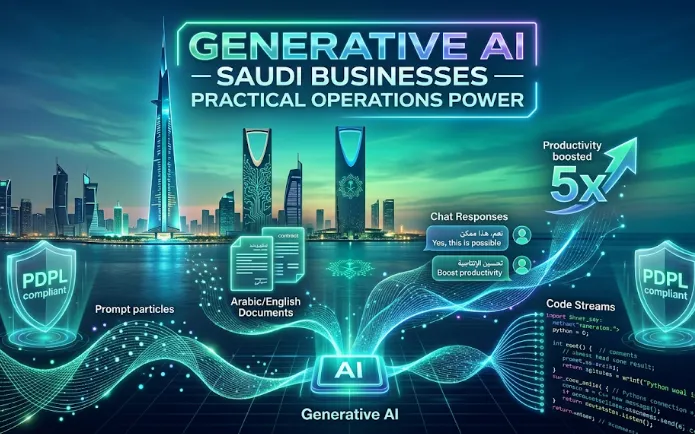
Generative AI has moved from experimental technology to practical business tool faster than almost anyone predicted.
In 2023, most Saudi businesses were cautious observers of the technology. By 2026, a growing number are using it every day: to draft documents, answer customer questions, process information, assist in decision-making, and reduce the administrative overhead that consumes a disproportionate share of skilled staff time.
At the same time, a lot of generative AI deployment in Saudi businesses is casual and unstructured. Individual employees are using consumer tools in ways that may expose sensitive business information. Businesses are making claims about AI capability that go beyond what the technology can actually deliver. And some are avoiding the technology entirely based on concerns that are legitimate but manageable.
This guide focuses on what generative AI can practically do for a Saudi business, with specific examples from the types of tasks it handles well, the types it does not, the data security questions every Saudi business should resolve before deploying it, and how to build a structured approach to using it effectively.
What Generative AI Actually Does
Generative AI refers to large language models (LLMs) and related systems that produce text, code, structured data, or other content in response to a prompt or instruction.
The most widely known example is ChatGPT. Others include Claude (Anthropic), Gemini (Google), and Mistral. Each model has different strengths, different cost structures, and different data handling policies that matter for Saudi business use.
What these systems do well is process, synthesise, and generate language-based content at a speed and scale that no human team can match. They can read a 50-page contract and produce a structured summary in seconds. They can draft a client proposal in Arabic from a set of bullet points. They can answer a customer question from a knowledge base of 500 documents without any human reading those documents first. They can generate 20 variations of a marketing headline for testing.
What they do not do well is produce reliable factual information about specific recent events, perform precise calculations, make judgments that require genuine contextual understanding of a specific business relationship, or operate without the possibility of producing errors that need human review.
Understanding this boundary is the most important thing a Saudi business leader needs to know before deploying generative AI. It is a powerful tool for certain categories of work. It is not a replacement for human judgment in the categories where judgment genuinely matters.
Practical Generative AI Applications for Saudi Businesses
Document Drafting and Editing
The clearest and most immediate value of generative AI in most Saudi businesses is in document production.
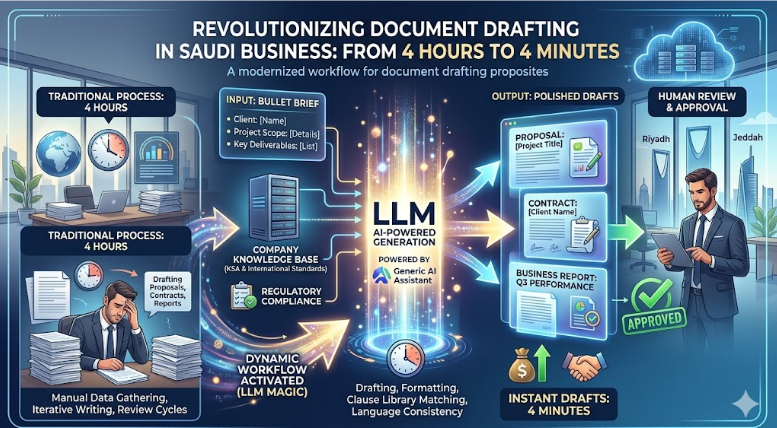
Proposals, contracts, SOW documents, policy documents, HR letters, client reports, board presentations, and marketing materials all involve significant writing effort by skilled staff. A senior consultant who spends four hours drafting a client proposal is spending time on document production that could be spent on the analysis and insight that makes the proposal valuable.
A well-configured generative AI tool can produce a first draft of most standard business documents from a structured brief in minutes. The human reviews, corrects, and enriches the draft. The total time from brief to finished document drops significantly. The human contribution shifts from writing to judgment.
For Saudi businesses, this requires AI tools configured to draft in both Arabic and English. The Arabic drafting capability of different models varies significantly. Testing models on Arabic business document drafting before deployment is essential.
Customer Query Handling
A generative AI knowledge base connects a large language model to your company's documentation: service descriptions, pricing, FAQs, policies, terms, and product information. When a customer asks a question, the system searches the knowledge base, retrieves the relevant information, and generates a natural-language answer rather than returning a list of documents.
For a Saudi business with a high volume of inbound customer queries, this application reduces the load on customer service staff significantly. Common questions get accurate answers immediately. Staff focus on complex, sensitive, or relationship-critical conversations.
The system can be deployed on a website chat widget, through WhatsApp Business API, or as an internal tool for customer service staff. It needs to be connected to your current, accurate business documentation to produce reliable answers. A knowledge base built on outdated or inaccurate documents will produce outdated or inaccurate answers.
Arabic-English Content Translation and Adaptation
For Saudi businesses operating bilingually, translation and content adaptation between Arabic and English is a constant operational requirement. Generative AI models perform well at this task for standard business content, significantly reducing the time and cost of professional translation for internal documents, marketing materials, and routine business communications.
The distinction between translation and adaptation matters here. A direct translation of English marketing content into Arabic produces text that is grammatically correct but often feels foreign to Arabic-speaking audiences. Adaptation, adjusting tone, register, and cultural references for the Arabic-speaking audience, requires human judgment. Generative AI can produce a working translation draft that a bilingual professional then adapts, which is faster and less expensive than full professional translation.
For regulated content such as contracts, legal documents, and compliance materials, professional human translation remains necessary. Generative AI translation of these document types carries accuracy risk that the consequences of an error in a legal document do not justify.
Internal Knowledge Management
Many Saudi businesses have accumulated years of operational knowledge that is not documented anywhere. It lives in the heads of experienced employees, in email threads, in WhatsApp messages, and in files that nobody has organised. When those employees leave or are unavailable, the knowledge goes with them.
A generative AI knowledge management system indexes your business documentation, past project files, procedures, and institutional knowledge. Staff can query the system in natural language to find information, check procedures, or understand how similar situations have been handled in the past.
Building this system requires first creating the documentation that the AI will index. This is the harder part of the project for most businesses. The AI can help with this too, by drafting standard operating procedures from interviews or voice notes with experienced staff.
Sales Assistance and Proposal Generation
Generative AI can be connected to your CRM to assist sales teams with proposal generation, follow-up email drafting, and meeting preparation. When a sales meeting is logged in the CRM, the AI can generate a pre-meeting brief summarising the prospect's profile, past interactions, and relevant case studies. After the meeting, it can draft the follow-up email from meeting notes.
Proposal generation from a structured brief is one of the clearest ROI applications. A salesperson provides key details about the client and the recommended solution. The AI generates a structured proposal draft in the company's standard format. The salesperson reviews, customises, and sends. Total time per proposal drops from hours to minutes.
Data Security Considerations for Saudi Businesses
The most important question for a Saudi business deploying generative AI is: where does the data go?
When employees use consumer generative AI tools (ChatGPT, Claude.ai, Gemini) through a web browser, the text they enter is typically processed by the provider's servers and may be used for model improvement depending on the provider's data handling policy.
For a Saudi business, this creates two specific risks. First, employees may enter confidential business information, client data, or personal data covered by PDPL into a system whose data handling is not subject to Saudi data protection requirements. Second, proprietary business information entered into consumer AI tools may not be fully protected from use in training data.
The practical solutions are:
Configure organisational accounts with data handling policies: Microsoft 365 Copilot, Google Gemini for Workspace, and Claude for Enterprise all offer enterprise configurations where data entered is not used for model training and is handled under enterprise data protection agreements.
Use API access to models rather than consumer interfaces: connecting to AI models through their API allows the business to control the data handling environment.
Train staff on what not to enter: regardless of the tools used, employees should understand that client names, personal data, financial information, and confidential business information should not be entered into external AI systems without explicit approval.
Key Takeaways
Generative AI handles language-based work well: document drafting, customer query answering, translation, knowledge management, and sales assistance. It does not replace human judgment for decisions that genuinely require it.
Arabic-language capability varies significantly between different AI models. Testing models on Arabic business document drafting before deployment is essential for Saudi businesses.
A generative AI customer query system must be connected to current, accurate business documentation. Answers are only as reliable as the knowledge base behind them.
PDPL creates data protection obligations around what business and personal data can be entered into external AI systems. Consumer AI tools require specific risk assessment before business deployment.
Enterprise AI configurations (Microsoft Copilot, Google Gemini for Workspace, Claude for Enterprise) provide data handling guarantees that consumer tools do not. These are the appropriate deployment path for Saudi business use.
The highest-ROI applications for most Saudi businesses are document drafting assistance, customer query handling, and proposal generation. These deliver measurable time savings with manageable accuracy risk.
Frequently Asked Questions
Q: Is it safe for a Saudi business to use generative AI for PDPL-sensitive data?
A: It depends on the deployment model. Consumer AI tools (web-based ChatGPT, Claude.ai, Gemini) are not appropriate for processing personal data covered by PDPL without verifying the provider's data processing agreements and data residency. Enterprise configurations of major AI platforms include data processing agreements that specify how data is handled and provide the contractual basis for business use. Any deployment involving personal data about Saudi residents should be reviewed against PDPL requirements before implementation.
Q: How accurate is generative AI for Arabic business content in Saudi Arabia?
A: Arabic language capability has improved significantly in major AI models since 2023, but it varies between models and between content types. For standard business correspondence, formal document drafting, and general customer communication, current models perform well enough for Saudi professional use with human review. For specialised content such as legal contracts, regulated financial communications, or creative content with specific cultural references, human review and editing remains essential. Testing the specific model on the specific type of content you plan to produce is the most reliable way to assess accuracy for your use case.
Q: What is the difference between a chatbot and a generative AI customer service system?
A: A traditional chatbot follows a defined decision tree: if the customer says X, reply with Y. It can only handle the specific scenarios it has been programmed for and produces rigid, template-based responses. A generative AI customer service system understands the intent of a question in natural language and generates a contextually relevant answer from a knowledge base. It can handle questions it was never explicitly programmed for, as long as the relevant information exists in the knowledge base. The generative approach handles a much wider range of queries and produces more natural responses, but requires more careful knowledge base management to ensure answers are accurate.
Q: What should a Saudi business do first when starting to deploy generative AI?
A: Start with a specific, well-defined use case rather than a broad deployment. The best first use cases are low-risk (internal use rather than customer-facing), high-volume (tasks that happen many times per week), and clearly measurable (you can track the time saved or the quality improvement). Document drafting for internal reports, proposal drafts from structured briefs, and internal knowledge base queries are all good starting points. Run a defined pilot with a small user group, measure the results, and use those results to guide the next deployment decision.
Conclusion
Generative AI is not a future technology for Saudi businesses. It is a present one.
The businesses that deploy it thoughtfully, starting with high-ROI use cases, using enterprise-grade data handling, and maintaining human oversight for outputs that require accuracy, are building a productivity advantage that will compound over time. The businesses that either avoid it entirely or deploy it casually without structure are both missing the opportunity or creating risks they have not assessed.
The most important principle for Saudi businesses deploying generative AI is the same principle that applies to any technology investment: start with the business problem, not the technology. Identify where your team is spending significant time on language-based work that follows consistent patterns. Test a focused AI solution for that specific problem. Measure the result. Then expand from there.
Softriva helps Saudi businesses deploy generative AI in a structured, compliant way. Our services include use case identification, knowledge base development, Arabic and English AI configuration, enterprise deployment on Microsoft and Anthropic platforms, and PDPL-compliant data handling for AI applications.
A free consultation gives you a specific, realistic picture of where generative AI could deliver the most value for your business at its current stage.
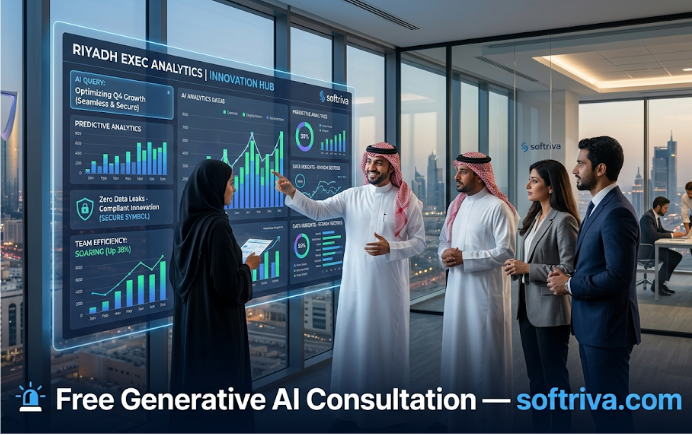
Book a Free Generative AI Consultation at softriva.com


