

How to Choose the Right IT Solutions Company in Saudi Arabia
Introduction
The decision to bring in an IT partner is one of the most consequential choices a business leader makes. Get it right, and you gain a team that accelerates your operations, keeps your systems secure, and helps you build the digital infrastructure your business needs to compete. Get it wrong, and you lose months, budget, and often significant internal morale dealing with the fallout.
The IT services market in Saudi Arabia has grown considerably in recent years, driven by Vision 2030 investment and a wave of enterprise digital transformation projects. That growth has attracted a wide range of vendors ,from highly experienced, full-service firms to generalist developers marketing themselves as technology consultants. For a business owner evaluating options, the quality signals are not always obvious.
This guide provides a structured, practical framework for evaluating IT companies in Saudi Arabia. It covers the eight factors that genuinely differentiate reliable, capable partners from those who promise more than they deliver. Whether you are sourcing your first IT partner or reconsidering an existing relationship, this framework will help you ask the right questions and make a better decision.
Why the Stakes Are Higher Than Most Businesses Realize
The cost of a poor IT partnership is rarely visible on a single invoice. It accumulates over time through delayed projects that push your market launch date back by a quarter, budget overruns that consume money allocated for other growth initiatives, systems that work in the demo but fail in production, security vulnerabilities that are discovered after a breach rather than before, and the internal time your team spends managing a vendor relationship that should be managing itself.
Across Saudi Arabia, businesses that have switched IT partners mid-project consistently report that the decision cost them two to three times the original contract value when all indirect costs are included. The research phase is not overhead ,it is risk management.
Factor 1: Genuine Local Presence and Regional Knowledge
There is a meaningful difference between an IT company that sells into Saudi Arabia from a distance and one that is genuinely embedded in the Kingdom's business environment. Local presence matters for several concrete reasons:
• Regulatory familiarity: ZATCA compliance, data localization requirements under the Personal Data Protection Law, and sector-specific regulations (particularly in finance and healthcare) require detailed, current knowledge that a remote vendor rarely maintains.
• Cultural understanding: Saudi business culture values long-term relationships, Arabic-language capability, and the kind of trust that develops through face-to-face engagement. A vendor who cannot meet you in person when a critical project decision needs to be made is a vendor operating at a disadvantage.
• Response time: When something goes wrong ,and in IT, something eventually goes wrong ,physical proximity matters. A Jeddah-based team can be on-site within hours. A remote team in a different time zone cannot.
When evaluating local presence, look beyond a claimed address. Ask how many team members are based in Saudi Arabia, how frequently they meet clients in person, and what their experience is with Saudi-specific regulatory requirements. The answers will quickly separate genuine local partners from those with a nominal regional presence.
Factor 2: A Verifiable Track Record with Measurable Outcomes
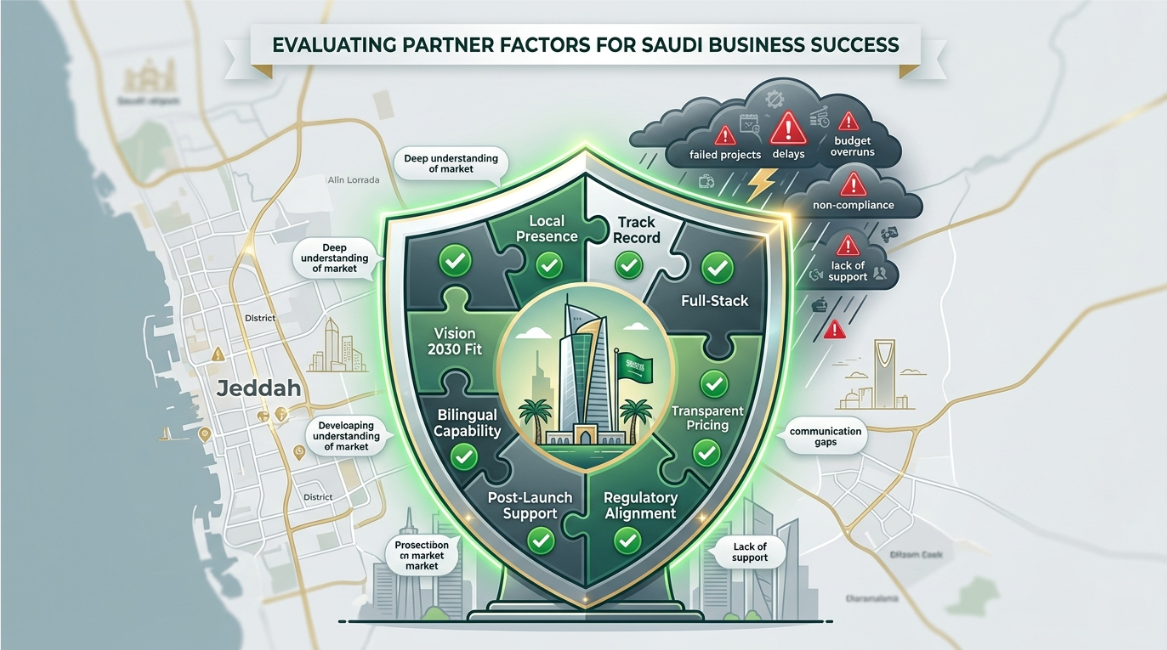
Client testimonials are useful evidence, but they are rarely sufficient for a significant IT investment. What you need is a track record you can verify ,ideally through direct conversations with reference clients in industries similar to your own.
When reviewing case studies and asking for references, focus on specificity. A reference that says 'they were great to work with' is pleasant but uninformative. A reference that says 'they built a BI dashboard that reduced our monthly reporting cycle from four days to four hours, and it has been running without issues for two years' tells you something genuinely useful.
Look for evidence across several dimensions: technical competence in the specific services you need, project management quality (delivered on time and within scope), post-launch support quality, and the longevity of the client relationship. A vendor with many one-time clients and few long-term relationships is telling you something important about the experience of working with them.
Factor 3: Full-Stack Capability Under One Roof
The fragmentation of IT services across multiple vendors is one of the most common sources of project failure in Saudi Arabia. It works like this: one company builds your website, another manages your hosting, a third is engaged for data analytics, and a fourth is supposed to handle integration between everything. When something breaks ,and integration points are always where things break ,every vendor points at the others.
The most efficient and accountable IT partnerships are with vendors who can own the complete technical scope of your needs. This does not mean you need one vendor for everything forever ,it means the partner you choose for a given project should have genuine depth across the areas that project touches.
For most Saudi businesses, that means looking for a partner with proven capability across web development and hosting, data analytics and business intelligence, AI and automation, managed services and cybersecurity, and enterprise software such as ERP and HRMS. When a single partner owns all of these, accountability is clear and integration quality is far higher.
Factor 4: Clear and Transparent Pricing
Hidden costs are endemic in the IT services market globally, and the Saudi market is no exception. The most common patterns are initial proposals that underscope the project to win the business, then expand the scope mid-engagement through change requests that each carry their own price tag, vague service level agreements that leave the client responsible for anything not explicitly specified, and ongoing support contracts that auto-renew at rates that were not clearly disclosed in the original agreement.
A trustworthy IT partner provides a detailed scope of work before any contract is signed, explains clearly what is included and what is not, uses measurable deliverables rather than vague descriptions of work to be done, and does not change the price mid-project without a formally agreed change control process. Test this in the proposal stage: ask the vendor to walk you through every line item and explain how they would handle scope expansion. Their response will tell you a great deal about what the engagement will actually look like.
Factor 5: Alignment with Saudi Arabia's Digital Regulatory Environment
Saudi Arabia's digital regulatory landscape has evolved significantly over the past three years, and it will continue to evolve as Vision 2030 implementation deepens. The businesses most exposed to risk are those whose IT partners are not keeping pace with these changes.
Key areas where regulatory knowledge is essential include data protection under the Personal Data Protection Law (PDPL), which governs how personal data is collected, stored, processed, and transferred; cybersecurity requirements under the National Cybersecurity Authority's frameworks, particularly for businesses in critical sectors; ZATCA e-invoicing requirements, which apply to VAT-registered businesses with phased implementation; and sector-specific regulations in healthcare, finance, and education that have their own data and system requirements.
Ask any potential IT partner directly about their experience with these regulations. If they cannot speak to them specifically and credibly, that is a significant red flag ,particularly for any project involving customer data, financial transactions, or regulated industries.
Factor 6: Quality of Post-Launch Support
The most revealing question you can ask an IT vendor is not about the project ,it is about what happens after the project. How do they handle bugs that appear post-launch? What is their response time for support requests? What does ongoing maintenance look like, and what does it cost? How do they handle system updates and security patches?
Technology is not a one-time purchase. It is an ongoing operating environment that requires regular maintenance, security updates, and adaptation as your business changes. A partner who treats project completion as their exit point is a partner who has transferred the ongoing risk to you. The best IT partners in Saudi Arabia operate on long-term relationship models ,they are invested in your success because their reputation in the market depends on the ongoing quality of every system they have built.
Factor 7: Bilingual Capability and Cultural Alignment
Saudi Arabia's business environment operates in both Arabic and English, and the ratio varies significantly by industry, organization size, and client profile. An IT partner who cannot deliver in Arabic ,documentation, interfaces, support, client-facing content ,is a partner who is going to create friction at some point in your engagement.
This goes beyond translation. It encompasses understanding of Saudi business communication norms, familiarity with Arabic-language user experience requirements, experience building products that serve Arabic-speaking end users, and the cultural sensitivity to navigate the relationship dimensions of Saudi business partnerships that matter as much as technical delivery.
Factor 8: Vision 2030 Alignment and Future Orientation
Saudi Arabia's national transformation agenda is not a static policy document ,it is an active reshaping of the Kingdom's economic and regulatory environment. The IT partners who will be most valuable over the next five years are those who understand where this agenda is heading and can help their clients build in that direction.
This means experience with government digital services and compliance requirements, the ability to design systems that meet Saudi data sovereignty requirements, familiarity with the industries and sectors that Vision 2030 is prioritizing, and a genuine understanding of the digital maturity journey that Saudi businesses are on ,not a transactional approach to selling technology, but a strategic partnership in building competitive capability.
Key Takeaways
✓ Local physical presence and Saudi market knowledge are non-negotiable differentiators ,not nice-to-haves.
✓ Verify track records through direct reference conversations, not just testimonials. Ask for measurable outcomes, not general praise.
✓ Full-stack capability in a single partner eliminates the fragmentation and accountability gaps that cause most IT project failures.
✓ Transparent pricing and detailed scoping before signing are the clearest signals of a trustworthy partner.
✓ Post-launch support quality is as important as project delivery quality ,ask specifically about what happens after go-live.
✓ Bilingual capability and Vision 2030 alignment are increasingly essential requirements, not differentiating extras, in the Saudi market.
Frequently Asked Questions
Q: How many IT companies should I evaluate before choosing a partner?
A: A rigorous evaluation of three to five vendors is typically sufficient. More than five creates comparison fatigue without meaningfully improving the decision. The quality of your evaluation process matters more than the number of vendors. Focus on detailed discovery conversations and reference checks rather than collecting more proposals.
Q: Should I choose a local Saudi IT company or an international vendor?
A: For most Saudi businesses, a locally based vendor provides significant advantages in regulatory knowledge, cultural alignment, response time, and accountability. International vendors can be appropriate for highly specialized technical work that is not available locally, but for ongoing IT partnership and managed services, local presence consistently produces better outcomes.
Q: What red flags should I watch for during the proposal process?
A: Watch for vague deliverables described in general terms rather than specific outputs, pricing that seems significantly below market without a clear explanation, reluctance to provide direct client references, inability to explain their approach to Saudi-specific regulatory requirements, and proposals that arrive very quickly without evidence of genuine discovery of your business needs.
Q: How should I structure the contract to protect my business?
A: Key contract protections include clearly defined deliverables with acceptance criteria, payment milestones tied to delivery rather than time, explicit IP ownership clauses confirming your ownership of all developed assets, a formal change control process for any scope changes, defined SLA response times with remedies for non-compliance, and data handling provisions compliant with Saudi PDPL requirements.
Q: What is a reasonable timeline for selecting an IT partner?
A: A thorough selection process ,including brief, RFP, vendor presentations, reference checks, and contract negotiation ,should take four to eight weeks for a significant engagement. Rushing this process to meet an internal deadline is a common source of poor decisions. The time invested in proper evaluation is consistently recovered in smoother project delivery.
Conclusion
Choosing the right IT solutions company in Saudi Arabia is not a purely technical decision. It is a business decision that requires evaluating local knowledge, verifiable outcomes, full-service capability, pricing transparency, regulatory alignment, post-launch support, cultural fit, and strategic orientation.
The framework in this guide does not guarantee a perfect outcome ,no framework can. But it significantly improves the odds by focusing your evaluation on the factors that genuinely predict the quality of a long-term IT partnership, rather than the factors that vendors most effectively market.
Softriva has been operating in Saudi Arabia since 2006, serving businesses across investment, education, real estate, retail, and professional services. Our approach is built on long-term partnership, transparent delivery, and the kind of accountability that comes from being embedded in the market we serve.
If you are currently evaluating IT partners, we welcome the scrutiny. Ask us the hard questions. Check our references. Review our case studies. That is exactly how the best IT partnerships begin.


