

IT Disaster Recovery for Saudi Businesses: A Practical Planning Guide
Introduction
Most Saudi businesses do not find out that their disaster recovery plan does not work until the disaster happens.
A server fails. Ransomware encrypts business data. A fire damages the office and its equipment. A software update corrupts the database. Each of these is an IT disaster, and each one tests whether the business has a realistic plan for returning to normal operations.
For businesses without a tested plan, the response is improvised under pressure. This produces the worst possible combination: maximum downtime, maximum data loss, and maximum cost, while the team tries to figure out in real time what should have been decided and documented months earlier.
Disaster recovery planning is not an insurance product. It is a set of documented, tested decisions about how your business will restore its critical systems and data when normal operations are disrupted. This guide explains what it requires, how to assess your current position, what realistic recovery targets look like for a Saudi business, and how to build a plan that actually works when it is needed.
Why Saudi Businesses Are More Exposed Than They Realise
Saudi businesses face specific IT risk factors that raise the importance of disaster recovery planning above the level that many owners currently give it.
Rising Cybersecurity Incidents
Saudi Arabia's National Cybersecurity Authority has documented consistent year-on-year growth in cybersecurity incidents affecting Saudi organisations. Ransomware attacks, which encrypt business data and demand payment for its release, are among the most damaging incident types for Saudi SMEs. The average downtime from a ransomware attack on a small business is six to ten days. Without a clean, tested backup, full recovery may be impossible.
Power Infrastructure Variability
Jeddah and other Saudi cities experience periodic power outages, particularly during peak summer demand. An unprotected server exposed to unexpected power loss can fail in ways that corrupt stored data. UPS systems and generator backup protect against common outage scenarios, but many Saudi businesses have not invested in these protections.
Single-Point Hardware Dependence
Many Saudi SMEs run their business on a small number of physical servers or a single network-attached storage device. When hardware is old and there is no redundancy, one failure can take the entire business offline. Unlike cloud environments where hardware redundancy is built in, single-server setups have no automatic failover.
Regulatory Obligations
Saudi businesses in regulated sectors including financial services under SAMA and CMA, healthcare under MOH and CBAHI, and any business holding personal data under PDPL have documented obligations around data protection, availability, and recovery. Demonstrating that recovery arrangements exist and have been tested is part of regulatory compliance for these sectors.
The Two Numbers Every Saudi Business Must Define
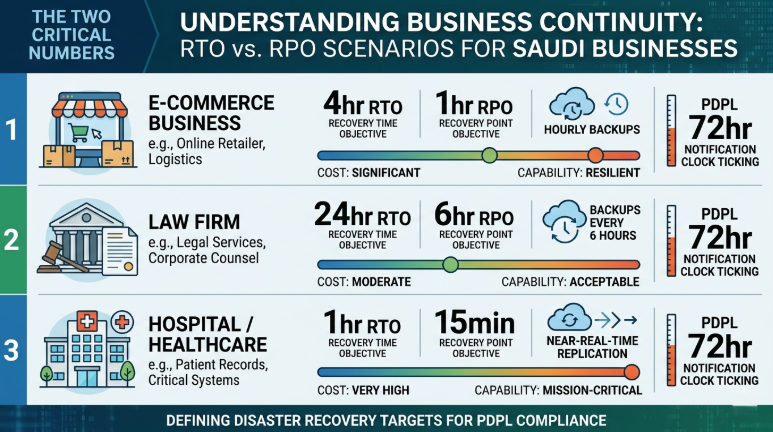
Disaster recovery planning is built around two metrics that define what recovery actually means for your specific business:
Recovery Time Objective (RTO)
RTO is the maximum time your business can be without a critical system before the operational or financial impact becomes unacceptable. For an e-commerce business with an active storefront, RTO might be four hours. For a law firm's document management system, 24 hours may be acceptable. For a hospital's patient records system, it might be one hour or less.
RTO drives the technology choices in your recovery plan. A four-hour RTO requires different infrastructure and a different budget than a 48-hour RTO. Defining it forces the business to have an honest conversation about which systems are genuinely critical and what downtime actually costs.
Recovery Point Objective (RPO)
RPO is the maximum amount of data loss your business can accept. If backups run every 24 hours and a failure occurs 23 hours after the last backup, the business loses up to 23 hours of data.
For a financial services company processing hundreds of transactions per hour, a 24-hour RPO is likely unacceptable. For a marketing agency's project management system, losing six hours of work may be manageable.
RPO drives backup frequency. A four-hour RPO requires backups running at least every four hours. A 24-hour RPO allows daily backups. Both cost and complexity increase as RPO decreases.
Every Saudi business should define RTO and RPO for each critical system before designing any recovery solution. Without these numbers, any backup solution is guesswork about what the business actually needs.
The Components of a Working Disaster Recovery Plan
System and Data Inventory
A disaster recovery plan cannot cover systems that have not been identified. The first step is documenting every system and data source the business relies on: servers, workstations, cloud applications, databases, file shares, and communication tools.
For each system, document what business functions it supports, who owns it, what data it holds, how it connects to other systems, and what the impact of losing it would be. This inventory is the foundation of the prioritisation that follows.
Backup Architecture
Best practice for Saudi businesses follows the 3-2-1 rule: maintain three copies of data, on two different types of storage media, with one copy stored offsite or in the cloud. The offsite copy is critical. A business that backs up to a device in the same office as the primary server loses both in a fire, flood, or theft.
Cloud backup is the most practical offsite solution for most Saudi businesses. Gulf-region cloud storage options from major providers satisfy data residency requirements while providing the geographic separation that makes offsite backup valuable.
Recovery Procedures Documentation
A backup without documented recovery procedures takes significantly longer to restore than it should, because the person doing it is figuring out the steps in real time during the worst possible moment.
Recovery documentation covers step-by-step instructions for restoring each critical system, the estimated time required for each restoration, the personnel responsible, the order in which systems should be restored when multiple are affected, and contact information for all relevant vendors and technical support.
This documentation must be stored somewhere accessible even when the primary office and its systems are unavailable. A printed copy in a secure location and a cloud-stored copy accessible from any device are the minimum.
Communication Plan
When a disaster occurs, multiple groups need timely information: leadership, affected staff, clients experiencing service disruption, and regulators. For PDPL-covered data breaches, SDAIA notification within 72 hours is a legal requirement.
The communication plan defines who communicates what to whom and when. Decisions made during an event produce delayed and inconsistent messages. Decisions made in advance and documented produce timely, appropriate communication that limits reputational damage.
Testing and Review
A disaster recovery plan that has never been tested is a document, not a plan. Testing reveals the gaps between what the plan assumes and what actually happens during recovery.
There are three testing levels. A tabletop exercise reviews the plan verbally with all relevant parties, working through scenarios without system changes. A partial test restores a non-critical system from backup to verify the process works. A full test restores all critical systems in a controlled environment to verify the complete recovery process and measure actual recovery times against RTO targets.
Saudi businesses should conduct tabletop exercises at least annually, partial restoration tests every six months, and full tests at least every two years. Any significant system change should trigger a review of relevant recovery procedures.
Cloud-Based Disaster Recovery for Saudi Businesses
Cloud infrastructure has significantly reduced the cost and complexity of disaster recovery for Saudi businesses that have adopted it.
In a cloud environment, infrastructure can be replicated across multiple availability zones automatically. Failover can be triggered in minutes rather than hours. Backup and restoration are managed through the cloud provider's tools. And cost scales with usage rather than requiring upfront hardware investment.
For Saudi businesses moving from on-premise to cloud, disaster recovery is one of the strongest practical arguments for the transition. A properly configured cloud environment has built-in redundancy that a single-server on-premise setup cannot match.
Gulf-region data centres from AWS (Bahrain), Google Cloud, and Microsoft Azure provide cloud infrastructure options for Saudi businesses with data residency requirements. Confirming that backup data is stored in an approved region is part of the architecture decision for PDPL compliance.
Key Takeaways
RTO defines how quickly critical systems must be restored. RPO defines how much data loss is acceptable. Both must be defined before designing any recovery solution.
The 3-2-1 backup rule is the practical standard: three copies of data, on two media types, with one copy offsite or in the cloud. A backup stored alongside the primary system provides no protection from fire or theft.
A disaster recovery plan that has never been tested is a document, not a plan. Tabletop exercises, partial restoration tests, and full recovery tests must all be completed and documented.
Recovery procedures must be stored somewhere accessible even when primary systems and the office are unavailable. A cloud-stored copy and a printed copy in a secure location are the minimum.
PDPL requires breach notification to SDAIA within 72 hours of discovering a personal data incident. A business without security monitoring will miss this window.
Cloud infrastructure with Gulf-region data centres provides significantly better recovery capability than single-server on-premise environments at a cost accessible to most Saudi SMEs.
Frequently Asked Questions
Q: How often should Saudi businesses test their disaster recovery plan?
A: Tabletop exercises should be conducted at least annually and after any major system change. Partial restoration tests, restoring a non-critical system from backup, should be conducted every six months. Full recovery tests in a controlled environment should be conducted at least every two years. Any significant change to the business's IT environment should also trigger a review of the relevant recovery procedures.
Q: What is the difference between backup and disaster recovery?
A: Backup is the creation and storage of copies of data at defined intervals. Disaster recovery is the complete process of restoring business operations after a disruptive event. Backup is one component of disaster recovery. A business that has backups but no documented recovery procedures, no tested restoration process, and no communication plan has backup but does not have disaster recovery. Many Saudi businesses make this assumption and discover the gap during an actual incident.
Q: How much does disaster recovery planning cost for a Saudi SME?
A: For a 20 to 50-person Saudi business, properly designed disaster recovery infrastructure including cloud backup with Gulf-region storage, documented recovery procedures, and annual testing typically costs between SAR 1,500 and SAR 5,000 per month depending on data volumes and recovery time targets. This compares against the average cost of a significant IT outage for a business of this size, which typically runs between SAR 50,000 and SAR 200,000 when staff downtime, lost revenue, and recovery costs are calculated.
Q: Is cloud backup compliant with Saudi PDPL data residency requirements?
A: Cloud backup using Gulf-region data centres satisfies the geographic proximity requirement for most PDPL use cases. For cross-border transfer compliance the relevant consideration is whether the cloud provider has a Data Processing Agreement that meets PDPL requirements and whether the destination country is on SDAIA's approved transfer list. Your IT partner should confirm data residency and transfer compliance in writing before deploying any cloud backup solution that holds personal data about Saudi residents.
Q: What should a Saudi business do immediately after a major IT failure?
A: The immediate priority is containment, not recovery. Disconnect affected systems from the network to prevent a malicious event from spreading further. Do not restart or power off servers without technical guidance, as this can destroy forensic evidence and make data recovery harder. Contact your IT support provider immediately. Document what you observe: which systems are affected, what error messages appear, and the approximate time of the failure. If personal data may have been compromised, the 72-hour PDPL notification clock starts from the moment the incident is confirmed.
Conclusion
Disaster recovery planning is not a project Saudi businesses complete once and forget. It is an ongoing practice that keeps pace with changes in the business's systems, data, and risk environment.
The businesses that handle IT disasters well are almost never those who respond most cleverly in the moment. They are the ones who made the right decisions months earlier: they defined recovery objectives, built the right backup infrastructure, documented recovery procedures, and tested the plan before they needed it.
The businesses that handle IT disasters poorly are almost always those who assumed they would figure it out when it happened. Real disasters are consistently harder, slower, and more expensive to recover from than expected.
Softriva provides disaster recovery assessment, planning, and implementation for Saudi businesses. Our managed backup and recovery services include Gulf-region cloud backup, recovery procedure documentation, regular testing, and 24-hour incident response support.
A free disaster recovery assessment reviews your current backup arrangements, identifies gaps between your current position and a working recovery capability, and gives you a clear picture of what building that capability would involve.
Get a Free Disaster Recovery Assessment at softriva.com


