
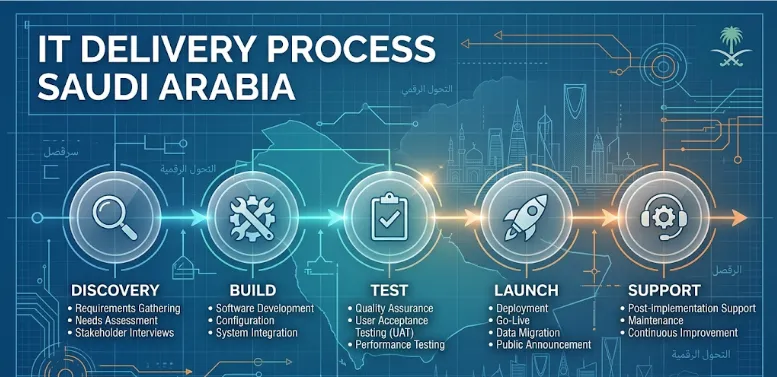
How a Structured IT Delivery Process Protects Saudi Businesses From Project Failure
Introduction
Most IT projects do not fail because of bad technology.
They fail because of missing process: a scope that was never clearly defined, requirements that changed without being formally documented, unrealistic timelines that nobody challenged, insufficient testing before go-live, or a post-launch period where the client was left with a system they did not fully understand and a vendor who had moved on to the next project.
In Saudi Arabia's IT market, project failure is common and consistently expensive. The businesses that avoid it are not necessarily working with larger budgets or more sophisticated technology. They are working with partners who follow a structured delivery process that addresses the root causes of project failure at each stage.
This guide explains what a structured IT delivery process looks like, what each stage protects against, and how to evaluate whether a potential IT partner has the process discipline to deliver what they promise.
Why IT Projects Fail in Saudi Arabia
The patterns of IT project failure in Saudi Arabia are consistent across industries and project types. Understanding them makes the value of structured process much clearer.
Undefined Scope
The most common cause of IT project failure is a scope of work that was never clearly defined. The client had a general idea of what they wanted. The vendor produced a proposal that described it in general terms. Both parties signed and started work with different mental models of what the final product would look like.
When the deliverable does not match the client's expectations, the client feels they were not delivered what they paid for. The vendor feels they delivered exactly what was agreed. Both are right, because the agreement was not specific enough to resolve the disagreement.
A structured delivery process prevents this by requiring a detailed, written scope of work before any development begins, with specific deliverables, acceptance criteria, and explicit exclusions.
Scope Creep Without Cost Control
Even well-defined projects encounter requests to add features or change requirements during delivery. When these additions are not formally managed, they accumulate into scope creep: the project becomes larger than planned without a corresponding adjustment to timeline or budget.
The vendor absorbs the additional cost in a fixed-price contract, which motivates them to cut quality elsewhere. Or the client absorbs it through budget overruns, which creates conflict and erodes the relationship.
A structured change control process prevents this by requiring any scope change to be formally documented, assessed for its impact on timeline and budget, and agreed by both parties before the change is implemented.
Insufficient Discovery
Many IT projects begin with a vendor proposing a solution before fully understanding the business problem it is meant to solve. The solution may be technically competent but not fit for the specific business context, workflow complexity, or user behaviour of the client.
A discovery phase that genuinely investigates the client's current systems, processes, data environment, user needs, and constraints produces a much more accurate solution design than one based on the client's initial description of what they think they want.
Poor Post-Launch Support
An IT project is not complete at go-live. Systems have bugs that only appear in production with real users and real data. Users need support as they adapt to new workflows. Configurations need adjustment as the system is used in ways that were not anticipated during development.
Vendors who treat go-live as the end of their engagement leave clients managing these inevitable post-launch challenges alone. The quality of the first 30 to 90 days after launch often determines whether a system is successfully adopted or quietly abandoned.
The Four-Stage IT Delivery Framework
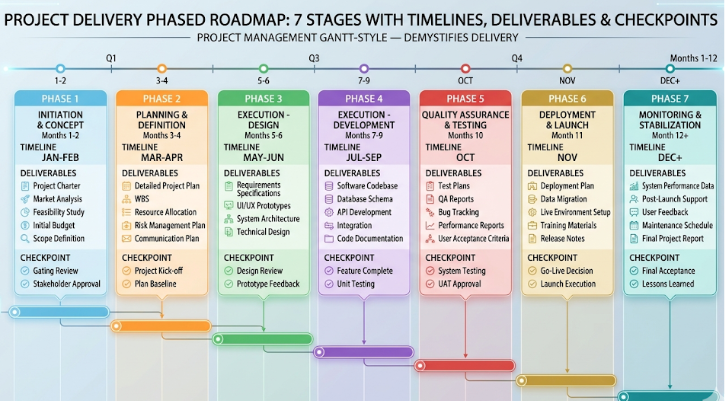
Softriva's delivery process follows four stages that address each of the failure patterns described above. This framework applies across all service areas: web development, data analytics, AI automation, and managed IT.
Stage 1: Discover
The Discover stage is the investment in understanding before any solution is designed or built.
In this stage, the Softriva team conducts a structured audit of the client's existing systems, processes, and data environment. For a web project, this means reviewing the current site performance, understanding the client's audience and conversion goals, and mapping the technical integrations required. For a data analytics project, it means auditing existing data sources, assessing data quality, and identifying the decisions the analytics output needs to support.
The Discover stage produces three things: a detailed understanding of the real problem to be solved, a solution design that addresses the actual business need rather than the initially stated one, and a project scope document with specific deliverables, timelines, budget, and exclusions that both parties have reviewed and agreed.
Many vendors skip or abbreviate this stage to move faster to billing. This is a false saving. Every hour spent in discovery that catches a misalignment prevents ten hours of rework later in the project.
Stage 2: Build
The Build stage is where the solution is designed and developed to the specification produced in discovery.
A structured build process includes regular client checkpoints (typically at the completion of each defined milestone), version control for all code and configuration, documented testing at each stage rather than only at completion, and a formal change control process for any requirements that need to change during development.
Client involvement during the build stage is important. Clients who review work at each milestone and provide timely, specific feedback experience significantly faster and smoother final delivery than those who are hands-off until the end and then provide extensive feedback on a nearly complete system.
For Saudi clients, the build stage also includes all Saudi-specific technical requirements: ZATCA compliance, Arabic language implementation, Hijri calendar handling, local payment gateway integration, and any sector-specific regulatory requirements identified in discovery.
Stage 3: Deploy
The Deploy stage covers the controlled release of the built system into the live environment, integration with existing systems and tools, and the intensive support period immediately after go-live.
A controlled deployment for a web project involves final testing in a staging environment, planned DNS cutover during low-traffic hours, performance monitoring immediately after go-live, and a defined escalation path for any critical issues that appear in the first 24 to 72 hours.
For a Saudi business deploying a ZATCA-integrated e-invoicing system or a SAMA-compliant financial platform, the deployment stage also involves regulatory compliance verification: confirming that the live system meets all applicable requirements before it begins processing real transactions.
The first two to four weeks after go-live are the highest-risk period of any IT project. Softriva provides intensive support during this period, with daily monitoring, rapid response to any issues, and the team fully available to the client before transitioning to standard managed service or support arrangements.
Stage 4: Scale
The Scale stage is where the delivered system is optimised, extended, and evolved as the business grows and as new needs emerge.
Technology is not a one-time purchase. A website built will need updates for search engine algorithm changes, new browser standards, and evolving user expectations. A data analytics system will need new dashboards as the business adds new product lines or expands to new markets. An AI automation system will need retraining as the data it learns from changes.
The Scale stage at Softriva involves regular performance reviews, proactive recommendations for improvements based on how the system is actually being used, and the ability to add new capabilities as the business's needs evolve, without the disruption and cost of starting from scratch.
Clients who engage Softriva for the Scale stage consistently report that having a partner who already understands their full system context makes new projects and enhancements significantly faster and less expensive than starting fresh with a new vendor.
How to Evaluate Whether a Vendor Has Process Discipline
When evaluating IT vendors, the quality of their delivery process is as important as their technical capability. Here are the specific questions to ask:
What does your discovery process look like? How long does it take, what does it produce, and what does the client need to provide?
How is scope documented before development begins? Can you show us an example scope of work document from a comparable project?
How do you handle scope changes during delivery? Walk me through your change control process with a specific example.
What does your post-launch support period look like? How long is it, what is included, and what is the transition to ongoing support?
How do you handle a situation where a delivered system does not meet the client's acceptance criteria?
Vendors with genuine process discipline will answer these questions specifically and confidently, from experience. Vendors without it will give vague answers or pivot to questions about technology rather than process.
Key Takeaways
Most IT project failures in Saudi Arabia are caused by process failures: undefined scope, unmanaged scope creep, insufficient discovery, and poor post-launch support.
A structured discovery stage produces a specific, agreed scope of work before any development begins. Every hour spent in discovery prevents ten hours of rework.
Change control is not bureaucracy. It is the mechanism that prevents scope creep from silently inflating project costs and eroding both the budget and the relationship.
The first 30 to 90 days after go-live are the highest-risk period of any IT project. Intensive post-launch support during this period determines whether a system is successfully adopted.
The Scale stage treats technology as an ongoing asset, not a one-time purchase. It delivers the optimisation, extension, and evolution that keeps systems performing as businesses grow.
Evaluating vendor process discipline requires specific questions about discovery, scope documentation, change control, and post-launch support. Vague answers signal process weakness.
Frequently Asked Questions
Q: How long does the Discover stage take for a typical Saudi IT project?
A: For a focused project such as a website rebuild or a single-workflow automation, discovery typically takes one to two weeks. For a more complex engagement covering multiple systems or a full digital transformation programme, discovery may take three to four weeks. The time invested in discovery is not overhead. It directly reduces risk in the build stage and produces a scope that both parties can hold each other accountable to.
Q: What happens if we discover mid-project that our requirements have changed?
A: Requirements changes during a project are managed through the formal change control process. When a change is identified, the team assesses its impact on the timeline and budget, documents the change clearly, and presents the client with specific options: accept the change with a timeline or budget adjustment, defer the change to a future phase, or remove something from the current scope to accommodate the new requirement. The client decides with full information about the trade-offs. No changes are implemented without formal agreement.
Q: What does post-launch support include and how long does it last?
A: Post-launch support covers bug fixes for issues that appear in the live environment (as distinct from new feature requests), performance monitoring, and response to questions from the client team as they use the new system. For standard web and digital projects, Softriva provides 30 days of intensive post-launch support included in the project scope. For managed IT and data analytics projects, post-launch transitions into an ongoing managed service arrangement. The terms of post-launch support are specified in the project contract, not left to be negotiated after go-live.
Q: How does the Scale stage differ from standard ongoing IT support?
A: Standard IT support is reactive: something breaks, you call, it gets fixed. The Scale stage is proactive and strategic. It involves regular performance reviews of delivered systems, proactive recommendations for improvements based on usage patterns and business changes, and the planned addition of new capabilities as the business grows. It is the difference between maintaining a system and actively improving it. Clients in the Scale stage receive a quarterly review session with the Softriva team covering performance metrics, recommended enhancements, and the technology roadmap for the next period.
Q: Can we start with a small project and expand if the first delivery goes well?
A: Yes, and this is often the most sensible approach for businesses that are evaluating a new IT partner. Softriva recommends starting with a focused, well-defined project that delivers clear, measurable value within a defined timeframe. This gives both parties direct experience of working together, establishes trust, and produces a result that builds the internal business case for the next investment. A small successful project is a better foundation for a long-term technology partnership than a large ambitious one that carries higher risk.
Conclusion
Technology does not fail Saudi businesses. Process does.
The IT projects that succeed consistently share a common characteristic: a delivery partner with the discipline to invest in proper discovery, maintain scope control, support clients through the full deployment, and stay engaged as the system evolves. These are process qualities, not technical ones.
The businesses that choose IT partners based primarily on technical credentials or price, without evaluating process quality, are consistently the ones that experience the project failures described at the start of this guide.
Softriva's four-stage delivery framework, developed and refined over 20 years of Saudi IT delivery, is built specifically to prevent the failure patterns that are most common in the Saudi market. Every project, from a small website to a full digital transformation programme, follows the same structured approach: Discover, Build, Deploy, Scale.
A free project discovery call is the most direct way to experience this process in practice. In 30 minutes, we will assess your project needs, ask the right questions, and give you an honest picture of what delivery would look like.

Start Your Project with a Free Discovery Call at softriva.com


