
IT Solutions for Construction and Contracting Companies in Saudi Arabia
Introduction
Saudi Arabia's construction sector is one of the most active in the world.
NEOM, Red Sea Project, Diriyah Gate, Qiddiya, and hundreds of supporting infrastructure projects are generating construction activity at a scale that is genuinely unprecedented in the Kingdom's history. Private sector construction, including residential development, commercial builds, and industrial facilities, is expanding simultaneously.
For Saudi construction and contracting companies, this scale of activity creates both significant opportunity and significant operational pressure. Managing a SAR 50 million construction project on a spreadsheet is possible. Managing five simultaneously, across multiple sites, with dozens of subcontractors, hundreds of workers, and complex procurement chains, is not.
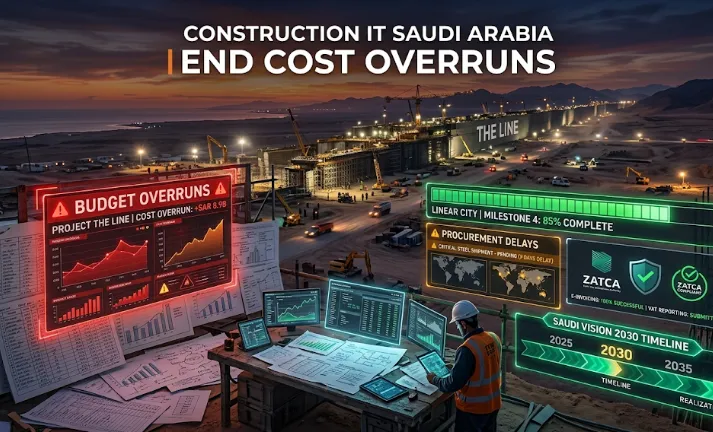
The gap between operational complexity and system capability shows up in the same ways across the industry: budget overruns that were not detected until they were large, site delays that cascaded into contract penalties, procurement errors that held up critical works, and disputes with clients over project status that could not be resolved because the documentation was incomplete.
This guide covers the specific IT systems that address the most costly operational problems for Saudi construction and contracting companies, what each system does, the Saudi-specific requirements they must meet, and how to prioritise investment.
The Operational IT Problems Saudi Construction Companies Face
No Real-Time Budget Visibility
Construction project budgets are under pressure from the first day. Material costs change. Work quantities vary from estimate. Subcontractor claims arrive unexpectedly. Change orders add scope without always adding budget clarity.
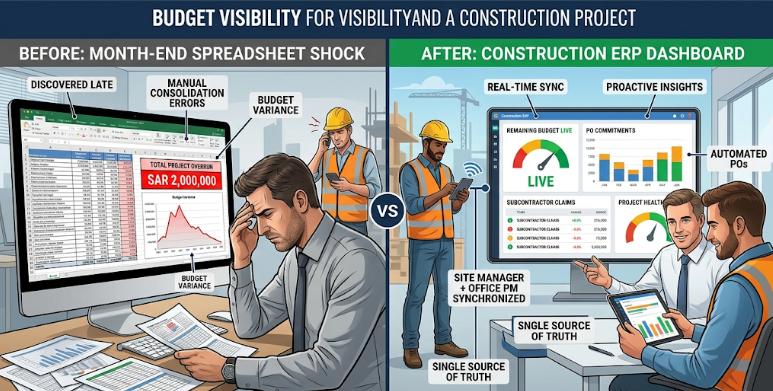
Without a system that tracks committed costs, actual spend, and remaining budget in real time, project managers discover budget problems when they reconcile spreadsheets at month end. By the time the overrun is visible, it has compounded for weeks. The window for corrective action has narrowed.
A project management system that tracks every purchase order, every subcontractor claim, and every change order against the budget in real time gives project managers the visibility to act when a variance is small rather than when it is unrecoverable.
Site Progress That Is Not Visible from the Office
On a large construction site, senior management and clients want to know: what percentage of the work is complete, where is the project against the programme, and are there any critical path activities at risk?
In a manually managed project, this information is assembled by the site team, transmitted to the project manager, formatted, and reported in a document that may be a week or two behind reality by the time it reaches the reader. Decisions made on this information are decisions made on a stale picture.
A connected project management system with site progress reporting by the foreman team, using a mobile app from any location on site, makes current progress data available to the project office in near real time. Project managers see variances as they develop. Clients receive accurate progress reports without the site team spending hours preparing documents.
Procurement Delays That Hold Up the Programme
Construction procurement is one of the most complex administrative functions in the industry. Materials must be specified, suppliers sourced, quotes compared, purchase orders raised, deliveries scheduled, and payments processed, all on timelines that are directly connected to the construction programme.
When procurement is managed through a combination of email, WhatsApp, and spreadsheets, delays occur when messages are missed, when approvals are not tracked, and when the connection between the procurement timeline and the construction programme is not visible to anyone with authority to accelerate it.
A procurement management system with approval workflows, supplier management, and direct integration with the project programme allows procurement teams and project managers to see which materials are due when, which orders are overdue, and which delivery delays will affect the critical path before they do.
Document Management Across Multiple Sites
A construction project generates thousands of documents: drawings, specifications, RFIs (Requests for Information), submittals, method statements, inspection records, variation orders, and correspondence. Managing these across multiple active sites, ensuring that the most current drawing is always the one in use on site, and maintaining the complete project record for contract dispute resolution are genuine operational challenges.
Construction projects in Saudi Arabia have faced contract disputes where the outcome turned on which version of a drawing was in use at a critical time, and the document management was not good enough to prove it. The cost of losing these disputes consistently exceeds the cost of proper document management many times over.
The IT Systems Saudi Construction Companies Need
1. Construction Project Management System
A construction project management system is the operational hub for managing one or more active projects. It covers work breakdown structure and programme management, budget tracking against the cost plan, daily and weekly progress reporting, subcontractor management, and RFI and submittal workflows.
Common platforms used in Saudi construction include Procore, Aconex (now Oracle Construction), Microsoft Project connected to a Power Apps reporting layer, and construction-specific ERP modules from SAP and Oracle.
For Saudi construction companies, the project management system needs to handle multiple simultaneous projects with shared resources (equipment, management staff) across them, produce reports in formats required by Saudi government clients and joint venture partners, support Arabic-language interfaces for site staff who work in Arabic, and connect to the financial system for budget versus actual reporting.
2. Construction ERP for Finance and Procurement
A construction-specific ERP connects project management to finance and procurement in a single system. Budget allocations in the project management module flow to budget controls in the finance module. Purchase orders raised against a project automatically commit budget and update the remaining available balance. Subcontractor payment certificates trigger approval workflows and payment processing.
For Saudi construction companies with ZATCA Phase 2 obligations, the ERP must generate ZATCA-compliant invoices for all billable transactions and process incoming subcontractor invoices through ZATCA-compliant receipt workflows.
Construction ERP in Saudi Arabia also needs to handle the specific payment structures common in Saudi government and semi-government contracts: milestone-based billing, retention management (typically 5 to 10 percent of contract value held back until completion), and performance bond tracking.
3. Document Control System
A document control system maintains a single controlled repository for all project documents, with version control, distribution tracking, and access rights that ensure only authorised people can access or modify specific document types.
For a Saudi construction project, the document control system needs to manage Arabic and English documents in the same repository, maintain the complete history of each document revision with timestamps and user records, provide a site access point (through a mobile app or a web interface accessible from site devices) so that site staff always have access to the current approved version of every drawing and specification, and produce the complete project record in a format suitable for contract closeout and dispute evidence.
4. Site Workforce and Attendance Management
Saudi construction sites typically employ large workforces with a mix of Saudi national and expatriate workers from multiple countries. Managing attendance, working hours, overtime, and the associated payroll, GOSI, and WPS compliance manually for 500 or more workers is a major administrative burden and a significant source of error and compliance risk.
A workforce management system with biometric or RFID attendance recording, connected to the payroll system, automates attendance tracking, overtime calculation, and the generation of WPS-compliant payroll files. Iqama expiry tracking for expatriate workers alerts HR before a worker's legal status lapses, which is a significant compliance risk on Saudi construction sites.
5. Equipment and Asset Tracking
Heavy construction equipment represents a substantial capital investment. Tracking where equipment is, whether it is in use or idle, what its maintenance status is, and how its operating cost compares to rental alternatives requires more than a manual asset register.
An equipment management system with GPS tracking provides real-time location of all tracked equipment across multiple sites. Utilisation reporting shows which equipment is earning its cost and which is idle. Maintenance scheduling based on operating hours prevents unexpected breakdowns. And equipment cost allocation to specific project codes provides the data needed for accurate project cost reporting.
Saudi-Specific Construction IT Requirements
Construction IT in Saudi Arabia must account for several sector and market-specific requirements:
Muqeem and GOSI integration: the workforce management system must be able to produce reports in formats required for Muqeem verification of expatriate worker status and GOSI monthly contribution reporting.
Nitaqat compliance: Saudi construction companies with significant workforces must maintain their Saudisation percentage within the required Nitaqat band. The HR and payroll system should track the Saudi national percentage in real time and alert management when it approaches a compliance threshold.
Vision 2030 project reporting: Saudi government construction projects, particularly those connected to giga-projects, have specific digital reporting requirements for project progress, quality, and compliance. Some require connection to government project management platforms. The construction project management system should be able to produce reports in the formats these clients specify.
Arabic-language documentation: all formal project documents (contracts, RFI responses, variation orders, inspection certificates) must be available in Arabic where required by the client or by regulation. The document control system must handle Arabic-language documents with proper right-to-left formatting.
ZATCA Phase 2 for all project invoicing: every invoice raised against a Saudi construction project must be ZATCA Phase 2-compliant. The construction ERP must generate invoices in the required XML format and submit them to the ZATCA portal through the API integration.
Key Takeaways
Real-time budget tracking against committed costs, purchase orders, and subcontractor claims is the most direct IT improvement for Saudi construction companies. Budget overruns detected early are recoverable. Those detected at month-end may not be.
Site progress data reported from mobile devices by site staff makes current project status visible to the project office in near real time, eliminating the reporting delay that makes weekly reports stale.
Procurement management connected to the construction programme allows project managers and procurement teams to see which material deliveries will affect the critical path before delays happen.
Document control with version management and mobile site access ensures that the drawing in use on site is always the current approved version. This protects the company in contract disputes where the document record is the evidence.
Workforce management with biometric attendance, WPS-compliant payroll output, and Iqama expiry tracking addresses the compliance complexity of large multi-national construction site workforces.
Saudi construction IT must handle ZATCA Phase 2 invoicing, Nitaqat tracking, Muqeem integration, Arabic-language documentation, and government project reporting formats from the design stage.
Frequently Asked Questions
Q: Is Procore suitable for Saudi construction companies?
A: Procore is used by a number of large Saudi construction and contracting companies and has been adapted for the Saudi market in several respects. Its strengths are in project management, document control, and site reporting. Its limitations for Saudi use include the need for localisation for Arabic-language workflows, the requirement for integration with Saudi-specific finance and payroll systems for full construction ERP capability, and the need for ZATCA compliance integration which requires additional configuration. For a Saudi construction company evaluating Procore, the key questions are which integration work is needed to connect it to Saudi-compliant finance and payroll, and whether the implementation partner has done this before.
Q: How do Saudi construction companies handle project reporting to government clients?
A: Requirements vary significantly by client and project. Saudi Aramco, NEOM, and Royal Commission projects each have specific reporting formats and often require connection to the client's own project management platform. The most practical approach is to confirm the specific reporting requirements with each government client before selecting the project management system, rather than after. Systems that export data to multiple formats or that have open API connections are more flexible for meeting diverse client reporting requirements than closed systems with fixed output formats.
Q: What is the typical cost of a construction project management system for a Saudi mid-sized contractor?
A: For a Saudi contractor managing three to ten simultaneous projects with a workforce of 100 to 1,000, a construction project management system implementation (including the software licence, implementation, configuration, and training) typically costs between SAR 80,000 and SAR 300,000 depending on the platform selected and the complexity of the integrations required. Annual software licence costs typically run SAR 20,000 to SAR 80,000 after implementation. These figures should be compared against the cost of a single significant cost overrun or contract dispute that proper project visibility would have prevented.
Q: How do we manage construction site workers who have limited technology literacy?
A: Site-level technology adoption is one of the most common implementation challenges in construction IT. The most effective approaches are: mobile apps with minimal required inputs (a foreman reports today's work completion in two taps rather than filling a form), biometric devices that require no digital input from workers at all, visual interfaces with icons rather than text for workers with limited literacy, and a site champion model where one person per crew is trained as the first point of support for digital tools. Forcing complex digital workflows on site staff without these adaptations consistently produces low adoption and poor data quality.
Q: Does construction IT help with winning tenders in Saudi Arabia?
A: Increasingly, yes. Saudi government procurement and joint venture qualification processes are asking for evidence of digital project management capability as part of supplier prequalification. Companies that can demonstrate a structured project management system, a document control system with full version history, and real-time budget tracking are presenting a more credible operational capability than those still describing manual processes. Vision 2030-connected projects in particular are trending toward digital capability requirements in their supplier qualification criteria.
Conclusion
Saudi Arabia's construction boom is creating the conditions for rapid growth for well-run contracting companies. But the scale of opportunity also amplifies the consequences of poor operational management. A cost overrun on a SAR 10 million project is a problem. The same percentage overrun on a SAR 100 million project is a crisis.
The IT systems that give construction companies real-time budget visibility, current site progress data, controlled procurement workflows, and complete project documentation are the operational infrastructure that makes growth manageable rather than chaotic.
The investment in these systems is consistently recovered within the first year through avoided overruns, reduced rework, faster dispute resolution, and improved client reporting capability. For companies competing for Vision 2030-connected projects, digital operational capability is becoming a qualification requirement, not just a competitive advantage.
Softriva works with Saudi construction and contracting companies to implement the technology infrastructure that supports project management at scale. Our experience covers construction project management systems, procurement integration, ZATCA-compliant construction ERP, and the workforce management systems that handle the compliance complexity of large Saudi construction site workforces.
A free consultation gives you a clear picture of which operational problems in your current construction management approach technology would address most directly.
Book a Free Construction IT Consultation at softriva.com


