
IT Solutions for Saudi Startups and Scale-ups: Build Right From the Start
Introduction
Saudi Arabia's startup ecosystem is growing at a pace that was not predicted even five years ago.
Monshaat's support programmes, the Jeddah and Riyadh startup communities, KAUST Innovation District, and a growing base of VC activity have created conditions where early-stage businesses are launching and scaling faster than they used to. The Vision 2030 economic diversification agenda is creating new market opportunities in sectors that were previously dominated by government or large established players.
For a Saudi startup founder, the technology decisions made in the first 12 to 24 months have a disproportionate effect on the next three to five years. A startup that builds on a poorly chosen tech stack, launches with a website that cannot support growth, or skips foundational data infrastructure spends significantly more later to undo those decisions than it would have spent making better ones at the start.
This guide covers what IT a Saudi startup needs at each stage of its journey, what to spend money on early, what to defer, what mistakes to avoid, and how to build a technology foundation that supports scale rather than fights it.
The Most Expensive IT Mistakes Saudi Startups Make
Before covering what to do, it helps to understand what most founders get wrong. These are the patterns that create the most expensive technology problems for Saudi startups:
Overbuilding Too Early
The most common mistake is building more technology than the business currently needs. A startup with 50 customers does not need a custom-built ERP system. A pre-revenue business does not need a machine learning recommendation engine. These investments consume budget and time that should be going into finding and serving customers.
The right technology for a startup is the minimum that supports current operations reliably and positions the business to scale when it is needed, not the most impressive system that could theoretically be built.
Choosing Technology for the Wrong Reasons
Founders sometimes choose technology based on what they have heard other startups use, what sounds impressive in a pitch deck, or what a single developer they know is comfortable with. None of these are good selection criteria.
Technology should be chosen based on what the business actually needs to do, what will cost the least to operate and maintain at your current stage, what your team can use without extensive training, and what can scale without a full rebuild when your business grows.
Skipping the Legal and Compliance Foundation
Saudi startups frequently underinvest in the digital compliance foundation: ZATCA-compliant invoicing from the first transaction, PDPL-compliant handling of customer data from the first customer, and cybersecurity controls appropriate for the data the business holds.
Starting without these foundations and retrofitting them later is significantly more expensive and more disruptive than building them in from the beginning. The PDPL applies from the first moment you hold personal data about a Saudi resident. ZATCA compliance applies from the first VAT invoice. Neither has a startup exemption.
Underestimating the Website's Commercial Role
Saudi startup founders often deprioritise the website in favour of social media presence, reasoning that most of their early business will come through WhatsApp and Instagram anyway. This is often true in the very early stages.
The problem arrives when the business starts scaling and needs to present credibly to investors, larger clients, or international partners. A weak website creates an immediate credibility gap that is disproportionately damaging for a business trying to move upmarket. Rebuilding a website during a critical growth phase is disruptive and costly. Building it right initially is not expensive if done with growth in mind.
The IT Stack a Saudi Startup Needs at Each Stage
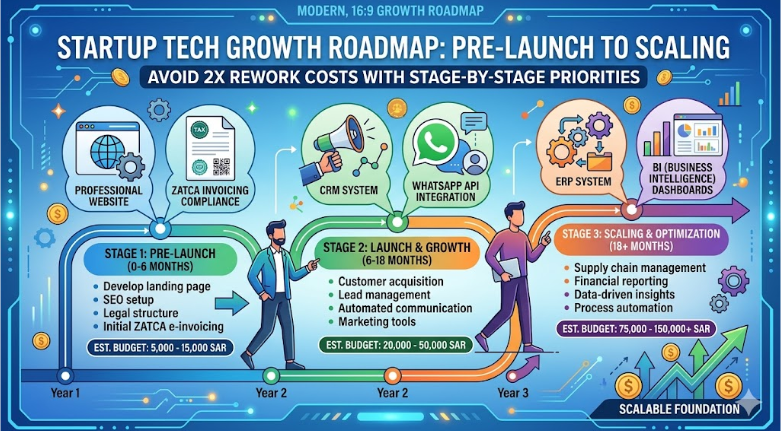
Stage 1: Pre-Launch and Early Revenue (0 to 12 Months)
At this stage, the priority is speed to market, compliance from day one, and a digital presence that can handle basic business development.
The minimum viable IT stack for a Saudi startup launching includes:
A professional website: Not a template with stock photos, but a site that clearly communicates what the business does, who it is for, why it is credible, and how to get in touch. Fast, mobile-first, with Arabic and English support. This does not need to be expensive, but it does need to be done correctly.
Business email on a custom domain: operating from a Gmail or Hotmail address immediately signals a lack of professionalism to Saudi B2B buyers. A custom domain email is a basic credibility signal that costs almost nothing.
Cloud hosting: a reliable cloud hosting environment for the website with adequate performance and security. Shared hosting is acceptable at this stage if the website is simple. A VPS is worth the small additional cost if the website will handle form submissions or any dynamic content.
ZATCA-compliant invoicing: from the first VAT-registered transaction. A simple cloud accounting tool with ZATCA e-invoicing integration is sufficient at this stage. QuickBooks, Zoho Books, or similar platforms with Saudi compliance modules work well.
WhatsApp Business App: at this stage, the free WhatsApp Business App is appropriate. Set up a business profile, configure quick replies, and use labels to organise incoming conversations. This is sufficient for low message volumes.
Google Analytics 4: free, takes 30 minutes to set up, and gives you the data needed to understand where your website visitors come from and what they do when they arrive. There is no excuse for not having this from day one.
Stage 2: Growth Phase (12 to 36 Months)
As the business grows past the initial customer base, manual systems start to fail and the need for more structured technology becomes clear.
The IT priorities at this stage are:
CRM system: when you have more than 50 active prospects and customers, tracking them in a spreadsheet or WhatsApp labels produces errors and loses relationships. A CRM (Zoho CRM, HubSpot, Salesforce depending on budget and complexity) centralises customer data, tracks pipeline, and enables the sales activity management that a growing team needs.
WhatsApp Business API: when message volume exceeds what one person can manage, or when the business needs to operate outside one person's working hours, the transition to WhatsApp Business API becomes necessary. This enables multi-agent handling, automation flows, and CRM integration.
HR and payroll system: once the team reaches 10 or more people, managing payroll, leave, and employment records manually creates compliance risk. A basic HRMS with GOSI integration, WPS-compliant payroll output, and leave management is the right investment at this stage.
Basic BI reporting: connecting your CRM, accounting system, and website analytics into a simple dashboard gives leadership current visibility into the numbers that matter. This does not need to be complex at this stage. A connected Google Looker Studio dashboard can provide significant value with relatively low implementation cost.
Cybersecurity baseline: multi-factor authentication on all business accounts, endpoint security on all staff devices, and a documented password management policy. These should be in place before, not after, a security incident.
Stage 3: Scale-up (36 Months and Beyond)
At scale-up stage, the business is operating at a complexity level where technology choices have significant operational and commercial consequences.
The IT priorities at this stage are:
ERP system: connecting finance, operations, inventory or project management, and HR into a single system. The right time to implement ERP is when the cost of disconnected systems (manual data transfer, reconciliation errors, management overhead) exceeds the cost of the ERP itself.
Data warehouse and advanced analytics: a structured data environment that connects all operational data sources into a single layer for reporting and analysis. This enables the predictive modelling, customer segmentation, and operational analytics that drive scale-up decision quality.
API integration layer: as the business accumulates specialist tools (CRM, ERP, e-commerce, accounting, HR, communication platforms), building a structured integration layer between them reduces manual data transfer and improves data consistency across the business.
Advanced cybersecurity: as the business grows, its attack surface grows with it. Endpoint detection and response, security monitoring, penetration testing, and formal incident response planning become necessary investments rather than optional ones.
Saudi-Specific Startup IT Requirements
Saudi startups face specific requirements that international startup guides often overlook:
Maroof registration: most Saudi B2B clients and government bodies check a supplier's Maroof profile before engaging. An up-to-date Maroof registration with correct category and contact information is a basic credibility requirement.
Arabic-first digital presence: Saudi customers, investors, and partners expect to engage in Arabic. A startup that operates only in English limits its addressable market and its ability to build local trust.
PDPL from day one: if your startup collects any personal data about Saudi residents, whether customer names, email addresses, or usage data, PDPL applies immediately. Build compliant data handling practices into your systems from the start.
Saudisation planning: startups planning to grow their teams need to understand Nitaqat requirements early. The categories and thresholds affect hiring strategy and should be factored into HR system design from the beginning.
Key Takeaways
The most expensive IT mistake Saudi startups make is overbuilding too early. The right technology is the minimum that supports current operations and positions for scale when needed.
ZATCA compliance, PDPL data handling, and cybersecurity basics are not optional for startups. They apply from the first transaction and the first customer record.
A professional website that communicates clearly in Arabic and English is a foundational credibility asset, not a luxury. Building it correctly from the start is significantly cheaper than rebuilding during growth.
The three IT stages for Saudi startups are: minimum viable stack (pre-launch), structured growth systems (12 to 36 months), and scale-up infrastructure (beyond 36 months). Each stage builds on the last.
WhatsApp Business API becomes necessary when message volume exceeds one person's capacity or when the business needs to operate outside business hours. It is a growth stage investment, not a launch stage one.
Saudi-specific startup requirements include Maroof registration, Arabic-first digital presence, PDPL compliance, and Saudisation planning in the HR system design.
Frequently Asked Questions
Q: How much should a Saudi startup budget for IT in its first year?
A: A realistic first-year IT budget for a Saudi startup covers a professional website (SAR 8,000 to SAR 25,000 depending on complexity), cloud hosting (SAR 300 to SAR 800 per month), business email and productivity tools (SAR 50 to SAR 150 per user per month on Microsoft 365 or Google Workspace), a basic cloud accounting system with ZATCA compliance (SAR 200 to SAR 500 per month), and basic cybersecurity (SAR 100 to SAR 300 per user per month for endpoint protection and MFA tools). Total first-year technology cost for a 5-person startup typically runs between SAR 40,000 and SAR 90,000 including the website build.
Q: Should a Saudi startup build a custom app or website, or use off-the-shelf tools?
A: Start with off-the-shelf tools for everything that does not require custom functionality. Custom development is expensive to build and expensive to maintain. Use it only for the parts of the business where your specific requirements cannot be met by existing platforms. A startup that builds a custom CRM instead of using Zoho or HubSpot is spending development budget on a problem that has already been solved. Reserve custom development for the parts of your product that are genuinely differentiated.
Q: When is the right time for a Saudi startup to implement a CRM?
A: Implement a CRM when you have more active prospects and customers than one person can reliably track without a system. For most startups, this threshold falls somewhere between 30 and 100 active relationships. Earlier implementation is not harmful, it just requires less of the CRM's capability. Later implementation risks losing relationships and pipeline visibility that have already accumulated, because the data that should have been in the CRM is instead scattered across WhatsApp, email, and spreadsheets that nobody has time to consolidate.
Q: How do we choose between Zoho, HubSpot, and Salesforce for a Saudi startup CRM?
A: For most Saudi startups, Zoho CRM is the most practical choice at early stage. It offers the best price-to-capability ratio, has Saudi-specific localisation including Arabic interface options, and integrates with Zoho's broader business suite (accounting, HR, email, campaigns). HubSpot is strong for startups with a strong inbound marketing focus and offers a free tier that covers basic CRM functionality. Salesforce is appropriate for startups that expect to grow rapidly into complex enterprise sales processes, but its cost and implementation complexity make it excessive for most early-stage businesses.
Q: Does a Saudi startup need to register with SDAIA for PDPL compliance?
A: Businesses processing personal data do not need to register with SDAIA as a standard requirement, but they must comply with the PDPL's obligations from the moment they hold personal data. The practical compliance requirements for a startup are: having a privacy policy that meets PDPL requirements, having a documented legal basis for each type of personal data processed, implementing appropriate security controls for the data held, and having a process for handling data breach notifications. These requirements apply regardless of company size or stage.
Conclusion
Saudi Arabia's startup ecosystem is producing businesses with genuine ambition and market potential. The ones that succeed long-term are not necessarily those with the most innovative ideas. They are the ones that build the operational foundations (including the technology foundations) that allow good ideas to be executed reliably and scaled efficiently.
The technology decisions made in the first year of a Saudi startup's life have consequences that last three to five years. Building correctly from the start is significantly cheaper than rebuilding under the pressure of growth. Compliance from day one is significantly less disruptive than retrofit compliance during a fundraise or a major client onboarding.
Softriva works with Saudi startups and scale-ups at every stage: from first website and basic digital setup through CRM implementation, data infrastructure, and the advanced analytics and automation systems that support scale. Our team understands the Saudi startup context and the specific compliance requirements that Saudi founders need to build around from the beginning.
A free startup technology consultation gives you a clear picture of what your business needs at its current stage, what to defer, and what a realistic IT investment looks like.

Build Your Startup IT Stack with Softriva at softriva.com


