
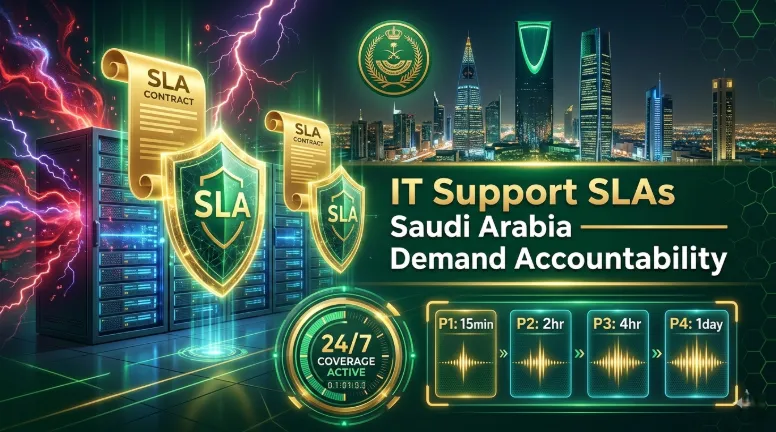
IT Support SLAs in Saudi Arabia: What to Demand from Your IT Provider
Introduction
Most Saudi businesses sign IT support contracts without reading them carefully enough.
The contract describes 'comprehensive IT support' in general language. It mentions that the provider will respond 'promptly' to issues. It may reference business hours without defining them. It does not specify what happens when a critical system goes down at 9pm on a Wednesday, how long the provider has to fix it, or what the client receives if the provider fails to meet their commitments.
This vagueness is not accidental. A contract with no measurable commitments cannot be used to hold a provider accountable. When things go wrong, the provider has maximum flexibility to define their obligations narrowly. The client absorbs the cost of every delay.
A Service Level Agreement (SLA) is the section of an IT support contract that converts general promises into specific, measurable commitments. A good SLA protects your business. A weak or absent SLA protects your provider.
This guide explains what a proper IT support SLA must include for a Saudi business, how to evaluate the SLA in any contract you are offered, and what to do when a provider cannot or will not commit to specific standards.
What a Service Level Agreement Actually Is
A Service Level Agreement is a documented commitment between a service provider and a client that defines the expected standard of service, how it will be measured, and what happens when it is not delivered.
In IT support, an SLA covers four core areas:
Response time: how quickly the provider acknowledges that an issue has been reported.
Resolution time: how quickly the provider resolves the issue completely.
Availability: what hours and days the IT support service operates.
Remedies: what the client receives when the provider fails to meet the agreed standards.
Without all four of these elements, what looks like an SLA is actually a set of aspirations. Any of these four elements missing from a contract is a specific gap the client will feel during an incident.
The IT Issue Priority Framework
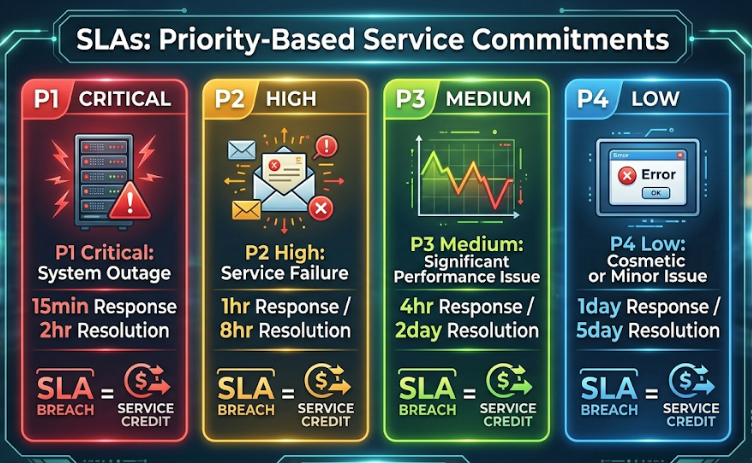
Not all IT issues are equal. A laptop keyboard issue is not the same as a server outage that has stopped all business operations. A properly structured SLA defines different priority levels and different response and resolution time commitments for each.
A standard four-level priority framework for Saudi business IT support works as follows:
Priority 1: Critical
Definition: a complete outage of a system that is essential to business operations. Examples include server failure that prevents all staff from working, a cyberattack that has shut down systems, a website outage during a major sales period, or a POS system failure that prevents all transactions.
Appropriate SLA standard: response within 15 to 30 minutes, resolution or meaningful workaround within two to four hours, 24 hours a day, seven days a week coverage.
A Saudi business that only has IT support during business hours is fully exposed to critical incidents at any other time. If your business depends on systems that must be available outside 8am to 5pm on weekdays, your IT support must cover those hours.
Priority 2: High
Definition: a significant issue that affects a material number of staff or an important business function but does not completely stop operations. Examples include a key application crashing for a department, email delivery failures, or network slowness affecting productivity across the office.
Appropriate SLA standard: response within one hour during business hours, resolution within four to eight business hours.
Priority 3: Medium
Definition: an issue affecting one or a small number of staff members but with a workaround available. Examples include a single workstation failure where the employee can use another device, a printer issue in one location, or a software configuration problem for one user.
Appropriate SLA standard: response within two to four business hours, resolution within one to two business days.
Priority 4: Low
Definition: a non-urgent request or minor issue with no immediate operational impact. Examples include new user account setup, software installation requests, and general IT queries.
Appropriate SLA standard: response within one business day, resolution within three to five business days.
The Coverage Hours Question
SLA response times are only meaningful relative to the coverage hours they apply to.
A '30-minute response time for critical issues' means very different things depending on whether it applies 24 hours a day, seven days a week, or only between 8am and 5pm on weekdays.
For most Saudi businesses, the critical question is what happens outside business hours. Saudi business culture involves significant evening and weekend activity. An e-commerce site can go down at 11pm on a Thursday, which is effectively Friday morning in the Saudi working week. A hospitality business has peak operational hours in the evening.
Before signing any IT support contract, confirm in writing: what are the covered hours, what is the response time for critical issues outside those hours, and what is the additional cost (if any) for out-of-hours emergency response.
A provider who cannot offer 24/7 critical incident response is a provider who is not appropriate for businesses with operational systems that must be available outside business hours.
What SLA Remedies Must Cover
An SLA without a remedy mechanism is an aspirational document. A remedy is what the client receives when the provider fails to meet a committed standard.
Common remedy structures in IT support SLAs include:
Service credits: a reduction in the monthly support fee for each breach of the SLA. For example, one day of service credit for each hour beyond the committed resolution time for a Priority 1 incident.
Right to escalate: a defined escalation process that requires senior management involvement when SLA standards are missed, rather than leaving the issue with the same team that has already failed to resolve it.
Termination rights: the right to exit the contract without penalty if SLA standards are repeatedly missed within a defined period.
If a contract offers no remedy for SLA failure, ask directly what the provider will do when they miss their commitments. If the answer is 'we will try harder next time,' the SLA is not a commitment. It is a description of intentions.
Escalation Procedures
Every IT support relationship will eventually face an incident that takes longer than expected to resolve. The escalation procedure defines what happens at that point.
A proper escalation procedure specifies: after how long the incident is escalated to a senior engineer, after how long it is escalated to management, who the escalation contacts are on both sides (your business and the provider), what additional resources the provider commits to bringing in when escalation is triggered, and how frequently updates are provided during an escalating incident.
Without a documented escalation procedure, a business experiencing a prolonged outage has no structured mechanism to apply pressure for faster resolution. The incident manager at the provider has no trigger to bring in additional resources or management attention.
Reporting and Transparency
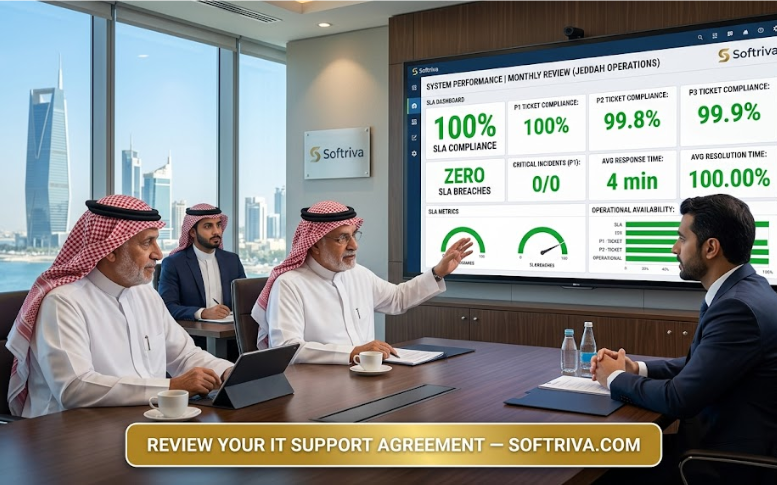
A good IT support SLA includes a reporting commitment. The provider delivers a regular (monthly or quarterly) report covering:
Total ticket volume by priority level
Average response and resolution times versus SLA targets
SLA breach incidents and the reasons for each breach
Recurring issue patterns that indicate underlying infrastructure problems
Recommended actions to reduce future incident volume
This reporting serves two functions. It holds the provider accountable with objective data rather than subjective assessments. And it gives your business actionable information about the state of your IT environment.
Providers who resist the reporting commitment do so because they know the data will reveal performance gaps. A provider comfortable with full transparency has confidence in their service delivery.
Saudi-Specific SLA Considerations
IT support SLAs for Saudi businesses need to account for several market-specific factors:
Arabic-language support: if a significant portion of your staff require IT support in Arabic, this should be a specified requirement in the SLA. Response times in Arabic should be the same as response times in English. A provider who offers faster service in English than in Arabic is providing unequal service to part of your team.
Saudi working week: the Saudi working week is Sunday to Thursday in most organisations. SLA business hours should be defined around the Saudi calendar, not a Western Monday to Friday assumption. Friday and Saturday public holidays should be addressed specifically in the coverage terms.
Ramadan working hours: many Saudi businesses operate on reduced hours during Ramadan. If this affects your IT support requirements, it should be addressed in the SLA rather than left to informal arrangement.
On-site response capability: for issues that require physical presence (hardware failures, network infrastructure problems, on-site security incidents), the SLA should specify the on-site response time and the geographic coverage. A provider based outside your city cannot offer the same on-site response time as a locally based team.
Key Takeaways
A Service Level Agreement must define four things: response time, resolution time, coverage hours, and remedies for failure. Any of these missing creates a gap the client absorbs during incidents.
A four-level priority framework (Critical, High, Medium, Low) with different response and resolution targets for each is the foundation of a structured IT support SLA.
24/7 critical incident coverage is not a luxury. Saudi businesses with operational systems that must be available outside business hours have no protection without it.
SLA remedies must be specific and enforceable: service credits, escalation rights, or termination rights. A provider who offers no remedy for SLA failure is making aspirational promises, not contractual commitments.
Monthly SLA performance reporting holds providers accountable with data rather than subjective impressions and gives the client actionable information about their IT environment.
Saudi-specific SLA requirements include Arabic-language support parity, Saudi working week coverage definitions, Ramadan hours arrangements, and on-site response time commitments from a locally based team.
Frequently Asked Questions
Q: What is a reasonable SLA response time for a critical IT issue affecting a Saudi business?
A: For a Priority 1 critical incident (complete operational outage), a response time of 15 to 30 minutes is the appropriate standard for a business with 24/7 support coverage. This means a qualified engineer acknowledges the incident and begins working on it within that window, not just that an automated ticket confirmation is sent. For resolution, a commitment of two to four hours for a workaround and a defined timeline for full resolution is reasonable for most critical incident types.
Q: Can we negotiate SLA terms with an IT support provider?
A: Yes, and you should. Most IT support providers offer standard contract terms as a starting point, not as a non-negotiable position. The areas most open to negotiation are coverage hours (adding evening or weekend coverage if the standard package does not include it), remedy terms (increasing the service credit for SLA breaches), and reporting frequency. Providers who refuse to negotiate any SLA term are communicating that their standard terms are set to minimise their obligations. That is a signal about how the relationship will work when problems arise.
Q: What should we do when our IT provider misses an SLA commitment?
A: Document the incident in writing: when the issue was reported, when the response was received, when resolution was achieved, and the total time from report to resolution compared to the SLA commitment. Submit a formal written record of the breach and invoke the remedy mechanism specified in the contract. If the provider's remedies process is not responsive, escalate to senior management on both sides. Repeated SLA breaches without satisfactory remediation are grounds for contract termination under most properly drafted IT support agreements.
Q: How do we know if our current IT support contract has a real SLA?
A: Review your contract specifically for the following: defined response times by issue priority, defined resolution times by issue priority, a clear definition of business hours and out-of-hours coverage, a documented remedy for SLA failure, and a reporting commitment. If any of these are absent or described in vague terms ('reasonable efforts,' 'as quickly as possible,' 'best endeavours'), the contract does not contain a functional SLA. You are receiving general IT support with no enforceable service standard.
Q: Does Softriva offer a documented SLA for its managed IT services?
A: Yes. Softriva's managed IT service agreements include a documented SLA covering Priority 1 through Priority 4 response and resolution times, 24/7 critical incident coverage, a defined escalation procedure, monthly performance reporting, and service credit remedies for SLA breaches. We provide the full SLA documentation for review before contract signing. We are not aware of any other position being reasonable for a Saudi business entering a managed IT services relationship.
Conclusion
An IT support contract without a proper SLA is a contract that protects the provider, not the client. It gives a provider maximum flexibility to define their obligations narrowly and leaves the client absorbing the cost of every delay, every missed response, and every prolonged outage.
Saudi businesses that have experienced poor IT support almost always discover that the contract they signed contained no enforceable commitments. The lessons are expensive ones.
The solution is straightforward: before signing any IT support agreement, verify that it contains specific, measurable commitments for response time, resolution time, coverage hours, and remedies. If any of these are absent, ask directly for them to be added. A provider who cannot commit to specific standards is communicating their expected performance level.
Softriva provides managed IT services to Saudi businesses under a fully documented SLA covering all four commitment types. Our Jeddah-based team offers Arabic and English support with documented response times, escalation procedures, and monthly reporting.
If you are uncertain whether your current IT support contract provides the protection your business needs, we offer a free contract review that identifies the specific gaps and recommends the standards you should be requiring.
Review Your IT Support Agreement with Softriva at softriva.com


