

IT Solutions for Logistics and Supply Chain Companies in Saudi Arabia
Introduction
Saudi Arabia's logistics sector is growing at a pace that makes it one of the most actively developing industries in the Kingdom.
Vision 2030 targets include making Saudi Arabia a global logistics hub, leveraging its geographic position between Asia, Africa, and Europe. The Saudi Vision 2030 Logistics Program has driven significant investment in ports, airports, dry ports, and infrastructure. Major projects including NEOM and Red Sea development are creating demand for complex supply chain management. E-commerce growth is expanding last-mile delivery requirements across every city in the Kingdom.
At the same time, many Saudi logistics and supply chain businesses are managing this growing complexity with systems that were not designed for it: shipment tracking through WhatsApp messages, customer communication by phone, driver coordination through informal voice calls, and invoicing through manually completed spreadsheets.
The operational cost of this gap between business scale and system capability is measurable. Orders are lost in communication threads. Drivers are dispatched without optimal routing. SLAs are missed because exceptions are caught too late to recover. Invoicing is delayed because trip records are assembled manually.
This guide covers the specific IT systems that address the most damaging operational problems for Saudi logistics and supply chain companies, what each system does, what Saudi-specific requirements apply, and how to prioritise investment for the fastest return.
The Specific IT Problems Saudi Logistics Companies Face
No Real-Time Shipment Visibility
The most consistent complaint from Saudi logistics clients is that they cannot tell a customer with confidence where their shipment is right now, without calling the driver or checking a separate tracking number on a carrier's website.
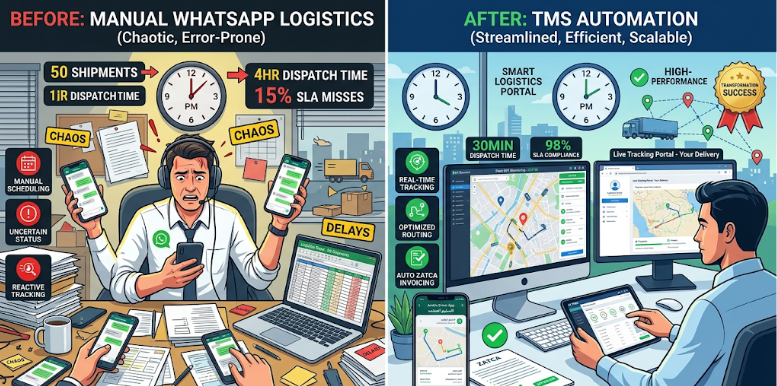
Without real-time tracking integrated into a single platform, visibility requires manual effort: calling drivers, checking emails, logging into multiple carrier portals. For a logistics company managing 50 or more active shipments simultaneously, this consumes dispatcher time that should be spent on coordination and exception management.
When a customer calls to ask where their shipment is and the answer is 'let me find out and call you back,' that is a visibility failure that affects client confidence regardless of whether the shipment is actually on time.
Inefficient Route Planning
Manual route planning for a fleet of delivery vehicles in a Saudi city is an exercise in educated guessing. Dispatchers allocate deliveries to drivers based on area knowledge and experience, without visibility into current traffic conditions, optimal sequence, vehicle capacity, or combined mileage efficiency.
The result is longer-than-necessary routes, higher fuel consumption, and lower delivery capacity per vehicle per day. For a logistics company with 20 or more vehicles, the efficiency gap between manual routing and optimised routing typically represents 15 to 25 percent of total fuel cost.
Paper-Based Proof of Delivery
Paper delivery receipts are the standard in many Saudi logistics operations. The driver gets a signature on a paper form. The form eventually makes its way back to the office. Someone enters the delivery confirmation into the billing system. The invoice is issued days after the delivery.
This process is slow, error-prone (paper forms get lost or damaged), and does not provide the digital proof of delivery that major Saudi commercial clients and government bodies now expect. It also makes dispute resolution difficult, because the evidence of delivery is a paper signature that may or may not be legible.
Warehouse Management Without System Support
For logistics companies operating warehouses or distribution centres, manual inventory tracking creates specific operational problems. Picking errors increase when warehouse staff work from printed pick lists rather than a system-guided process. Stock counts are inaccurate because updates happen on a schedule rather than in real time. Goods are misplaced because location records are not maintained systematically.
These errors have direct costs: returned goods, re-picks, customer disputes, and the staff time required to investigate and resolve each incident.
Billing Delays and Revenue Leakage
A logistics company that cannot issue a ZATCA-compliant invoice within 24 hours of service delivery is leaving cash flow on the table. When billing is assembled manually from trip records, driver reports, and fuel receipts, the process is slow, subject to omission errors, and requires significant finance team time for a task that should be largely automated.
Revenue leakage, when trips or services are completed but not billed due to missing or incomplete records, is a consistent problem in logistics businesses without proper trip management systems.
The IT Systems Saudi Logistics Companies Need
1. Transport Management System (TMS)
A Transport Management System is the operational core for a logistics company. It manages the full lifecycle of a shipment from booking to delivery: order intake, vehicle and driver assignment, route planning, real-time tracking, proof of delivery capture, and billing trigger.
For a Saudi logistics company, the TMS needs to include integration with Saudi mapping services for accurate local routing (Google Maps API or HERE Maps with Saudi road data), Arabic-language interface for drivers who use the driver mobile app, integration with ZATCA e-invoicing for automatic invoice generation on delivery confirmation, and support for the range of shipment types common in Saudi logistics (standard parcels, oversized freight, refrigerated goods, hazardous material documentation).
A well-implemented TMS typically reduces dispatching time by 30 to 50 percent, increases vehicle utilisation, and compresses the billing cycle from days to hours.
2. Fleet Management System
A fleet management system provides real-time GPS tracking of all vehicles, driver behaviour monitoring, fuel consumption tracking, maintenance scheduling, and compliance with Saudi vehicle inspection requirements.
Real-time GPS tracking is not primarily a security feature. It is an operational tool. A dispatcher who can see the current location of every vehicle in the fleet can make better assignment decisions, identify vehicles that are ahead of or behind schedule, and respond to delays proactively rather than when a customer calls.
Driver behaviour monitoring (harsh braking, speeding, idle time) enables fuel cost reduction and driver coaching. Saudi logistics companies that implement driver behaviour monitoring consistently report fuel savings of 10 to 20 percent within the first year.
Maintenance scheduling based on mileage and engine hours (rather than calendar dates) reduces unplanned breakdowns, which are among the most disruptive and expensive events in a logistics operation.
3. Warehouse Management System (WMS)
For logistics companies operating storage or distribution facilities, a Warehouse Management System manages every movement of goods within the warehouse: receiving, putaway, picking, packing, and dispatch.
A WMS directs warehouse staff through each task with a handheld scanner or a mobile device, eliminating the paper-based pick list that produces picking errors. It updates stock locations in real time, so any staff member can find any item without searching. And it optimises pick sequences to reduce travel time within the warehouse.
For Saudi warehouses handling mixed domestic and import goods, the WMS needs to handle Arabic and English item descriptions, Saudi customs reference numbers, and the documentation requirements for goods under bonded warehouse arrangements.
4. Customer Portal and Tracking Interface
Saudi commercial clients and e-commerce businesses that use third-party logistics providers expect to be able to track their shipments without calling. A customer portal gives clients access to real-time tracking, delivery confirmations, digital proof of delivery, and downloadable invoices without any intervention from the logistics company's staff.
This reduces inbound tracking enquiry calls, which are among the highest-volume and least value-added tasks in a logistics company's customer service function. It also positions the logistics company as a credible, professional operation to clients who use digital supply chain management tools in their own businesses.
The portal should support Arabic and English, display tracking information in a format that Saudi clients expect (WhatsApp notification integration for delivery status updates is increasingly standard), and integrate with the TMS so that tracking data is always current.
5. Analytics Dashboard for Logistics Operations
A logistics analytics dashboard gives operations managers live visibility into the metrics that drive performance and cost:
On-time delivery rate by customer, by route, and by driver
Vehicle utilisation rate: delivered volume versus capacity per vehicle per day
Fuel cost per kilometre by vehicle and by route
Average pick and pack time in the warehouse
Customer SLA compliance rate and breach reasons
Revenue per trip and billing cycle time from delivery to invoice
These metrics exist in every logistics operation. Without a connected analytics layer, they are buried in TMS logs, fuel receipts, and driver trip records that nobody has time to analyse systematically. A dashboard surfaces them automatically and makes them available to the people who can act on them.
Saudi-Specific Logistics IT Requirements
Saudi logistics IT has several requirements that generic international logistics software does not always address:
ZATCA Phase 2 integration: all logistics invoices must be ZATCA-compliant. The TMS must integrate with a ZATCA-compliant billing system that generates invoices in the required XML format and submits them to the ZATCA portal on delivery confirmation.
Muqeem and Absher integration: for logistics companies managing driver records, Iqama expiry tracking and Muqeem verification for expatriate drivers are compliance requirements. The HR module of the TMS or a connected HRMS should track and alert on Iqama expiry.
Saudi road network data: routing algorithms must use current Saudi road data including restricted zones, weight limits, and the specific routing challenges of Saudi cities (Jeddah's complex historic centre, Riyadh's grid structure, industrial area access requirements).
Arabic-language driver app: drivers who work in Arabic need a driver-facing mobile application that operates correctly in Arabic, with right-to-left layout and Arabic-language instructions for delivery confirmation and exception reporting.
Key Takeaways
Real-time shipment tracking integrated into a single platform eliminates the manual effort of tracking enquiries and gives customers the visibility they expect without staff intervention.
Optimised route planning versus manual dispatching typically reduces fleet fuel cost by 15 to 25 percent. For a fleet of 20 or more vehicles, this is a significant annual saving.
Digital proof of delivery, capturing signatures and photos on a mobile device, eliminates the paper-based process that delays billing and makes dispute resolution difficult.
A logistics analytics dashboard surfaces the operational metrics that drive cost and SLA performance: on-time rate, vehicle utilisation, fuel cost per kilometre, and billing cycle time.
ZATCA Phase 2 compliance requires logistics invoices to be generated automatically on delivery confirmation and submitted to the ZATCA portal. Manual billing processes cannot meet this requirement at scale.
An Arabic-language driver app is not a localisation option. It is a functional requirement for Saudi logistics companies whose drivers work primarily in Arabic.
Frequently Asked Questions
Q: What is the difference between a TMS and a fleet management system?
A: A Transport Management System (TMS) manages the business process of a shipment: order booking, vehicle assignment, routing, tracking, proof of delivery, and billing. A fleet management system manages the physical vehicles: GPS location, driver behaviour, fuel consumption, and maintenance scheduling. The two systems complement each other and are typically integrated. The TMS uses location data from the fleet management system to provide real-time tracking, while the fleet management system uses trip data from the TMS for fuel and route efficiency analysis.
Q: Can a Saudi logistics company implement a TMS without replacing its existing accounting system?
A: Yes. Most TMS platforms integrate with common accounting systems through APIs rather than replacing them. The TMS manages the operational and billing workflow. It generates invoices and passes them to the accounting system for financial recording and VAT processing. The integration means data flows automatically between the two systems without manual re-entry. The specific integration approach depends on which accounting system is in use. Softriva assesses the integration requirements for each client's existing system as part of the TMS scoping process.
Q: How do we transition from paper-based delivery records to a digital system without disrupting operations?
A: The most practical transition approach runs a parallel period of two to four weeks during which drivers use both the new digital system and the existing paper process. This allows drivers to build familiarity with the new system while maintaining the paper fallback for any deliveries where the new system encounters a problem. After the parallel period, with issues identified and resolved, the paper process is retired. The digital onboarding of drivers is the critical success factor: drivers who understand why the change is being made and how the app works adopt it significantly faster than those who receive the app without context.
Q: What connectivity do drivers in Saudi Arabia need to use a mobile logistics app?
A: Most Saudi TMS and fleet management driver apps require a mobile data connection for real-time tracking and delivery confirmation uploads. Saudi mobile connectivity is generally strong across Jeddah, Riyadh, and major highways, but connectivity gaps exist in some industrial areas, border crossings, and remote delivery locations. Well-designed logistics apps handle connectivity gaps by storing actions locally on the device and syncing when connection is restored. This offline capability should be confirmed with any TMS vendor before deployment for routes that include areas with intermittent connectivity.
Q: How does a logistics analytics dashboard connect to operational data in the TMS?
A: A logistics analytics dashboard connects to the TMS database through an API or direct database connection, pulling operational data (trip records, delivery timestamps, driver assignments, fuel logs) into the analytics platform where it is transformed into the metrics and visualisations management uses. The dashboard updates on a defined schedule, typically daily for most operational metrics and real-time for live tracking data. Building this connection is a data engineering task that typically takes two to four weeks for a standard TMS implementation with a well-documented data structure.
Conclusion
Saudi Arabia's logistics sector is one of the most significant beneficiaries of Vision 2030 investment. The opportunities are real, and the companies that capture them will be those whose operational infrastructure can support the scale that the growing market demands.
A logistics company that cannot provide real-time tracking, digital proof of delivery, ZATCA-compliant invoicing, and data-driven operational management is not just less efficient than one that can. It is increasingly disqualified from the contracts that major Saudi commercial clients and government-connected projects require.
The systems that provide these capabilities, a properly implemented TMS, a fleet management system, and a customer portal, are accessible to Saudi logistics companies of all sizes. The implementation timelines are realistic. The returns are measurable within the first year.
Softriva works with Saudi businesses in logistics, supply chain management, and distribution to implement the technology infrastructure that supports operational growth. Our experience covers TMS selection and implementation, fleet management system integration, ZATCA e-invoicing compliance, and the analytics layer that makes operational data usable for management decisions.
A free consultation gives you a clear picture of which of your current operational problems technology would solve most directly and what a realistic implementation would involve.
Book a Free Logistics IT Consultation at softriva.com


