

Machine Learning for Saudi Businesses: What It Is, What It Needs, and When It Makes Sense
Introduction
Machine learning gets discussed at two extremes in Saudi business circles.
At one extreme it is treated as a force that will reshape every industry overnight. At the other it is dismissed as something only technology companies with large research teams can use.
Neither view is accurate.
Machine learning is a set of statistical techniques that allow software systems to improve their outputs through exposure to data rather than through rules written by a programmer. It has specific, well-understood strengths and real limitations. When applied to the right problem with the right data it delivers measurable improvements in decision quality and operational efficiency.
This guide explains what machine learning is in practical terms, when it makes more sense than simpler analytical tools, what data a Saudi business needs to use it, what a machine learning pipeline looks like from end to end, and how to know whether your business is ready.
What Machine Learning Actually Does
Traditional software follows rules a programmer wrote. A rule-based pricing system applies the same formula to every transaction. A rule-based fraud check tests every transaction against a fixed list of conditions.
Machine learning software learns patterns from data instead. A demand forecasting model learns which combinations of product, season, location, and promotion level correspond to which sales volumes. A fraud detection model learns what fraudulent transactions look like across thousands of examples and flags new ones that share those characteristics, even when they match no specific rule.
The practical implication is this: machine learning is most valuable when the patterns in the data are too complex, too numerous, or too variable for a human to specify them as rules. When patterns are simple and stable, a rule-based system is often simpler, cheaper, and equally effective.
When Machine Learning Makes More Sense Than Simpler Approaches
Many Saudi businesses invest in machine learning for problems that a well-designed report or simple statistical forecast would solve equally well. The result is a model that is expensive to build and no more useful than the simpler approach.
Machine learning genuinely outperforms simpler approaches when:
The outcome depends on many variables interacting in complex, non-linear ways that rules or standard regression cannot capture cleanly.
Patterns in the data change over time in ways that would require constant rule updates, but that a self-updating model handles automatically.
The data volume is large enough that a human analyst cannot review it efficiently, but a model can find patterns across the full dataset.
The cost of prediction errors is high enough to justify the investment in the most accurate approach available.
For most Saudi SMEs the right starting point is good descriptive analytics and statistical forecasting. Machine learning becomes the right next step when those approaches have been tried and their limits have been reached.
The Business Problems Machine Learning Solves Best
Customer Churn and Retention
A churn prediction model reviews each customer's behaviour: purchase frequency, average order value, product mix, support interactions, response to promotions. It identifies combinations of signals that historically preceded customers leaving and flags current customers showing similar patterns.
For a Saudi subscription business, a B2B service firm, or a retail membership programme, early identification of at-risk customers allows targeted retention action before the customer has decided to leave. The model concentrates retention effort on the customers most worth retaining at the moment when action is most likely to work.
Demand Forecasting for Large Catalogues
A Saudi retailer managing 2,000 SKUs across five locations cannot produce accurate individual-product demand forecasts manually. The interactions between categories, location variation, seasonal patterns, promotional effects, and pricing are too complex.
A machine learning demand forecasting model learns these interactions from sales history and produces SKU-level, location-level weekly forecasts automatically. It improves over time and handles the non-linear demand spikes of Ramadan, National Day, and White Friday more accurately than seasonal averages.
Credit and Risk Assessment
For Saudi financial services companies, assessing the risk of a new customer or transaction involves many interacting variables. A machine learning risk model learns which combinations predict default, late payment, or insurance claims, and produces calibrated risk scores for new applications.
These models consistently outperform scorecard-based approaches when trained on sufficient data because they capture non-linear relationships that fixed scorecard weightings cannot represent.
Document Classification and Processing
Saudi businesses that process large volumes of documents (contracts, invoices, applications, compliance forms) spend significant staff time reading, sorting, and extracting information. A machine learning document classification model categorises documents automatically and extracts specified fields (dates, amounts, party names, reference numbers) without any human reading.
For a financial services company processing hundreds of credit applications per week, or an insurance company classifying claims, this reduces processing time and improves the consistency of classification across the team.
Product Recommendations
For Saudi e-commerce and retail businesses, recommendation models identify which products a specific customer is most likely to buy next based on their purchase history and the behaviour of similar customers. Well-implemented recommendation systems increase average order value and repeat purchase rates without any additional marketing spend.
What a Machine Learning Pipeline Looks Like
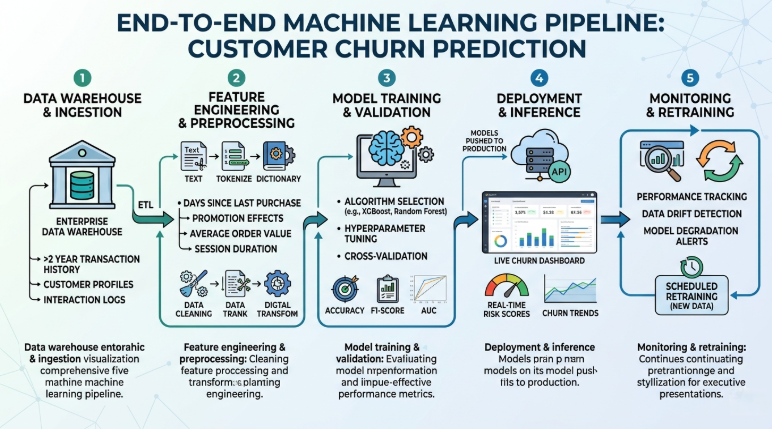
A machine learning pipeline is the complete system that takes raw business data and produces model outputs your team can act on. Understanding its stages helps you plan projects accurately and hold partners accountable.
Data Collection and Storage
The pipeline starts with historical data about the outcome being predicted. A churn model needs records of customers who churned and those who did not, with their associated attributes at the time. A fraud model needs records of fraudulent and legitimate transactions.
This data must be stored in a structured, accessible format. A data warehouse or well-organised database with consistent schema is the foundation. Models trained on data from disconnected spreadsheets consistently underperform models trained on clean, structured data.
Data Preparation and Feature Engineering
Raw data almost never goes directly into a model. It must be cleaned, transformed, and enriched. Dates become useful features like day of week or days since last purchase. External data may be combined with internal records where it adds predictive value.
Feature engineering, creating the specific variables the model learns from, is one of the most important and most underestimated steps in any machine learning project. Getting this right often matters more than the choice of model architecture.
Model Training and Validation
Training exposes the model to historical data and allows it to learn the patterns that predict the outcome. Validation tests how well the model performs on data it has not seen before, confirming it has learned genuine patterns rather than memorising the training data.
A model that performs well on training data but poorly on new data has overfit. It has learned the specific noise in the training set rather than the underlying pattern. Proper validation methodology is essential for trusting a model's outputs in production.
Deployment and Monitoring
A trained model that is not connected to the business processes where it adds value is a research project. Deployment means integrating model outputs into the systems and workflows where they will be used, and making predictions available to the people or automated processes that will act on them.
After deployment, monitoring is essential. Models degrade over time as business patterns change. A churn model trained on 2023 behaviour may become less accurate. Monitoring tracks performance on live data and triggers retraining when accuracy falls below an acceptable level.
What Saudi Businesses Need Before Starting
Three things are genuinely required before a machine learning project will deliver value:
Sufficient, clean historical data. At minimum two years of consistent transaction or event data for the outcome being predicted. Quality matters more than volume. A clean 18-month dataset outperforms a four-year dataset with 30 percent missing values.
A specific, measurable business problem. Not 'improve our analytics.' Something like: 'reduce churn among customers with subscriptions under 12 months old by 20 percent within six months.' Specific problems produce specific models. Vague objectives produce expensive models that nobody uses.
A committed implementation partner. Successful machine learning projects have a business owner who validates that model outputs are useful and a technical team that builds, validates, and maintains the pipeline. Without both, the project typically produces a technically impressive model with no business impact.
Key Takeaways
Machine learning learns patterns from data rather than following fixed rules. It is most valuable when patterns are complex, variable, and too numerous for explicit rules to capture.
Machine learning outperforms simpler approaches only when patterns are genuinely complex and data volume is sufficient. Start with statistical forecasting and regression before investing in ML.
The highest-value ML applications for Saudi businesses are churn prediction, demand forecasting, risk assessment, document classification, and product recommendations.
A machine learning pipeline covers five stages: data collection, feature engineering, model training and validation, deployment, and ongoing monitoring with retraining.
Two to three years of clean, consistent historical data is the practical minimum for most ML applications. Data quality matters more than data volume.
A specific, measurable business problem is essential before starting any ML project. Vague objectives produce expensive models with no business impact.
Frequently Asked Questions
Q: How is machine learning different from regular business analytics?
A: Business analytics describes what has happened in the past. Machine learning uses those historical patterns to estimate what will happen next or to classify new inputs automatically. Analytics answers: what happened and why? Machine learning answers: what is likely to happen next, or what category does this belong to? Both are valuable. Analytics helps you understand your data. Machine learning helps you act on it predictively.
Q: How much data does a Saudi business need to start a machine learning project?
A: For classification problems (churn, fraud, document categorisation) a dataset with at least 1,000 examples of each outcome class is a practical minimum. For time-series forecasting at least 24 months of consistent monthly data is a typical starting point, with weekly or daily data preferred. For recommendation systems at least six months of transaction data with sufficient volume per customer is needed before recommendations become meaningfully personalised.
Q: Can Arabic-language data be used in machine learning models?
A: Yes, though Arabic text data requires specific preprocessing. Arabic is morphologically rich, meaning a single root word produces many surface forms through prefixes and suffixes. Arabic text processing requires tokenisation and stemming tools designed for Arabic, and handling of right-to-left encoding. Machine learning models for Arabic text work well when preprocessing is done correctly and the training data reflects the Arabic dialect and register used in the actual business context.
Q: What is the difference between a machine learning model and an AI chatbot?
A: A machine learning model is trained on structured or unstructured data to predict a specific outcome or classify inputs. Examples include churn prediction, demand forecasting, and fraud detection models. An AI chatbot is a conversational system that generates text responses to queries, typically built on a large language model. The two are different technologies with different applications. A business might use a machine learning model for demand forecasting and a chatbot for customer service, and the two do not need to be connected.
Q: How long does a machine learning project take from start to first useful output?
A: A focused ML project for a well-defined problem with clean data typically takes eight to sixteen weeks from project start to initial model output. This covers data preparation (two to four weeks), model development and validation (four to six weeks), and integration of outputs into the relevant business process (two to four weeks). Projects with significant data quality problems or complex deployment requirements take longer. The quality and accessibility of historical data at the start of the project is the most reliable predictor of timeline.
Conclusion
Machine learning is not a technology Saudi businesses should rush to adopt or dismiss as irrelevant. It is a practical tool for specific categories of business problem where patterns in data are too complex for simpler approaches and where improved prediction accuracy justifies the investment.
The Saudi businesses that benefit most from machine learning approach it with a specific problem, clean data, and a realistic understanding of what the technology can and cannot do. They treat it as one tool in a broader data strategy.
Softriva builds machine learning pipelines for Saudi businesses across retail, financial services, real estate, and logistics. Our approach starts with your specific business problem, assesses whether machine learning is genuinely the right tool, and builds solutions your team can use and trust.
A free consultation gives you an honest assessment of whether your current data and business problems are suited to machine learning and what a focused project would involve.

Book a Free Machine Learning Consultation at softriva.com


