
Top AI Use Cases for SMEs in Saudi Arabia
Introduction
Artificial Intelligence (AI) is often associated with global technology companies, multinational corporations, and billion-dollar innovation projects.
For many small and medium-sized enterprises (SMEs), AI may seem expensive, complex, or relevant only to large organizations with substantial technology budgets.
The reality is very different.
Today's AI technologies are more accessible than ever before.
Cloud-based platforms, subscription services, automation tools, and AI-powered applications have made advanced capabilities available to businesses of all sizes.
In fact, SMEs often experience some of the fastest returns on investment from AI because they can implement targeted solutions that address specific operational challenges.
Whether the goal is improving customer service, automating repetitive tasks, increasing sales efficiency, enhancing decision-making, or reducing operational costs, AI offers practical opportunities for growth.
For businesses in Saudi Arabia navigating digital transformation and increasing competition, AI can help SMEs operate more efficiently while delivering better customer experiences.
The key is focusing on real-world business applications rather than pursuing technology for its own sake.
This guide explores the most impactful AI use cases for SMEs and explains how organizations can begin their AI journey successfully.
Why AI Matters for SMEs
Small and medium-sized businesses face unique challenges.
They often operate with:
Limited resources
Smaller teams
Tighter budgets
Growing customer expectations
Increasing competition
AI helps address these challenges by enabling businesses to achieve more with existing resources.
Instead of hiring additional employees for every new operational requirement, organizations can automate repetitive activities and improve productivity.
This creates opportunities for sustainable growth without proportional increases in operational costs.
Common Misconceptions About AI
Before exploring use cases, it is important to address several misconceptions.
"AI Is Only for Large Companies"
Modern AI solutions are available through affordable cloud-based platforms.
Many SMEs already use AI without realizing it through CRM systems, marketing platforms, and productivity applications.
"AI Requires Huge Investments"
Many AI tools operate through subscription models that minimize upfront costs.
Businesses can begin with small pilot projects and expand gradually.
"AI Replaces Employees"
AI is most effective when augmenting human capabilities.
Employees focus on strategic activities while AI handles repetitive tasks.
AI Use Case #1: Customer Service Automation
Customer service is one of the most common AI applications for SMEs.
Many customer inquiries involve repetitive questions such as:
Product information
Pricing
Business hours
Order tracking
Service availability
AI-powered chatbots can answer these questions instantly.
Benefits
Faster responses
24/7 availability
Reduced support workload
Improved customer satisfaction
Employees can focus on complex customer issues requiring human expertise.
AI Use Case #2: Lead Generation and Qualification
Sales teams often spend significant time identifying and qualifying potential customers.
AI can automate much of this process.
How It Works
AI systems analyze inquiries and customer behavior to identify high-potential prospects.
Leads can be scored automatically based on:
Engagement levels
Interests
Demographics
Purchase intent
Benefits
Better lead prioritization
Increased sales productivity
Faster follow-up
Higher conversion rates
AI Use Case #3: Marketing Automation
Marketing requires consistent communication across multiple channels.
AI helps businesses automate and optimize these activities.
Applications
Email marketing
Social media content
Campaign optimization
Customer segmentation
Personalized messaging
Benefits
Improved engagement
Reduced manual effort
Better targeting
Higher marketing ROI
AI Use Case #4: Content Creation
Many SMEs struggle to produce sufficient content for marketing and communication activities.
Generative AI can assist with:
Blog articles
Social media posts
Product descriptions
Email campaigns
Website content
Benefits
Faster content production
Improved consistency
Increased productivity
Reduced content creation costs
Human review remains important, but AI significantly accelerates content development.
AI Use Case #5: Sales Assistance
AI supports sales teams throughout the customer journey.
Applications
Proposal generation
Meeting summaries
Customer research
Email drafting
Follow-up automation
Benefits
Reduced administrative work
Faster response times
Better customer engagement
Increased sales efficiency
Sales professionals spend more time building relationships and closing deals.
AI Use Case #6: Predictive Analytics
Many business decisions rely on historical data and assumptions.
AI helps organizations forecast future outcomes more accurately.
Examples
Sales forecasting
Demand prediction
Inventory planning
Customer behavior analysis
Benefits
Better planning
Reduced uncertainty
Improved resource allocation
More informed decisions
AI Use Case #7: Inventory Management
Managing inventory effectively is critical for many SMEs.
Excess inventory increases costs.
Insufficient inventory creates lost sales opportunities.
AI helps optimize inventory levels.
Benefits
Improved forecasting
Reduced stock shortages
Lower carrying costs
Better operational efficiency
Organizations gain greater visibility into inventory requirements.
AI Use Case #8: Financial Operations
Finance teams often perform repetitive administrative tasks.
AI can automate activities such as:
Invoice processing
Expense categorization
Financial reporting
Payment tracking
Benefits
Faster processing
Reduced errors
Improved compliance
Better visibility into financial performance
AI Use Case #9: Human Resources
HR departments can leverage AI to improve efficiency across multiple processes.
Applications
Resume screening
Candidate communications
Employee onboarding
Policy assistance
Training recommendations
Benefits
Faster recruitment
Improved employee experiences
Reduced administrative workload
Better workforce management
AI Use Case #10: Business Intelligence and Reporting
Many SMEs struggle to transform data into actionable insights.
AI-powered analytics platforms simplify this process.
Applications
Performance dashboards
Trend analysis
Executive reporting
Operational monitoring
Benefits
Faster access to information
Better decision-making
Improved visibility
Increased agility
Leadership teams gain deeper insights into business performance.
AI Use Case #11: Appointment Scheduling
Businesses that rely on consultations, meetings, or service appointments can automate scheduling.
AI systems can:
Manage calendars
Confirm appointments
Send reminders
Reschedule bookings
Benefits
Reduced administrative effort
Improved customer convenience
Fewer missed appointments
AI Use Case #12: Customer Retention
Retaining customers is often more cost-effective than acquiring new ones.
AI helps businesses identify customers who may be at risk of leaving.
Applications
Churn prediction
Engagement monitoring
Personalized retention campaigns
Benefits
Improved loyalty
Higher retention rates
Increased customer lifetime value
Industries Benefiting from AI
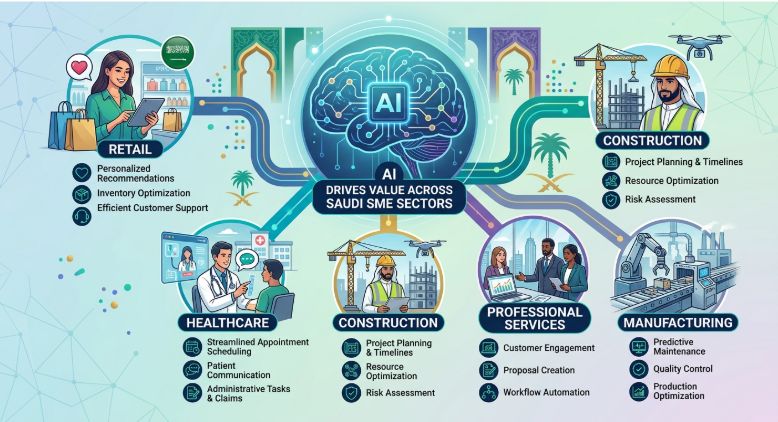
AI adoption is growing across multiple sectors.
Retail
Product recommendations
Inventory optimization
Customer support
Healthcare
Appointment scheduling
Patient communication
Administrative automation
Construction
Project planning
Resource management
Risk assessment
Professional Services
Customer engagement
Proposal creation
Workflow automation
Manufacturing
Predictive maintenance
Quality control
Production optimization
How SMEs Can Start Their AI Journey
Many organizations delay adoption because they believe implementation is complicated.
A structured approach simplifies the process.
Step 1: Identify Business Challenges
Focus on specific operational problems.
Examples include:
Slow customer response times
Manual reporting
Lead management challenges
Administrative inefficiencies
Step 2: Prioritize High-Impact Opportunities
Select use cases with clear business value and measurable outcomes.
Step 3: Start Small
Pilot projects reduce risk and allow organizations to learn gradually.
Step 4: Measure Results
Track metrics such as:
Productivity improvements
Cost savings
Customer satisfaction
Revenue growth
Step 5: Expand Strategically
Successful initiatives can be scaled across additional departments and processes.
Common Challenges
Data Quality
AI systems depend on accurate information.
Poor data quality limits effectiveness.
Employee Adoption
Employees should understand how AI supports their work.
Training and communication are critical.
Integration
AI delivers greater value when integrated with existing business systems.
Governance
Organizations should establish clear guidelines regarding AI usage, security, and oversight.
The Future of AI for SMEs
AI adoption among SMEs is expected to accelerate significantly in the coming years.
Several trends are emerging:
More affordable AI platforms
Improved automation capabilities
Greater integration with business software
Enhanced personalization
Advanced predictive analytics
As these technologies become increasingly accessible, AI will likely become a standard business capability rather than a competitive advantage.
Organizations that begin building AI capabilities today will be better positioned for future growth.
Key Takeaways
AI is accessible and practical for SMEs, not just large enterprises.
Customer service, marketing, sales, reporting, and finance are among the highest-value AI applications.
AI helps organizations improve efficiency, reduce costs, and enhance customer experiences.
Many AI solutions are available through affordable subscription-based platforms.
Successful adoption begins with solving specific business challenges.
Pilot projects help organizations gain experience while minimizing risk.
Human oversight remains essential for quality, strategy, and decision-making.
AI supports business growth by enabling SMEs to achieve more with existing resources.
Frequently Asked Questions
Q: Is AI affordable for small businesses?
A: Yes. Many AI solutions are available through cloud-based subscription models, making them accessible to organizations with limited budgets.
Q: Which AI use case delivers the fastest ROI?
A: Customer service automation, chatbots, lead qualification, and marketing automation often provide some of the quickest returns.
Q: Do SMEs need technical expertise to use AI?
A: Many modern AI platforms are designed for business users and require minimal technical knowledge to implement and manage.
Q: Will AI replace employees in SMEs?
A: No. AI is most effective when supporting employees by automating repetitive tasks and improving productivity.
Q: How should SMEs begin implementing AI?
A: Start by identifying a specific business challenge, selecting a high-impact use case, running a pilot project, and measuring results before expanding further.
Conclusion
Artificial Intelligence is no longer a technology reserved for large enterprises.
Today, SMEs across Saudi Arabia can leverage AI to improve customer experiences, automate operations, increase productivity, strengthen decision-making, and support sustainable growth.
The most successful organizations are not adopting AI because it is trendy.
They are implementing AI because it solves real business challenges and delivers measurable outcomes.
By starting small, focusing on business value, and scaling strategically, SMEs can unlock significant advantages while preparing for a future increasingly shaped by intelligent technologies.
Softriva helps businesses identify, implement, and optimize AI solutions that align with operational goals and growth objectives.
Book Your Free AI Readiness Assessment at softriva.com and discover how AI can help your business work smarter, serve customers better, and grow more efficiently.


