
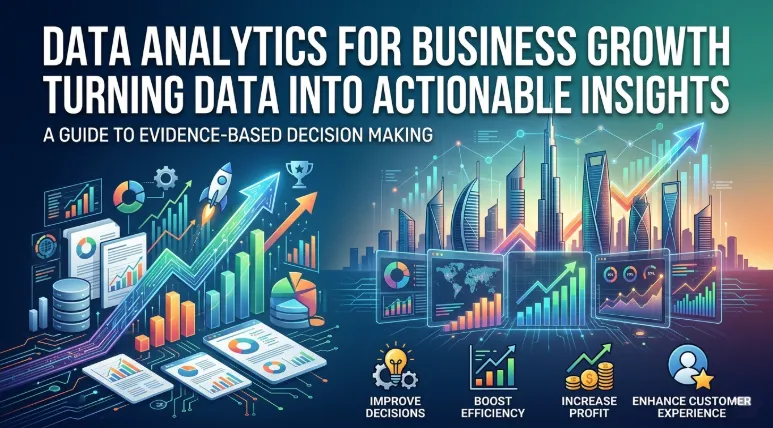
Data Analytics for Business Growth: Turning Data into Actionable Insights
Introduction
Every business generates data.
Customer interactions, sales transactions, website visits, marketing campaigns, financial records, operational activities, and employee performance all create valuable information.
Despite having access to more data than ever before, many organizations struggle to use it effectively.
Data often exists across multiple systems, spreadsheets, applications, and databases. As a result, decision-makers may rely on assumptions rather than evidence when planning strategies or solving business challenges.
This is where data analytics becomes essential.
Data analytics helps organizations collect, organize, analyze, and interpret information to uncover meaningful insights. Instead of simply reporting what happened, analytics helps businesses understand why it happened and what actions should be taken next.
For businesses in Saudi Arabia pursuing digital transformation and growth, data analytics has become a strategic capability that supports better decision-making, improved efficiency, and stronger competitive positioning.
This guide explores the role of data analytics in modern business and how organizations can use data to drive measurable growth.
What Is Data Analytics?
Data analytics is the process of examining data to identify patterns, trends, relationships, and insights that support business decisions.
The goal is not merely collecting information but transforming raw data into useful knowledge.
Organizations use analytics to answer questions such as:
Which products generate the highest revenue?
What factors influence customer satisfaction?
Which marketing campaigns deliver the best results?
Where are operational inefficiencies occurring?
How can future performance be improved?
By analyzing data, businesses gain a clearer understanding of their operations and opportunities.
Why Data Analytics Matters
Organizations that make decisions based on evidence often outperform those that rely primarily on intuition.
Data analytics helps businesses:
Improve decision-making
Identify opportunities
Reduce risks
Enhance customer experiences
Increase operational efficiency
Improve profitability
In today's competitive environment, access to information alone is not enough.
The ability to interpret and act on information creates real business value.
Types of Data Analytics
Understanding different types of analytics helps organizations apply the right approach.
Descriptive Analytics
Descriptive analytics explains what has happened.
Examples include:
Monthly sales reports
Revenue dashboards
Website traffic summaries
Customer service metrics
This is often the starting point for business intelligence.
Diagnostic Analytics
Diagnostic analytics helps explain why something happened.
Examples include:
Identifying reasons for declining sales
Understanding customer churn
Analyzing operational bottlenecks
This deeper analysis supports more informed decisions.
Predictive Analytics
Predictive analytics uses historical information to forecast future outcomes.
Examples include:
Sales forecasting
Demand prediction
Customer behavior analysis
Risk assessment
Organizations can prepare for future scenarios more effectively.
Prescriptive Analytics
Prescriptive analytics recommends actions based on available information.
Examples include:
Inventory optimization
Resource allocation
Pricing recommendations
This represents one of the most advanced forms of analytics.
Key Business Benefits of Data Analytics
Better Decision-Making
Data-driven decisions reduce uncertainty.
Leaders gain access to objective information rather than relying solely on assumptions.
This improves strategic planning and operational management.
Improved Customer Understanding
Analytics helps organizations understand:
Customer preferences
Purchasing behavior
Service expectations
Engagement patterns
Businesses can deliver more relevant and personalized experiences.
Increased Operational Efficiency
Analytics identifies inefficiencies that may otherwise remain hidden.
Organizations can optimize workflows, reduce waste, and improve productivity.
Enhanced Financial Performance
Better visibility into revenue, costs, and profitability supports stronger financial management.
Businesses can identify opportunities to improve margins and reduce unnecessary expenses.
Competitive Advantage
Organizations that use data effectively often respond faster to market changes and customer needs.
This creates stronger competitive positioning.
Common Business Applications of Data Analytics
Sales Analytics
Sales teams use analytics to monitor:
Revenue trends
Sales performance
Lead conversion rates
Customer acquisition costs
This information supports more effective sales strategies.
Marketing Analytics
Marketing departments analyze:
Campaign performance
Website traffic
Customer engagement
Return on investment
Data helps optimize marketing activities and budgets.
Customer Analytics
Organizations evaluate customer behavior to improve:
Retention
Satisfaction
Personalization
Loyalty
Customer insights often drive revenue growth.
Financial Analytics
Finance teams use analytics to monitor:
Cash flow
Profitability
Budget performance
Financial risks
Improved visibility supports stronger financial decision-making.
Operational Analytics
Operations teams analyze data to improve:
Productivity
Resource utilization
Process efficiency
Service delivery
Operational improvements often generate significant cost savings.
Business Intelligence vs Data Analytics
These terms are often used interchangeably but serve different purposes.
Business Intelligence
Business Intelligence (BI) focuses on reporting and visualization.
Examples include:
Dashboards
Reports
Performance monitoring
BI helps organizations understand current performance.
Data Analytics
Analytics goes further by identifying trends, relationships, and future opportunities.
Analytics helps organizations understand not only what happened but why it happened and what should happen next.
Challenges Organizations Face
Despite its benefits, implementing data analytics can present challenges.
Data Silos
Information often exists across multiple systems.
Disconnected data limits visibility and analysis capabilities.
Poor Data Quality
Inaccurate or incomplete information reduces confidence in results.
Organizations should establish data governance practices.
Limited Skills
Employees may require training to interpret and use analytics effectively.
Technology Complexity
Analytics platforms vary in sophistication and capabilities.
Organizations should select tools aligned with business requirements.
Building a Data-Driven Culture
Technology alone does not create value.
Organizations must foster a culture where decisions are informed by data.
Encourage Evidence-Based Decisions
Leaders should promote the use of analytics when evaluating opportunities and challenges.
Improve Data Accessibility
Employees should have access to relevant information when needed.
Invest in Training
Teams should understand how to interpret analytics and apply insights effectively.
Align Analytics with Business Goals
Analytics initiatives should focus on measurable business outcomes rather than collecting data for its own sake.
The Role of Artificial Intelligence in Analytics
Artificial Intelligence is transforming analytics capabilities.
AI helps organizations:
Detect patterns automatically
Generate predictions
Identify anomalies
Automate reporting
Produce insights faster
Combining analytics with AI creates more powerful decision-support capabilities.
Organizations gain deeper visibility into business performance while reducing manual analysis effort.
How to Start a Data Analytics Strategy
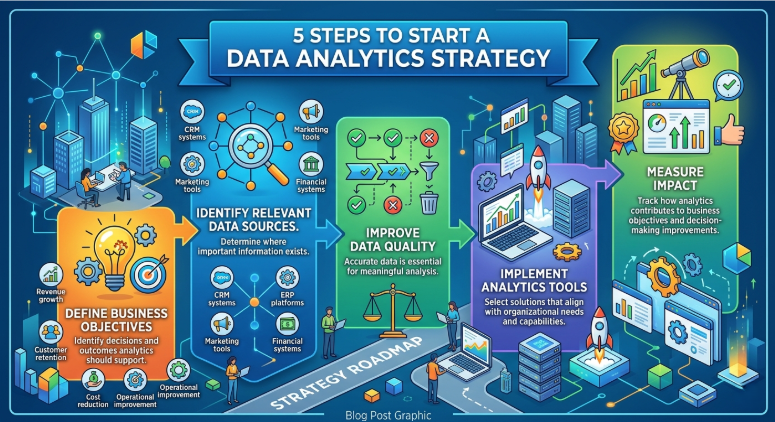
Step 1: Define Business Objectives
Identify the decisions and outcomes analytics should support.
Examples include:
Revenue growth
Customer retention
Cost reduction
Operational improvement
Step 2: Identify Relevant Data Sources
Determine where important information exists.
Examples include:
CRM systems
ERP platforms
Marketing tools
Financial systems
Step 3: Improve Data Quality
Accurate data is essential for meaningful analysis.
Step 4: Implement Analytics Tools
Select solutions that align with organizational needs and capabilities.
Step 5: Measure Impact
Track how analytics contributes to business objectives and decision-making improvements.
The Future of Data Analytics
Data analytics continues to evolve rapidly.
Emerging trends include:
AI-powered analytics
Real-time dashboards
Predictive decision support
Automated reporting
Self-service analytics
As organizations generate increasing amounts of information, analytics will become even more important for maintaining competitiveness and driving growth.
Businesses that develop strong analytics capabilities today will be better positioned to capitalize on future opportunities.
Key Takeaways
✓ Data analytics transforms raw information into actionable business insights.
✓ Analytics improves decision-making, efficiency, customer experiences, and profitability.
✓ Descriptive, diagnostic, predictive, and prescriptive analytics each provide unique value.
✓ Sales, marketing, finance, operations, and customer service teams all benefit from analytics.
✓ Data quality and governance are critical success factors.
✓ AI is enhancing analytics capabilities through automation and predictive intelligence.
✓ Organizations should align analytics initiatives with business objectives.
✓ A data-driven culture helps maximize the value of analytics investments.
Frequently Asked Questions
Q: What is data analytics?
A: Data analytics is the process of examining information to identify trends, patterns, and insights that support better business decisions.
Q: How does data analytics help businesses grow?
A: Analytics improves decision-making, identifies opportunities, enhances efficiency, strengthens customer experiences, and supports strategic planning.
Q: What is the difference between business intelligence and analytics?
A: Business Intelligence focuses on reporting and visualization, while analytics explores deeper insights, trends, predictions, and recommendations.
Q: Can small businesses benefit from data analytics?
A: Yes. Organizations of all sizes can use analytics to improve operations, understand customers, and make smarter decisions.
Q: Is AI replacing data analytics?
A: No. AI enhances analytics by automating analysis and generating insights, but analytics remains a foundational business capability.
Conclusion
Data has become one of the most valuable assets in modern business.
Organizations that can effectively transform information into actionable insights gain significant advantages in decision-making, efficiency, customer engagement, and growth.
The challenge is no longer collecting data.
The challenge is understanding what the data means and how to use it strategically.
Businesses that embrace data analytics can identify opportunities faster, solve problems more effectively, and adapt to changing market conditions with greater confidence.
Softriva helps organizations implement analytics strategies, business intelligence solutions, reporting platforms, and data-driven decision-making frameworks that support measurable business outcomes.
Book Your Free Data Analytics Consultation at softriva.com and discover how data can become one of your organization's most powerful growth drivers.


