
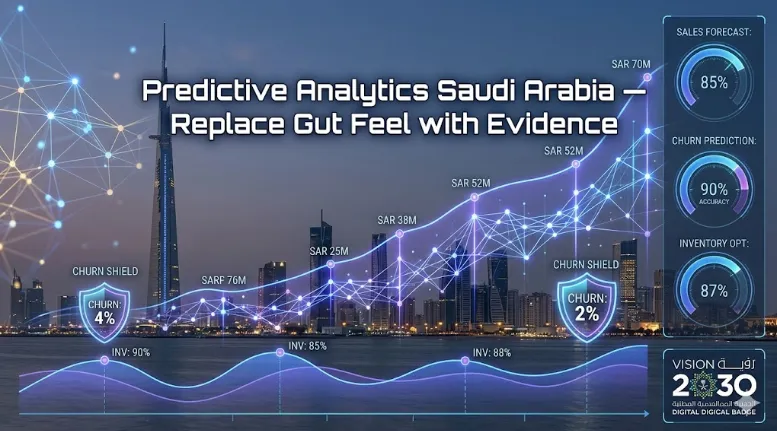
Predictive Analytics for Saudi Businesses: How to Forecast Smarter?
Introduction
Every Saudi business makes forecasts. Sales targets, inventory orders, staffing plans, marketing budgets. All of these require a view of what is coming, not just what has happened.
Most of the time, these forecasts are based on a combination of last year's numbers, gut instinct, and the optimism or caution of whoever is presenting them. The result is forecasts that are directionally reasonable but routinely wrong in the specific ways that matter most: inventory ordered too late for a demand spike, staff hired for a season that underperforms, marketing spend allocated to a channel that produces less return than expected.
Predictive analytics uses your historical business data to produce statistically grounded forecasts that are more accurate than gut-feel estimates. Not perfectly accurate. More accurate, and in a way that is transparent and improvable over time.
This guide explains what predictive analytics actually is, how it works with real business data, which forecasting problems it addresses best, what data a Saudi business needs to start, and how to build predictive capability without a data science department.
What Predictive Analytics Actually Is?
Predictive analytics is the use of statistical methods and, in some cases, machine learning models to estimate future outcomes based on historical data patterns.
It is not a crystal ball. It does not produce certainty. What it produces is a probability-weighted estimate of future outcomes that is consistently more accurate than estimates made without data, because it captures patterns that human judgment misses or systematically misweights.
There are three levels of predictive analytics that Saudi businesses typically progress through:
Level 1: Statistical Forecasting
The simplest level uses mathematical time-series models, such as moving averages, exponential smoothing, and seasonal decomposition, to project historical patterns forward.
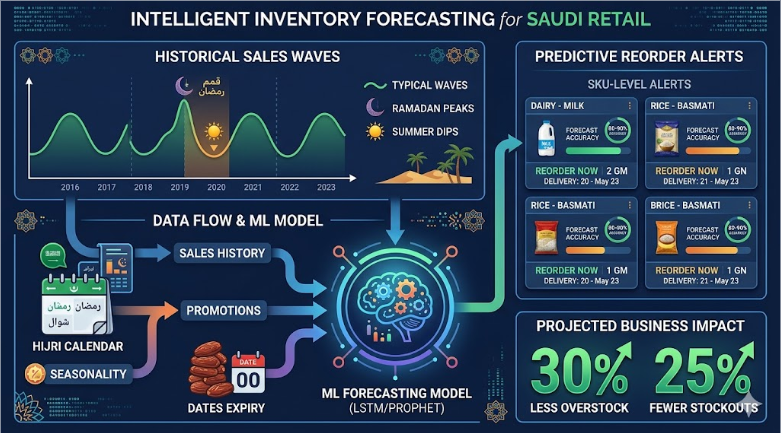
A retail business with three years of monthly sales data can use a seasonal model to estimate expected sales for each month of the coming year, accounting for the consistent uplift during Ramadan, the typical dip in summer months, and the surge around National Day. This is more reliable than simply taking last year's number and adding a growth percentage.
Statistical forecasting does not require machine learning or advanced data infrastructure. It can be done in Python, R, or even in Excel for simpler cases. The key input is a clean, consistent historical dataset.
Level 2: Regression Modelling
Regression models identify relationships between input variables and the outcome being forecast. Instead of just projecting past trends, they incorporate additional factors that influence the outcome.
A Saudi property developer might build a model that relates property enquiry volume to factors including mortgage rate levels, consumer confidence indicators, seasonal patterns, and the developer's own marketing spend. The model learns the relative influence of each factor from historical data and uses current values of those factors to produce a more contextually informed forecast than a pure time-series model.
Regression models require more data preparation than simple statistical forecasting and produce more nuanced outputs. They are appropriate for decisions where multiple external factors influence the outcome significantly.
Level 3: Machine Learning Models
Machine learning models can capture complex, non-linear relationships between variables that regression models miss. They are appropriate for problems where the relationships between inputs and outcomes are genuinely complex, where there is a large volume of data available, and where the business value of improved forecast accuracy justifies the investment in more sophisticated modelling.
Customer churn prediction, fraud detection, demand forecasting for large product catalogues, and credit risk assessment are examples of problems where machine learning models typically outperform simpler statistical approaches, given sufficient data.
For most Saudi SMEs, Level 1 and Level 2 analytics deliver significant value before any machine learning is needed. The decision to use machine learning should be driven by evidence that simpler approaches are not accurate enough for the decision at hand, not by the desire to use the most sophisticated technology available.
The Business Decisions Predictive Analytics Improves Most
Not all business forecasting benefits equally from predictive analytics. These are the decision types where the improvement in forecast accuracy delivers the most direct business value for Saudi companies:
Sales and Revenue Forecasting
A sales forecast that is 20 percent too optimistic leads to over-staffing, over-purchasing, and disappointed investors or shareholders. A forecast that is 20 percent too pessimistic leads to under-stocking, missed capacity investment, and lost revenue.
Predictive sales forecasting uses historical sales patterns, seasonal factors, pipeline data from the CRM, and where available, external indicators such as sector growth data and competitor activity to produce more accurate revenue estimates. Saudi businesses typically see their forecast accuracy improve by 15 to 30 percentage points after moving from gut-feel to data-driven sales forecasting.
Inventory and Demand Forecasting
For Saudi retailers, distributors, and manufacturers, inventory forecasting is one of the highest-return predictive analytics applications. The cost of carrying excess inventory (tied-up capital, storage cost, spoilage or obsolescence risk) and the cost of stockouts (lost sales, emergency reordering, customer disappointment) are both significant.
A demand forecast model trained on sales history, seasonal patterns, promotional calendars, and external demand signals produces reorder recommendations that are more accurate than manual estimation. For a Saudi retailer with 500 SKUs, manual demand estimation for each item is practically impossible. A model can produce daily reorder recommendations across the full catalogue with no manual effort.
Customer Churn Prediction
Retaining an existing customer is consistently less expensive than acquiring a new one. But most Saudi businesses do not identify customers at risk of churning until they have already left, when it is too late to intervene.
A churn prediction model identifies customers who are showing the behavioural patterns that historically precede departure: reduced purchase frequency, declining engagement, increasing complaint volume, or changes in the pattern of products purchased. These signals are invisible to a salesperson managing 200 accounts manually. A model that reviews all accounts daily catches them early enough for intervention.
Staffing and Capacity Planning
Saudi businesses with variable demand, including hospitality, healthcare, retail, and logistics, face consistent pressure to match staffing levels to demand accurately. Overstaffing is expensive. Understaffing reduces service quality and loses revenue.
Predictive staffing models use historical demand patterns, seasonal factors, upcoming events, and booking data to forecast demand by time period and recommend staffing levels accordingly.
A Saudi restaurant group that knows with 80 percent confidence that Thursday evening between 8pm and 11pm will require 30 percent more floor staff than Tuesday evening can plan rotas proactively rather than scrambling during service.
Financial Cash Flow Forecasting
Cash flow surprises are one of the most common causes of preventable business distress in Saudi Arabia. A business that is profitable on paper but runs out of cash due to a concentration of large receivables and upcoming payables faces a real operational crisis.
Cash flow forecasting models use accounts receivable aging, payment history by customer, upcoming payables by due date, and seasonal revenue patterns to produce rolling 30 and 90-day cash flow projections. These give finance leaders a meaningful window to take corrective action before a cash shortage becomes a crisis.
What Data a Saudi Business Needs to Start
The most common objection to predictive analytics is that the business does not have enough data. In most cases, this is not true. The barriers are more often data quality and data accessibility than data volume.
For sales and demand forecasting, two to three years of monthly sales data at the product or category level is a practical starting point. More granular data (daily or weekly) and longer history improve model accuracy, but even 24 months of monthly data supports useful forecasting.
For customer churn prediction, a database of customer transactions with dates, values, and product categories, covering at least 18 months, provides enough historical behaviour to identify early churn signals.
The more important data requirement is consistency. Data that has been entered differently over time, that contains many gaps or errors, or that mixes different definitions of the same metric is harder to use than a smaller but cleaner dataset.
A data quality audit before any predictive modelling project identifies what cleaning and preparation is needed. Skipping this step is the most common cause of models that are technically built but produce unreliable outputs.
Key Takeaways
Predictive analytics produces statistically grounded forecasts that are consistently more accurate than gut-feel estimates. It does not produce certainty. It produces better probability estimates.
Three levels of predictive analytics apply to Saudi businesses: statistical time-series forecasting, regression modelling, and machine learning. Most SMEs deliver significant value at levels 1 and 2 before needing level 3.
The highest-return predictive analytics applications for Saudi businesses are: sales forecasting, inventory and demand forecasting, customer churn prediction, staffing optimisation, and cash flow forecasting.
Two to three years of consistent monthly sales or transaction data is a practical starting point for most forecasting applications. Data quality matters more than data volume.
A data quality audit before building any predictive model is essential. Models trained on inconsistent or error-filled data produce unreliable outputs regardless of how sophisticated the modelling is.
The decision to use machine learning should be driven by evidence that simpler approaches are not accurate enough, not by the desire to use the most sophisticated technology available.
Frequently Asked Questions
Q: How accurate is predictive analytics for Saudi business forecasting?
A: Accuracy depends on the quality of the historical data, the consistency of the business patterns being modelled, and the forecasting method used. For retail demand forecasting with clean historical data, well-built models typically achieve 80 to 90 percent accuracy at the category level and 70 to 85 percent at the individual SKU level. For sales forecasting, improvements of 15 to 25 percentage points over gut-feel estimates are common in the first year of deployment. Accuracy improves over time as the model accumulates more data and is periodically retrained.
Q: Does a Saudi business need a data scientist to use predictive analytics?
A: Not necessarily. Many predictive analytics applications, particularly at levels 1 and 2, can be implemented using configurable BI platforms and statistical tools without a dedicated data scientist. More complex machine learning applications do require data science expertise, but this can be provided by an external partner rather than an internal hire. Softriva provides predictive modelling as a managed service, which means the data science expertise is on our team rather than a hire requirement for the client.
Q: What is the difference between predictive analytics and a standard BI dashboard?
A: A BI dashboard shows you what has happened: current revenue, today's orders, last month's performance. It is descriptive. Predictive analytics uses that historical data to estimate what will happen: expected demand next month, customers likely to churn in the next 60 days, cash flow position in 90 days. Both are valuable and they complement each other well. The dashboard tells you where you are. The predictive model helps you anticipate where you are going.
Q: How long does it take to build a predictive model for a Saudi business?
A: A focused predictive modelling project, covering one forecasting problem such as demand forecasting for a retail catalogue or sales forecasting for a specific product line, typically takes four to eight weeks from data audit to first model output. This includes data cleaning, model selection, training, validation, and delivery of the forecast outputs in a usable format. More complex projects covering multiple forecasting problems or requiring significant data infrastructure work take longer.
Q: How often does a predictive model need to be updated or retrained?
A: Predictive models should be evaluated and retrained regularly to account for changes in business patterns. A minimum cadence for most Saudi business forecasting models is quarterly evaluation and annual retraining. Models for rapidly changing environments, such as fashion retail demand or financial market indicators, may need more frequent updates. The right cadence is determined by how quickly the underlying patterns change and how much model accuracy degrades without retraining.
Conclusion
Forecasting will always involve uncertainty. No model eliminates that.
What predictive analytics does is reduce the unnecessary uncertainty that comes from relying on intuition and last year's numbers for decisions that have months or years of historical data behind them. For Saudi businesses making decisions about inventory levels, revenue targets, staffing plans, and customer retention, that reduction in uncertainty has a direct financial value.
The businesses across Saudi Arabia that have moved from gut-feel to data-grounded forecasting are consistently making better decisions on these questions, not because they have better instincts but because they are using the available data more systematically.
Softriva provides predictive analytics services for Saudi businesses, including data quality audits, forecasting model development, and integration with existing BI dashboards and reporting systems. Our team covers the full journey from raw business data to actionable forecast outputs that your team can use without a data science background.
A free analytics consultation gives you a realistic assessment of what your current data can support and where predictive modelling would deliver the most return for your specific business.

Book a Free Predictive Analytics Consultation at softriva.com


