
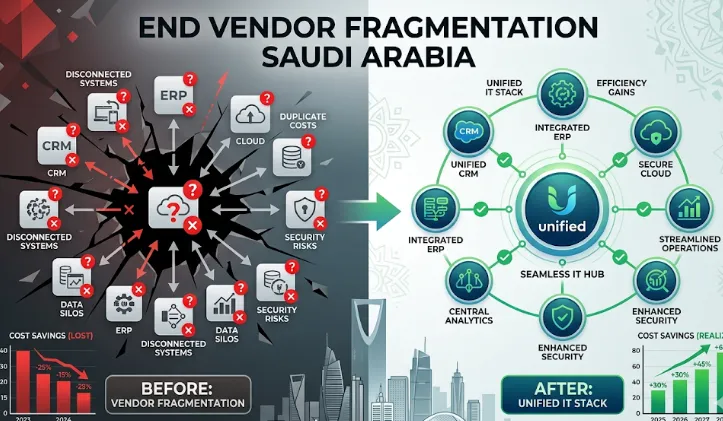
The Real Cost of Using Multiple IT Vendors in Saudi Arabia (And How to Fix It)
Introduction
Most Saudi businesses have not chosen their IT setup deliberately. It grew.
A web developer was hired for the original website. A separate company manages the hosting. A third vendor handles the CRM. A fourth was brought in for a data project that was never quite finished. The IT helpdesk is a fifth company on a retainer that nobody is entirely happy with.
Each of these relationships made sense at the time. Taken together, they create a fragmented IT environment that is expensive to manage, difficult to integrate, and almost impossible to hold accountable when something goes wrong.
This guide explains why vendor fragmentation is one of the most common and underrecognised costs in Saudi business technology, what it specifically costs, and what the alternative looks like in practice.
How IT Fragmentation Happens
IT fragmentation rarely results from a deliberate choice. It develops through a series of individual decisions that each seemed reasonable at the time.
A business launches with a web developer who builds the site but does not manage hosting. The owner finds a hosting company separately. When the business needs a CRM, the web developer does not offer one, so a third party is brought in. When the business grows and needs data reporting, a specialist analytics firm is engaged. When IT support becomes necessary, an MSP is added to the mix.
At each stage, the decision seemed logical. The problem is that none of these vendors were chosen as part of a coherent strategy. They were added reactively, and they do not work together as a system.
The Four Hidden Costs of Vendor Fragmentation
1. The Accountability Gap
When multiple vendors touch the same technology environment, accountability becomes genuinely ambiguous.
A Saudi business experiences a website outage. Is it a hosting problem? A web development issue? A DNS configuration error? A database problem caused by recent CRM integration work? Each vendor will initially point at the others. Identifying which vendor owns the problem takes hours. Getting the right vendor to fix it takes longer.
This accountability gap is not unique to any individual vendor. It is a structural property of fragmented IT. No single vendor has full visibility of the environment, so no single vendor can take ownership of the full problem.
An end-to-end IT partner who owns the complete technical environment eliminates this gap. When something goes wrong, there is one number to call and one team with full context to fix it.
2. Integration Failure
Integration between business systems is where most of the operational value of modern IT is generated. A CRM that talks to your accounting system saves hours of manual data entry. A website that feeds leads directly into your sales pipeline reduces response time. An inventory system that connects to your e-commerce platform prevents overselling.
When the systems involved were built and are managed by different vendors, integration is consistently harder than it should be. Each vendor has partial knowledge of the others' systems. Each has different incentives when it comes to supporting integration work that was not in their original scope. Each may use different data formats, different APIs, and different update cycles that affect compatibility.
Integration projects between systems from different vendors regularly cost twice as much and take twice as long as initially estimated. In many cases, the integrations are never completed or are so fragile that they require constant maintenance.
3. Communication and Management Overhead
Every additional vendor relationship requires management time. Each relationship involves a separate contract, a separate invoice, a separate point of contact, and a separate communication thread to maintain.
For a Saudi business with five IT vendors, the management overhead is not five times the overhead of one vendor. It is higher, because the complexity of coordinating between multiple vendors scales non-linearly.
When a project requires input from multiple vendors, scheduling alignment is a project in itself. When a security incident requires immediate action across multiple systems, coordinating four or five separate companies in real time is significantly harder than calling one.
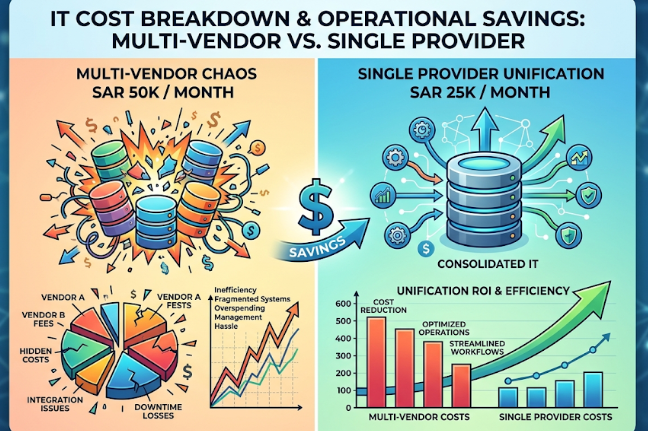
The internal staff time spent managing multiple IT vendor relationships is rarely measured but consistently significant. A business with five IT vendors may be spending 10 to 15 hours of senior staff time per month simply managing those relationships. At a conservative cost of SAR 200 per hour, that is SAR 24,000 to SAR 36,000 per year in management overhead for IT vendor coordination alone.
4. The Knowledge Gap Between Vendors
Each vendor in a fragmented IT environment has deep knowledge of their own component and limited knowledge of the others. The hosting provider knows the server environment. The web developer knows the application code. The CRM vendor knows the CRM. Nobody has a complete picture of how everything fits together.
This knowledge gap creates problems when the business needs to make changes. A change to the website may have implications for the hosting configuration that the web developer does not know about. A CRM upgrade may break integrations that were built by the analytics vendor who is no longer on retainer. A security patch to the server may affect database connections that were configured by the original developer.
In a consolidated IT environment managed by one partner, all of this knowledge is held in one place. Changes are assessed against full system context before they are made. Implications are identified before they become problems.
Signs Your Business Is Paying the Fragmentation Tax
These are the operational signs that IT fragmentation is costing your business:
When something goes wrong, the first call is to figure out whose problem it is, not to fix it
You spend time each month chasing different vendors for updates on connected issues
Integration between your business systems works inconsistently or requires manual workarounds
Your IT vendors do not know what software or systems the others manage
You have received conflicting technical advice from different vendors on the same question
IT invoices arrive from three or more separate companies each month
A new IT project requires briefing multiple vendors separately and managing their coordination
If three or more of these apply, the cost of your fragmented IT setup is almost certainly greater than the cost of consolidating it with a single end-to-end partner.
What End-to-End IT Partnership Looks Like
An end-to-end IT partner owns your complete digital environment: web development, hosting, data analytics, AI and automation, and managed IT services. They design, build, integrate, and maintain all components of your technology stack as a single coherent system.
This does not mean a single product or a single platform. It means a single partner who selects the right technology for each requirement, integrates the components properly, and maintains full-system knowledge across the engagement.
Single Point of Accountability
When the same team built your website, manages your hosting, configured your CRM integration, and monitors your systems, accountability for any problem is immediate and unambiguous. One call. One team with full context. Resolution without the inter-vendor blame cycle.
Coherent System Architecture
An end-to-end partner designs your technology environment as a system, not as a collection of individual components. Data flows are planned from the beginning. Integration points are built with maintenance in mind. Security controls are applied consistently across the environment rather than differently by each vendor.
Reduced Total Cost
Consolidating from five IT vendors to one does not mean paying the sum of five contracts to one company. It means redesigning the IT function with a partner who understands your full requirements and prices the whole engagement at a level that reflects the efficiency of managing one relationship rather than five.
The reduction in management overhead, integration failure costs, and rework from accountability gaps typically exceeds the visible cost savings from vendor consolidation even before the direct savings are counted.
Faster Response to Change
When your business needs a new digital capability, an end-to-end partner can assess and implement it with full knowledge of your existing environment. There is no need to brief multiple vendors, manage their interaction, or worry about whether a new component will conflict with existing ones. The partner knows the environment and can move faster with less risk.
How to Consolidate a Fragmented IT Environment
If your IT is currently fragmented across multiple vendors, consolidation should be approached carefully to avoid disrupting live systems:
Audit your current vendor landscape. Document what each vendor manages, what the contract terms are, and what the renewal dates are. This gives you the information needed to plan a consolidation timeline.
Identify the highest-friction relationships first. Which vendor relationships consume the most management time? Which integrations fail most often? These are the consolidation priorities.
Choose an end-to-end partner before cancelling existing contracts. Transition your IT environment to the new partner before ending relationships with existing vendors. Running them in parallel briefly is disruptive but much safer than creating gaps in coverage.
Document the full technical environment before transition. Every system, every integration, every credential, every configuration. This documentation is essential for a smooth transition and for the new partner's onboarding.
Transfer one component at a time. Start with the least operationally critical component, verify the transition is stable, then move to the next. Do not attempt a full environment migration in a single event.
Key Takeaways
IT fragmentation in Saudi businesses grows organically through individual reactive decisions. The resulting setup is expensive, difficult to integrate, and almost impossible to hold accountable.
The accountability gap is the most damaging property of fragmented IT. When something breaks, the first problem is figuring out whose problem it is before anyone starts fixing it.
Integration between systems managed by different vendors is consistently more expensive and fragile than integration within a single-partner environment.
The management overhead of five IT vendor relationships is not five times the overhead of one. It is higher, because coordination complexity scales non-linearly.
Consolidating to an end-to-end IT partner reduces total cost through lower management overhead, fewer integration failures, faster incident response, and coherent system architecture.
Consolidation should be approached carefully: audit the current landscape, choose the new partner first, and transfer one component at a time to avoid creating coverage gaps.
Frequently Asked Questions
Q: Is it better to have specialist vendors for each IT function or one end-to-end partner?
A: For most Saudi SMEs and mid-sized businesses, an end-to-end partner delivers better outcomes at lower total cost than multiple specialists. The exception is when a business has a specific requirement so technically complex or niche that it exceeds the capability of any generalist IT company, in which case bringing in a specialist for that component while maintaining a primary end-to-end partner for the rest of the environment is reasonable. Using multiple specialists for standard IT requirements creates the fragmentation costs described in this guide without a proportional quality benefit.
Q: How do we protect our business during the transition from multiple vendors to a single partner?
A: The key protections are: never cancel an existing vendor contract before the new partner has taken over that function and verified it is stable; maintain all existing credentials and access for at least 30 days after transition in case anything needs to be recovered; document every system, integration, and configuration before the transition begins; and run a parallel period where both the old and new partner can access the environment for at least two weeks. A rushed transition that creates coverage gaps is more damaging than a slower, careful one.
Q: Does consolidating to one IT partner create a dependency risk?
A: This is a legitimate concern. The mitigation is ensuring that everything your end-to-end partner manages is fully documented and that you own all credentials, code, and data. A reputable end-to-end partner should actively support your ability to leave if you need to, through clear documentation, code ownership in your name, and transparent data export processes. If a partner makes it difficult for you to understand or access your own systems, that is a warning sign regardless of whether they are a single vendor or one of five.
Q: What does Softriva manage as an end-to-end IT partner?
A: Softriva covers the complete digital stack: web development and design, cloud hosting and domain management, data analytics and business intelligence, AI and workflow automation, managed IT services including monitoring and helpdesk, and cybersecurity. This means a Saudi business can run its entire digital environment through a single partner relationship, with one contract, one point of contact, and one team that holds full knowledge of the complete system.
Q: How long does IT vendor consolidation typically take?
A: The timeline depends on the number of vendors being consolidated and the complexity of the systems involved. For a typical Saudi SME consolidating from four or five vendors, a careful, component-by-component transition typically takes two to four months. Simpler environments with fewer integrations can move faster. The priority is stability, not speed. A rushed consolidation that causes an outage or a data loss event is a far worse outcome than a careful three-month transition.
Conclusion
Fragmented IT is one of the most common and least visible costs in Saudi business operations. It shows up as management overhead, integration failures, slow incident response, and the ongoing cost of coordinating between vendors who have never been designed to work together.
The alternative is not simply a cost reduction. It is a fundamental improvement in how your technology environment functions: faster response, better integration, clear accountability, and a partner who understands your full system context rather than one component of it.
Softriva has been operating as an end-to-end IT partner for Saudi businesses since 2006. Our service range covers web, hosting, data analytics, AI automation, and managed IT under one roof, with one team in Jeddah who knows your environment completely.
If your current IT setup involves three or more vendors and the accountability and integration problems that come with it, a free IT audit is the most practical starting point. In under an hour, we can give you a clear picture of where the fragmentation is costing you most and what a consolidated approach would look like.

Book a Free IT Audit with Softriva at softriva.com


