IT Solutions for Schools and Education Institutions in Saudi Arabia
Introduction
Saudi Arabia's education sector is in the middle of significant change.
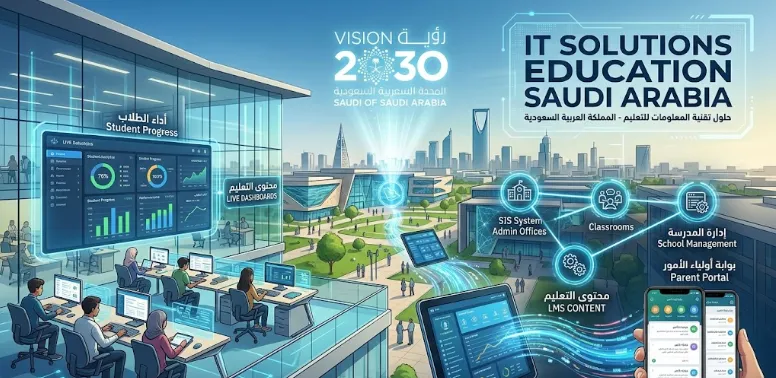
Vision 2030's education targets include major investments in curriculum reform, teacher development, and digital infrastructure. The Ministry of Education has accelerated the adoption of e-learning platforms, digital assessment, and data-driven school management.
At the same time, private schools, international schools, and higher education institutions are under commercial pressure to improve operational efficiency, demonstrate student outcomes, and maintain the quality of parent communication that families paying private school fees expect.
Many institutions are managing this growing complexity with systems that were not designed for it: attendance tracked in paper registers, parent communication happening through informal WhatsApp groups, student records stored in spreadsheets, and IT infrastructure that cannot reliably support a full school day of digital activity.
This guide covers the specific IT systems that address the most pressing operational challenges for Saudi education institutions, what each system does, and how to approach the investment in a way that delivers real results.
The Most Common IT Problems in Saudi Schools
The problems Saudi schools bring to Softriva are consistent across institution types and sizes:
Student Records That Cannot Be Trusted
When student records are stored in spreadsheets or in multiple disconnected systems, inconsistencies develop over time. The same student may have different date of birth entries in the admissions system and the exam registration system. Academic history is incomplete. Contact details are out of date.
These inconsistencies create administrative headaches, but they also create compliance risks. Saudi school accreditation requirements and the Ministry of Education's reporting obligations require accurate, complete student records. An institution that cannot produce accurate records on request is an institution at regulatory risk.
Parent Communication That Is Too Informal
Many Saudi private schools conduct parent communication through a mix of WhatsApp groups, paper newsletters, and phone calls. This creates several problems. Information reaches different parents at different times. Messages get lost in busy group threads. There is no record of what was communicated, when, and to whom.
For schools handling sensitive information (a child's academic performance, a behavioural incident, a health concern), informal channels like WhatsApp group chats are not appropriate. Communication needs to be secure, documented, and controlled.
IT Infrastructure That Fails Under Load
A school's IT infrastructure is stress-tested every school day. When 400 students and 40 teachers are simultaneously using an e-learning platform, video streaming, digital assessment tools, and administrative systems, the network and server infrastructure needs to handle that load reliably.
Schools that have not invested in proper network design, server capacity, or cloud-based infrastructure regularly experience slowdowns and outages that disrupt teaching time. A lesson plan built around a digital activity fails when the internet drops.
No Data on Student Performance Trends
Most school administrators can tell you a student's most recent grade. Very few can quickly tell you whether that student's performance is improving or declining compared to the same period last year, how the student compares to their cohort, or which teacher's classes consistently produce the strongest outcomes.
This data exists, scattered across mark books and assessment records. But without a system that connects and analyses it, the patterns are invisible. Interventions happen late, after problems have compounded, rather than early when they are most effective.
The IT Systems Saudi Education Institutions Need
1. Student Information System (SIS)
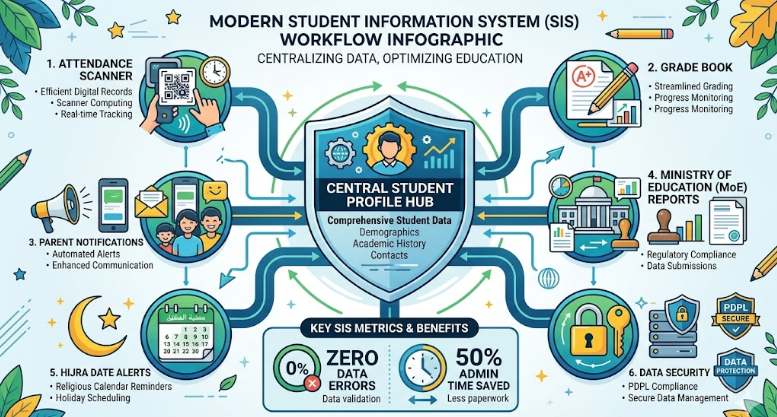
A Student Information System is the central database for everything related to your students: personal records, contact details, enrolment history, academic performance, attendance, behaviour records, health information, and document storage.
A good SIS is the single source of truth for your institution. Every other system (the learning management system, the parent communication portal, the finance system) connects to it rather than maintaining its own copy of student data.
For Saudi institutions, the SIS needs to handle Arabic names and addresses correctly, support Hijri date records for Saudi students, maintain Iqama and passport expiry alerts for non-Saudi students, and produce reports in formats required by the Ministry of Education.
Moving from spreadsheet-based student records to a proper SIS is the highest-priority IT investment for most Saudi schools that have not yet made it.
2. Learning Management System (LMS)
A Learning Management System is the digital platform through which teachers deliver course content, assignments, and assessments, and through which students access materials and submit work.
During and after the COVID-19 period, LMS adoption accelerated significantly across Saudi schools. Many institutions implemented platforms quickly without fully considering long-term usability, Arabic-language support, or integration with their other systems.
A well-chosen LMS for a Saudi school includes full Arabic-language interface for students and teachers, alignment with the Saudi national curriculum where applicable, assignment and assessment tools that work on mobile devices (where many Saudi students do their homework), integration with the SIS so that enrolment and results flow automatically, and reliable performance during peak hours when the whole school is online simultaneously.
Common platforms used in Saudi schools include Madrasati (the Ministry of Education's national platform for government schools), Microsoft Teams with Education, Google Classroom, Moodle, and Blackboard. The right choice depends on your institution type, your existing Microsoft or Google environment, and your integration requirements.
3. Parent Communication Portal
A structured parent communication portal replaces informal WhatsApp communication with a controlled, documented channel that is appropriate for an educational institution.
Features a Saudi school needs in a parent portal include secure messaging between teachers and individual parents (not group broadcasts), attendance notifications sent automatically when a student is absent, grade and assessment result publishing with configurable teacher approval workflows, calendar events and school announcements pushed to parent devices, and a document distribution system for reports, forms, and official communications.
The portal should work as a mobile app, since the majority of Saudi parents will access it from their phones. It should support Arabic and English. And it should maintain a complete communication history that can be reviewed if there is ever a dispute about what was communicated.
4. School Management and Finance System
A school management system covers the operational and financial functions of running an institution: fee collection, payroll for teaching and administrative staff, timetabling, room allocation, exam scheduling, and supplier management.
For private Saudi schools, ZATCA e-invoicing compliance is mandatory for fee receipts. The system needs to generate ZATCA-compliant receipts automatically for every fee payment. It also needs to handle VAT on applicable services and produce the quarterly VAT returns that registered institutions are required to file.
Timetabling in a Saudi school has specific requirements: separate prayer time allocations, gender-segregated scheduling in institutions that require it, and the ability to handle the Saudi school calendar including Hijri-date public holidays.
5. IT Infrastructure: Network, Devices, and Hosting
The physical and cloud infrastructure that supports all of the above systems is as important as the software running on it.
For a school building, this means a wired and wireless network designed for the number of simultaneous users at peak load (not average load), device management systems that allow IT staff to update and secure all school devices centrally, a cloud hosting environment for school systems with appropriate backup and disaster recovery, and a cybersecurity setup that protects student data and prevents unauthorised access to school systems.
Saudi student data is personal data covered by the PDPL. The school's IT infrastructure needs to be configured to protect that data appropriately, with access controls that limit who can see which student records and audit logs that record data access.
What Results Saudi Schools Report After Investing in IT
Qurtubah Schools, a Softriva client, noted that the school's hosting services have been reliable and consistent, ensuring the site is always accessible. This matters directly for a school that uses its digital presence for parent communication, student access, and enrolment.
More broadly, schools that have moved from spreadsheet-based records to a proper SIS report significant reductions in administrative time spent on student data queries, faster production of the Ministry reports that are required regularly, and more accurate data available when it is needed rather than after someone has spent hours pulling it together.
Schools that have implemented parent communication portals report fewer missed communications, better parent satisfaction, and a reduction in the informal WhatsApp communication that creates both administrative and privacy problems.
How to Approach IT Investment in an Education Institution
Education institutions have limited budgets and significant operational pressures. The following approach ensures investments deliver maximum value:
Start with the student record. A reliable SIS is the foundation everything else depends on. Without clean, accurate student data in a central system, the LMS, the parent portal, and the analytics tools all underperform.
Fix the communication channel. Replace informal WhatsApp communication with a proper parent portal. This is a relatively low-cost, high-impact change that improves parent satisfaction and reduces compliance risk.
Audit your infrastructure. Before adding new software, make sure your network, devices, and hosting can support it. New software running on inadequate infrastructure produces poor results and creates the false impression that the software itself is the problem.
Add analytics last. Student performance analytics and school management dashboards are powerful tools, but they require clean, connected data to function. Build the foundation first, then add the analytics layer once the data quality justifies it.
Key Takeaways
A Student Information System is the highest-priority IT investment for most Saudi schools that do not yet have one. It is the foundation that every other system depends on.
Parent communication portals replace informal WhatsApp groups with a secure, documented channel. This is both an operational improvement and a privacy compliance requirement.
Saudi school IT systems must handle Arabic names, Hijri dates, Ministry of Education reporting formats, and ZATCA-compliant fee receipts from the start.
Network and hosting infrastructure must be sized for peak load (the whole school online simultaneously), not average load. Infrastructure failure during teaching time directly costs learning time.
Student data is personal data covered by the Saudi PDPL. Access controls, audit logs, and appropriate hosting arrangements are legal requirements, not optional security features.
The right implementation order is SIS first, then communication portal, then infrastructure audit, then analytics. Each layer depends on the ones below it.
Frequently Asked Questions
Q: Does the Ministry of Education require Saudi private schools to use specific software systems?
A: Government schools are required to use the Madrasati platform. Private schools and international schools have more flexibility in their software choices but must meet Ministry of Education reporting requirements and ensure their systems can produce the data formats required for accreditation and inspection. The key requirement is that systems must be able to produce accurate, complete records on request, not that any specific commercial platform must be used.
Q: How do we migrate student records from spreadsheets to a new SIS without losing data?
A: Data migration from spreadsheets to an SIS requires three stages: data audit (identifying inconsistencies, duplicates, and gaps in the existing records), data cleaning (resolving those issues before migration), and data import (moving the cleaned data into the new system with verification checks). Skipping the audit and cleaning stages is the most common cause of SIS implementations that fail to deliver expected results. Plan for this work to take two to four weeks for a school of 500 to 1,000 students.
Q: What is the best LMS for a Saudi private school?
A: There is no single best answer. The right LMS depends on your existing technology environment (Microsoft or Google), your curriculum requirements, your student age range, and your budget. Schools already using Microsoft 365 often find Teams for Education the most practical choice because it integrates with existing accounts and tools. Schools prioritising structured Arabic-language content delivery may find Moodle more configurable. The platform matters less than the quality of teacher training and the integration with your SIS. A great platform poorly adopted delivers less value than a good platform properly used.
Q: How do we handle cybersecurity for student data in a school environment?
A: Student data protection requires several layers: access controls that limit who can view which records (a class teacher should not be able to access records for students not in their class), strong password policies and multi-factor authentication for staff accounts, network segmentation that separates student device traffic from administrative systems, and regular security awareness training for staff. The PDPL applies to student personal data in the same way it applies to customer data in a commercial context. Schools should treat student data security as a legal compliance requirement, not just good practice.
Q: How much IT support does a Saudi school typically need?
A: This depends heavily on the school size, the number of devices, and the complexity of the systems in use. A school with 500 students and 50 staff running an LMS, SIS, and network infrastructure typically needs either a part-time in-house IT technician supported by a managed IT services provider, or a full managed IT service from an external provider covering remote monitoring, helpdesk support, and on-site visits as needed. Schools frequently underestimate IT support needs and discover the gap when a system failure disrupts teaching.
Conclusion
Saudi Arabia's education sector is under growing pressure to operate more effectively, demonstrate better outcomes, and meet rising parent expectations, all while managing costs carefully.
IT is the practical tool for meeting all three of these demands. A reliable SIS removes administrative waste. A parent portal improves communication quality. A well-chosen LMS supports better teaching and learning. Proper infrastructure makes everything else work consistently.
The institutions that invest in these systems thoughtfully, starting with the foundation and building upward, consistently deliver better experiences to students, parents, and staff than those that either invest heavily in visible technology (devices, screens) without addressing the systems underneath, or avoid the investment entirely and manage growing complexity with inadequate tools.
Softriva has worked with Saudi education institutions including Qurtubah Schools, providing web, hosting, and IT services tailored to the operational requirements of schools in the Kingdom. Our team works in Arabic and English and is familiar with the specific regulatory, curriculum, and cultural requirements of Saudi education.
A free consultation gives you a clear picture of where your institution's IT creates friction, what the most practical improvements are, and what a realistic investment looks like.
Book a Free Education IT Consultation at softriva.com


