
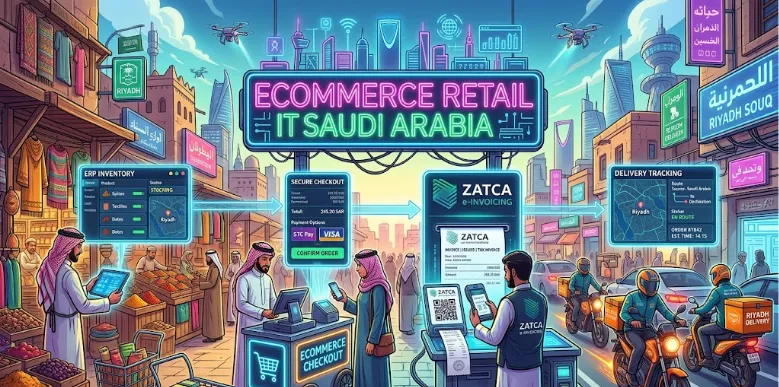
E-Commerce and Retail IT Solutions in Saudi Arabia: What Growing Businesses Need
Introduction
Saudi Arabia's retail sector is changing fast.
E-commerce growth in the Kingdom has consistently outpaced regional averages over the past five years. Saudi National Day campaigns, Ramadan promotions, and the expansion of delivery infrastructure have moved a significant share of consumer purchasing online. At the same time, physical retail is not disappearing. Customers increasingly move between online and offline, researching on their phones and buying in-store, or browsing in-store and ordering online.
For Saudi retail and e-commerce businesses, this creates both opportunity and operational pressure. The businesses capturing the opportunity have the technology to handle multi-channel sales, manage inventory accurately, fulfil orders quickly, and use customer data to make better decisions about what to stock and how to market it.
The businesses struggling are those whose IT has not kept pace with their sales volume. Orders are lost in WhatsApp messages. Inventory counts are wrong because updates happen manually. Customer data is spread across three different platforms with no connection between them. The site crashes during a National Day promotion.
This guide covers the IT systems that solve these problems, what each one does, and the order in which to prioritise them for a Saudi retail or e-commerce business.
The Specific IT Failures That Cost Saudi Retailers Money
A Website That Cannot Handle Traffic Spikes
Every Saudi retailer with an online presence experiences traffic spikes during Ramadan, National Day, White Friday, and brand-specific promotions. For businesses on shared hosting or under-powered cloud hosting, these spikes produce slow load times or complete outages at the exact moment when the most potential customers are visiting.
A site that loads in two seconds normally but takes eight seconds during a promotion loses approximately 40 percent of its visitors before they reach the product page, based on standard e-commerce abandonment data. A site that crashes entirely during a promotion loses all of them, plus the credibility damage with customers who planned to buy.
Inventory That Cannot Be Trusted
For retailers selling through multiple channels (a physical store, an online store, and a social commerce presence on Instagram or TikTok), inventory management becomes genuinely complex. A product that sells out in the physical store on a Saturday morning may still be showing as available on the website until someone manually updates the count, potentially on Sunday.
Overselling products that are not in stock is one of the fastest ways to damage customer trust in Saudi Arabia's word-of-mouth driven market. A customer who orders something and is told it is not in stock after payment is a customer who will not return and will tell others.
Checkout That Loses Sales
Saudi e-commerce has specific payment expectations. Customers expect MADA card acceptance as a standard option, alongside Visa and Mastercard. Apple Pay and STC Pay are increasingly expected, particularly for mobile purchases. Tabby and Tamara (buy now, pay later options) are growing rapidly and are now an expectation for higher-value purchases.
A checkout that is missing any of these options, that requires too many steps, or that does not work smoothly on mobile loses sales at the final moment of the purchase journey. Given that more than 70 percent of Saudi e-commerce transactions happen on mobile, a checkout that is not optimised for mobile is a significant revenue leak.
No Insight Into Customer Behaviour
Most Saudi retail businesses cannot answer basic questions about their customers: Who are the top 10 percent of customers by lifetime value? Which products are frequently bought together? Which customers have not purchased in 90 days and are at risk of lapsing? Which marketing campaigns produced the most repeat buyers, not just first purchases?
Without this data, marketing budgets are spent trying to acquire new customers when the most cost-effective revenue is often in retaining and expanding relationships with existing ones.
The IT Systems Saudi Retail and E-Commerce Businesses Need
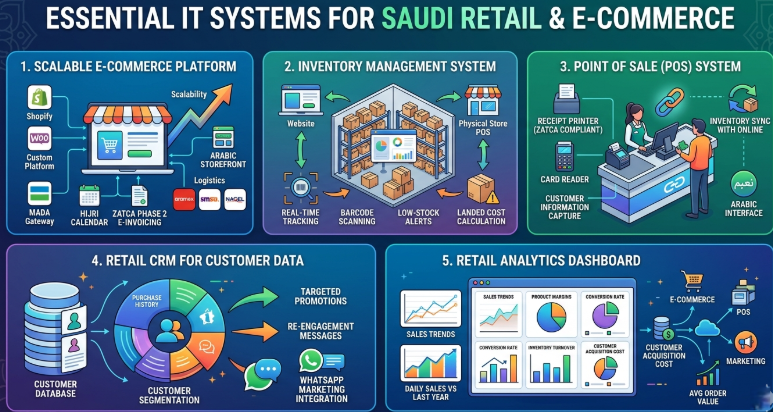
1. A Scalable E-Commerce Platform
The right e-commerce platform for a Saudi business depends on the size of the catalogue, the expected order volume, the payment methods required, and whether Arabic-language functionality is needed.
The platforms most commonly used by Saudi retailers include Shopify (strong for businesses wanting fast setup and a large app ecosystem, with good Arabic support), WooCommerce on WordPress (more flexible and lower ongoing cost, better for businesses wanting full control), and custom-built platforms (appropriate for businesses with unique requirements that off-the-shelf platforms cannot meet).
Key Saudi-specific requirements for any e-commerce platform: MADA payment gateway integration, Arabic-language storefront, Hijri calendar support for promotional campaigns, ZATCA Phase 2 e-invoicing compliance on all receipts, and delivery integration with Saudi logistics providers including Aramex, SMSA, and Naqel.
The platform choice matters less than the quality of the implementation. A poorly configured Shopify store performs worse than a well-built WooCommerce store of the same scale.
2. Inventory Management System
An inventory management system tracks stock levels across all your locations and channels in real time. When a product sells through your website, the inventory count decreases immediately. When a product sells in your physical store through the point-of-sale system, the count decreases immediately across all connected channels.
For retailers with a single location and a small product catalogue, a basic inventory module within your e-commerce platform may be sufficient. For retailers with multiple locations, high SKU counts, or complex supplier relationships, a dedicated inventory management system that connects to the e-commerce platform and the point-of-sale system is the right approach.
Key features to look for in a Saudi retail context: barcode scanning support, low-stock alerts, purchase order management linked to supplier reordering, landed cost calculation for imported goods, and Arabic-language labels and reports.
3. Point of Sale System
For retailers with physical stores, the point-of-sale system is where in-store transactions happen. Modern POS systems do far more than process payments. A good POS system connects inventory between online and offline, captures customer information at the point of sale (building your CRM database), tracks which products sell fastest at which times and locations, integrates with ZATCA e-invoicing for receipt generation, and supports Arabic interfaces for cashiers who work in Arabic.
The integration between POS and the online store is what makes true multi-channel inventory management possible. Without this connection, the two channels operate as separate businesses with the same name.
4. CRM for Retail Customer Data
Every transaction in your store or on your website generates data about a customer. A retail CRM captures this data, connects it to the customer's purchase history, and makes it available for marketing and customer service decisions.
With a retail CRM, you can identify your highest-value customers and create exclusive offers for them, send targeted promotions based on past purchase categories (a customer who bought home goods gets a furniture promotion, not a sportswear promotion), automate re-engagement messages to customers who have not purchased in 60 or 90 days, and track the effectiveness of promotions by the actual repeat purchases they generate, not just the clicks.
WhatsApp marketing integration is particularly important for Saudi retail CRM. Most Saudi consumers are reachable through WhatsApp, and WhatsApp broadcast lists managed through a CRM allow targeted, personalised messages at scale without the informal limitations of a personal WhatsApp account.
5. Analytics Dashboard for Retail Performance
A retail analytics dashboard gives buyers, marketing managers, and operations managers live visibility into the numbers that drive their decisions.
For a Saudi retailer, the most useful dashboard metrics are:
Daily and weekly sales versus same period last year, broken down by channel and by category
Inventory turnover by product and by location
Conversion rate from website sessions to purchases
Average order value trends over time
Top products by revenue and by margin
Customer acquisition cost by marketing channel
Repeat purchase rate and customer lifetime value trends
These numbers exist in every retail business. The problem is they are spread across the e-commerce platform, the POS system, the accounting software, and the marketing tools. A BI dashboard connects these sources and presents the numbers together, updated automatically, without anyone exporting spreadsheets.
Specific Requirements for Saudi E-Commerce
Beyond the standard e-commerce requirements, Saudi retailers need to pay attention to several market-specific factors:
Delivery expectations: Saudi consumers expect fast delivery. Same-day delivery in major cities and next-day delivery nationally is the emerging standard. Your e-commerce system needs to integrate with Saudi logistics providers and show accurate delivery estimates at checkout.
Cash on delivery: Despite rapid growth in digital payments, cash on delivery remains a significant payment preference for some segments of the Saudi market. Your platform needs to support it where relevant.
Returns management: Saudi consumers expect clear, simple return processes. A returns management system that generates prepaid return labels and automatically processes refunds reduces the customer service burden and improves customer satisfaction.
Seasonal capacity: Saudi e-commerce traffic spikes during Ramadan, Eid, and National Day are among the most intense in the region. Your hosting infrastructure must be able to scale to handle these peaks without degradation.
Key Takeaways
Saudi e-commerce traffic spikes during Ramadan, National Day, and White Friday are intense. Hosting infrastructure that cannot scale to meet them loses sales at the highest-demand moments.
Inventory management must connect online and offline channels in real time. Manual updates create overselling, which damages customer trust faster than almost any other operational failure.
Saudi checkout must include MADA, Apple Pay, STC Pay, and buy-now-pay-later options (Tabby, Tamara). Missing any of these loses sales at the final step of the purchase journey.
A retail CRM connected to purchase history enables targeted WhatsApp marketing that drives repeat purchases at significantly lower cost than new customer acquisition.
A retail analytics dashboard connects e-commerce, POS, and marketing data into one view. Without it, decisions about inventory, marketing spend, and pricing are based on incomplete information.
Saudi-specific requirements for any e-commerce system: MADA integration, Arabic storefront, ZATCA Phase 2 receipts, Saudi logistics provider integration, and Hijri calendar promotional support.
Frequently Asked Questions
Q: Should a Saudi retail business build a custom e-commerce site or use Shopify?
A: For most small to mid-sized Saudi retailers, starting with Shopify or WooCommerce is faster, lower risk, and lower cost than a custom build. Custom development becomes the right choice when the business has specific requirements that off-the-shelf platforms cannot meet: complex product configuration, unique fulfilment logic, deep integration with proprietary systems, or the need for a user experience that a platform's template structure cannot accommodate. Most businesses overestimate how unique their requirements are and underestimate the ongoing maintenance cost of custom code.
Q: How does ZATCA e-invoicing apply to Saudi e-commerce?
A: VAT-registered Saudi e-commerce businesses are required to generate ZATCA Phase 2-compliant e-invoices for every sale. This means invoices must be generated in the approved XML format and transmitted to the ZATCA platform within defined timeframes. Your e-commerce platform must have a ZATCA-compliant invoicing integration built in. Shopify and WooCommerce both have ZATCA-compliant apps and plugins available. Custom-built stores require custom ZATCA integration as part of the development scope.
Q: What is the best way to handle Arabic and English on a Saudi e-commerce site?
A: A properly built bilingual e-commerce site maintains separate Arabic and English versions of all product content, with a clear language toggle visible at all times. The Arabic version should be a genuine translation of the product information, not machine-translated. Product names, descriptions, and SEO metadata should be independently optimised in each language. Right-to-left layout for Arabic requires specific implementation in your theme or template. Google indexes Arabic and English pages separately, so a proper bilingual site effectively doubles your organic search presence.
Q: How can a Saudi retailer reduce cart abandonment on mobile?
A: Mobile cart abandonment in Saudi e-commerce is primarily driven by four factors: slow page load (fix with optimised images and fast hosting), too many checkout steps (reduce to three or fewer), missing preferred payment methods (add MADA, Apple Pay, STC Pay, and BNPL options), and checkout forms that are not optimised for mobile keyboard input. Address all four and measure the impact. Each one contributes to abandonment independently, so fixing one without the others produces limited improvement.
Q: How do we connect our physical store inventory with our online store?
A: The connection requires two integrations: a point-of-sale system that can sync inventory data with your e-commerce platform, and an inventory management layer that sits between the two and ensures both see the same stock levels in real time. Some POS and e-commerce combinations have pre-built integrations (Shopify POS with Shopify, for example). Others require middleware to handle the sync. The key requirement is that the sync happens automatically and immediately when a sale occurs on either channel, not on a scheduled batch update.
Conclusion
Saudi Arabia's retail market is rewarding the businesses that have built the operational infrastructure to serve customers consistently, at scale, across multiple channels.
The technology gap between retail businesses that have made this investment and those that have not is widening. The gap shows up in how reliably stock information is accurate, how quickly orders are fulfilled, how effectively customer data is used to drive repeat purchases, and how confidently the business can manage the traffic spikes that Saudi promotional periods generate.
The investments that close this gap are accessible. A scalable e-commerce platform, connected inventory management, a retail CRM, and a performance dashboard are achievable for a growing Saudi retailer at a cost that is justified by the revenue impact within the first year.
Softriva has built e-commerce and retail IT solutions for Saudi businesses across Jeddah and MENA. Our experience covers platform selection, payment integration, inventory systems, ZATCA compliance, and the analytics infrastructure that turns sales data into smarter decisions.
A free consultation is the fastest way to identify where your current technology is holding your retail operation back and what the most impactful improvements are.

Book a Free E-Commerce IT Consultation at softriva.com


