
Building a Technology Strategy That Supports Business Growth
Introduction
Technology has become one of the most important drivers of business success.
Organizations rely on technology for communication, customer engagement, operations, decision-making, financial management, security, and innovation. Regardless of industry, technology now influences nearly every aspect of business performance.
Despite this reality, many companies still approach technology investments reactively.
A department requests software.
A system is upgraded because it becomes outdated.
A security solution is purchased after a problem occurs.
A new platform is adopted because competitors are using it.
While these decisions may solve immediate challenges, they rarely contribute to a long-term strategic vision.
The result is often a fragmented technology environment consisting of disconnected systems, duplicated functionality, rising costs, and missed opportunities.
A technology strategy provides a different approach.
Instead of viewing technology as a collection of tools, organizations align technology investments with business objectives, growth plans, and operational priorities.
For businesses across Saudi Arabia navigating digital transformation, increasing competition, and evolving customer expectations, a well-defined technology strategy has become a critical component of sustainable growth.
This guide explains what a technology strategy is, why it matters, and how organizations can build one that supports long-term success.
What Is a Technology Strategy?
A technology strategy is a structured plan that defines how an organization will use technology to achieve its business goals.
It aligns technology initiatives with strategic priorities and provides a roadmap for future investments.
Rather than focusing solely on IT infrastructure, a technology strategy addresses:
Business objectives
Operational requirements
Customer needs
Security considerations
Innovation opportunities
Future growth plans
The goal is to ensure every technology investment contributes measurable business value.
Why Technology Strategy Matters
Many businesses invest heavily in technology but fail to achieve expected outcomes.
The problem is often not the technology itself.
The problem is the absence of a clear strategy.
Technology Without Strategy Creates Complexity
Organizations frequently accumulate:
Multiple software platforms
Disconnected systems
Duplicate applications
Inconsistent data
These environments become difficult and expensive to manage.
Technology Without Strategy Limits Growth
As businesses expand, technology requirements become more complex.
Without planning, systems may struggle to support growth initiatives.
Technology Without Strategy Increases Risk
Poorly coordinated investments can create:
Security vulnerabilities
Compliance challenges
Operational inefficiencies
Data quality issues
A strategic approach helps mitigate these risks.
Components of an Effective Technology Strategy
A successful technology strategy consists of several key elements.
Business Alignment
The first step is understanding business objectives.
Questions include:
Where is the company heading?
What growth targets exist?
What operational challenges need resolution?
What customer expectations must be met?
Technology should support these goals.
Current State Assessment
Organizations must understand their existing environment.
This includes evaluating:
Infrastructure
Applications
Security
Data management
Skills and capabilities
Without understanding the current state, future planning becomes difficult.
Technology Roadmap
A roadmap outlines planned initiatives over time.
This typically includes:
Short-term priorities
Medium-term improvements
Long-term transformation projects
Roadmaps help organizations sequence investments effectively.
Governance
Governance defines how technology decisions are made.
It addresses:
Standards
Policies
Responsibilities
Decision-making processes
Strong governance improves consistency and accountability.
Security and Risk Management
Technology strategy must include cybersecurity considerations.
Modern organizations face increasing threats and compliance requirements.
Security should be integrated into every technology initiative rather than treated as a separate project
Signs Your Organization Needs a Technology Strategy
Many businesses recognize the need for strategy only after problems emerge.
Common indicators include:
Disconnected Systems
Applications do not communicate effectively.
Information exists in multiple locations.
Increasing Technology Costs
Budgets continue growing without corresponding business benefits.
Slow Decision-Making
Leaders struggle to access accurate, timely information.
Operational Inefficiencies
Employees spend excessive time on manual tasks.
Security Concerns
Technology environments become difficult to secure and manage.
Growth Challenges
Existing systems cannot support expansion plans.
Key Areas Technology Strategy Should Address
Digital Transformation
Technology strategies should define how organizations modernize operations and customer experiences.
Examples include:
Automation initiatives
Cloud migration
Process optimization
Customer engagement platforms
Data and Analytics
Data has become a strategic asset.
Organizations should establish plans for:
Data governance
Reporting
Analytics
Business intelligence
Better information supports better decisions.
Cloud Strategy
Cloud technologies provide:
Scalability
Flexibility
Cost optimization
A technology strategy should define how cloud services support business objectives.
Artificial Intelligence
AI is rapidly becoming a strategic business capability.
Organizations should evaluate opportunities related to:
Automation
Predictive analytics
Customer engagement
Decision support
Cybersecurity
Security should be integrated into technology planning from the beginning.
Organizations must protect:
Systems
Data
Customers
Operations
The Benefits of a Strong Technology Strategy
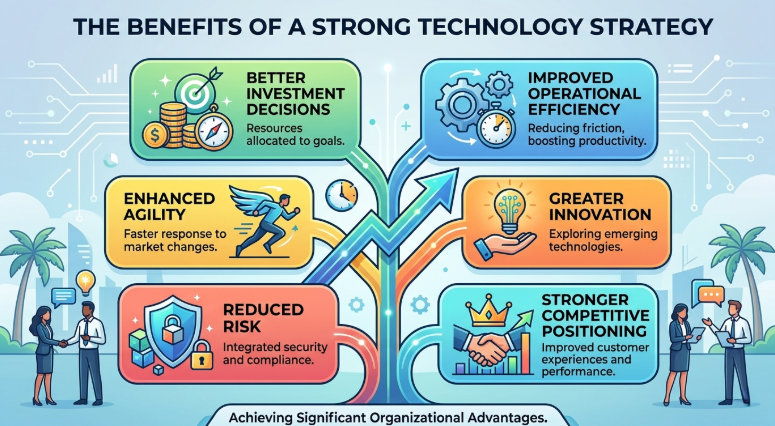
Organizations with well-defined strategies often achieve significant advantages.
Better Investment Decisions
Resources are allocated to initiatives supporting business goals.
Improved Operational Efficiency
Technology investments focus on reducing friction and increasing productivity.
Enhanced Agility
Organizations can respond more quickly to changing market conditions.
Greater Innovation
Strategic planning creates opportunities to explore emerging technologies.
Reduced Risk
Security, governance, and compliance considerations become part of the planning process.
Stronger Competitive Positioning
Businesses gain capabilities that improve customer experiences and operational performance.
Common Technology Strategy Mistakes
Focusing on Technology Instead of Business Outcomes
Technology should solve business problems.
Projects driven solely by technology trends often deliver disappointing results.
Lack of Executive Involvement
Technology strategy should involve leadership, not just IT teams.
Business objectives must drive decision-making.
Underestimating Change Management
Technology adoption depends on people.
Training, communication, and stakeholder engagement are essential.
Ignoring Future Growth
Strategies should address both current needs and future requirements.
Treating Strategy as a One-Time Activity
Technology evolves continuously.
Strategies should be reviewed and updated regularly.
How to Build a Technology Strategy
Step 1: Define Business Objectives
Identify organizational priorities and growth goals.
Technology should support these objectives.
Step 2: Assess Current Capabilities
Evaluate systems, infrastructure, processes, and skills.
Identify strengths and gaps.
Step 3: Identify Strategic Initiatives
Determine which projects will create the greatest business value.
Examples include:
ERP implementation
Automation projects
AI initiatives
Security improvements
Step 4: Develop a Roadmap
Prioritize initiatives based on:
Business impact
Cost
Complexity
Risk
Step 5: Establish Governance
Define ownership, responsibilities, and decision-making processes.
Step 6: Measure Success
Track metrics such as:
Productivity improvements
Cost savings
Customer satisfaction
Revenue growth
Risk reduction
Technology Strategy and Vision 2030
Saudi Arabia's Vision 2030 continues to accelerate digital transformation across both public and private sectors.
Organizations increasingly recognize technology as a strategic enabler of:
Innovation
Productivity
Economic diversification
Competitiveness
Businesses that align technology investments with strategic objectives are better positioned to capitalize on these opportunities.
The Future of Technology Strategy
Technology strategy is becoming increasingly important as organizations adopt:
Artificial Intelligence
Advanced Analytics
Cloud Computing
Automation
Cybersecurity Frameworks
Smart Business Systems
Future success will depend on an organization's ability to integrate these technologies into a cohesive business strategy.
Technology will continue to evolve.
The organizations that thrive will be those with clear plans for leveraging innovation effectively.
Key Takeaways
Technology strategy aligns technology investments with business objectives.
A strategic approach improves efficiency, reduces risk, and supports growth.
Technology decisions should be driven by business outcomes rather than trends.
Roadmaps help organizations prioritize investments and manage transformation initiatives.
Data, cloud computing, AI, automation, and cybersecurity should be incorporated into strategic planning.
Executive involvement is essential for success.
Technology strategy is an ongoing process rather than a one-time project.
Organizations with strong technology strategies are better positioned for long-term competitiveness.
Frequently Asked Questions
Q: What is a technology strategy?
A: A technology strategy is a structured plan that aligns technology investments and initiatives with business objectives to support growth, efficiency, and innovation.
Q: Why is technology strategy important?
A: It helps organizations make better investment decisions, improve efficiency, reduce risk, and ensure technology supports long-term business goals.
Q: Who should be involved in creating a technology strategy?
A: Technology strategy should involve executive leadership, business stakeholders, operational teams, and technology professionals.
Q: How often should a technology strategy be updated?
A: Most organizations should review and update their strategy annually or whenever significant business changes occur.
Q: Does every business need a technology strategy?
A: Yes. Regardless of size, organizations benefit from aligning technology investments with business priorities and future growth plans.
Conclusion
Technology is no longer simply a support function.
It has become a fundamental driver of business growth, operational excellence, customer experience, and competitive advantage.
Organizations that invest in technology without a clear strategy often struggle with complexity, inefficiency, and missed opportunities.
Those that align technology with business objectives create a foundation for sustainable success.
A well-defined technology strategy ensures that every investment contributes to measurable outcomes while supporting long-term growth and innovation.
Softriva helps organizations across Saudi Arabia develop technology strategies, digital transformation roadmaps, automation initiatives, and innovation programs that align technology with business success.
Book Your Free Technology Strategy Consultation at softriva.com and discover how a strategic approach to technology can accelerate growth and strengthen your competitive position.


