

Vision 2030 Digital Readiness: What Saudi Businesses Must Do Now to Stay Competitive
Introduction
Vision 2030 is the most significant reshaping of the Saudi business environment in a generation.
For most businesses, it is discussed primarily as an economic opportunity: new sectors opening up, new infrastructure being built, new categories of government spending flowing into the private sector. That is real. But Vision 2030 also creates direct operational and compliance requirements for businesses that are often less well understood.
Some of these requirements are already in effect and enforceable. Others are in active implementation. Others are approaching on a defined timeline. A Saudi business that is not tracking these requirements is building strategy on an incomplete picture of its operating environment.
This guide covers what Vision 2030 actually requires from Saudi businesses on the technology side, what is already mandatory, what is coming, and what practical steps a business of any size needs to take to operate effectively in the Saudi economy that Vision 2030 is building.
What Vision 2030 Is Actually Creating
Vision 2030 is commonly described as a diversification plan. It is more precisely a systematic modernisation programme that touches every part of the Saudi economy.
For businesses, the relevant dimensions are three:
A Digitised Government Interface
Saudi government services are being digitised at a rapid pace. Business registration, tax filing, customs clearance, visa processing, labour reporting, and regulatory compliance are all moving to digital-only channels.
This creates a direct requirement for businesses: to interact with government systems, you need digital capability. A business that cannot submit VAT returns through ZATCA's e-invoicing platform, that cannot manage its staff records through the Ministry of Human Resources' digital systems, or that cannot access Absher-connected services digitally is not just inconvenienced. It is operationally limited in ways that affect its ability to function.
A Higher-Standard Procurement Environment
Government procurement, semi-government procurement, and the procurement of large private sector organisations in Saudi Arabia is increasingly incorporating digital maturity as a selection criterion.
Tender documentation increasingly requests evidence of digital systems, cybersecurity practices, data protection compliance, and technology capability. The organisations with this evidence win contracts. The organisations without it do not qualify.
This is not a future trend. Saudi businesses competing for contracts in healthcare, education, construction, logistics, and professional services are already encountering these requirements in active tenders.
A More Demanding Consumer and Client Base
The Saudi population is young, highly connected, and has been shaped by digital-native consumer experiences. Expectations for how businesses communicate, deliver services, and handle customer information are rising consistently.
A business that communicates primarily through WhatsApp, that cannot accept digital payments through the full range of Saudi payment methods, or that cannot provide digital receipts and documentation is increasingly perceived as behind the market standard, regardless of the quality of its core product or service.
The Digital Requirements Already in Effect
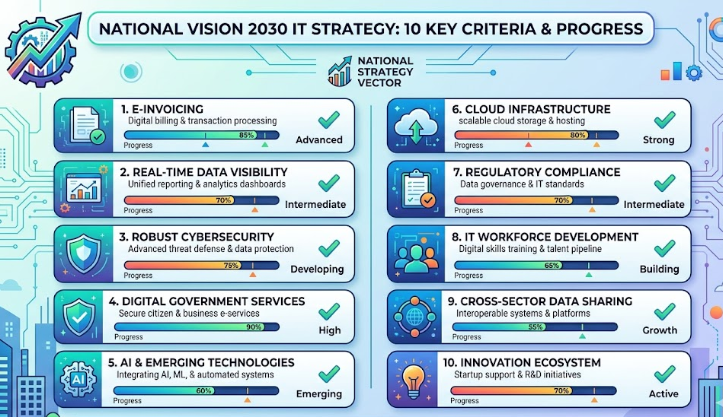
Several Vision 2030-linked digital requirements are not future ambitions. They are current compliance obligations:
ZATCA Phase 2 E-Invoicing (Fatoorah)
All VAT-registered businesses in Saudi Arabia are now required to issue invoices through ZATCA-compliant e-invoicing systems. Phase 1, requiring all invoices to be generated electronically, is complete. Phase 2, requiring real-time or near-real-time integration with the ZATCA platform for invoice clearance, is being rolled out in waves based on annual revenue thresholds.
Businesses that are not yet on the Phase 2 mandate need to track when their wave is due and implement compliant systems before that date. The requirement is not optional and the penalties for non-compliance are financial.
A ZATCA-compliant invoicing system is not simply accounting software that generates PDF invoices. It requires a specific XML invoice format, a cryptographic stamp applied to each invoice, and a direct API connection to the ZATCA portal for clearance or reporting.
Personal Data Protection Law (PDPL)
Saudi Arabia's Personal Data Protection Law came into full effect in 2023. It applies to any organisation that collects, stores, or processes personal data about Saudi residents, regardless of where the organisation is based.
Current compliance requirements include having a documented legal basis for processing personal data, providing privacy notices to data subjects, implementing appropriate security controls for personal data, having a process for handling data subject access requests, and notifying SDAIA and affected individuals within 72 hours of a personal data breach.
Many Saudi businesses are not yet fully compliant with PDPL. Enforcement is increasing. The time to implement compliant data handling practices is now, not after a regulatory notification.
National Cybersecurity Authority Requirements
Saudi Arabia's NCA has issued the Essential Cybersecurity Controls that define minimum cybersecurity standards for organisations operating in the Kingdom. While these are mandatory primarily for government entities and critical infrastructure, they are the recognised baseline for private sector cybersecurity and are increasingly referenced in procurement requirements and sector-specific regulations.
Financial services companies under SAMA and CMA supervision have specific cybersecurity requirements that align with the NCA framework and are already enforceable.
Wage Protection System
The Wage Protection System requires Saudi employers to pay salaries through approved channels and submit payroll data to the Ministry of Human Resources on a monthly basis. Non-compliance affects a business's Nitaqat (Saudisation) classification and can result in restrictions on government service access.
Compliance requires a payroll system that generates WPS-compliant payment files. Businesses managing payroll in spreadsheets and making manual bank transfers are not meeting this requirement reliably.
The Digital Requirements Coming in the Next Two Years
Several additional Vision 2030-linked digital requirements are in active development and will affect Saudi businesses before 2027:
Expanded PDPL enforcement: SDAIA has signalled that enforcement activity will increase as the regulatory framework matures. Businesses that have not yet implemented PDPL-compliant data handling should treat the next 12 months as an urgent implementation window.
Digital health records: The Ministry of Health's Unified Medical Record initiative is expanding. Healthcare providers that have not yet implemented electronic medical records will face increasing pressure to do so as the national health data infrastructure develops.
Expanded ZATCA scope: The e-invoicing mandate is expected to extend to smaller businesses over time. Businesses below the current revenue threshold should plan for compliance now rather than on deadline.
National Address integration: Government and quasi-government services are increasingly requiring verified National Address data for transactions and filings. Businesses that do not maintain National Address records for customers and staff will face friction in government-connected workflows.
Digital-first government contracting: The Monafasat government procurement platform is expanding its digital requirements for registered suppliers. Businesses competing for government contracts need to maintain up-to-date digital profiles and demonstrate compliance with required standards.
What Digital Readiness Actually Requires
Vision 2030 digital readiness is not a single project. It is a state of operational capability across several dimensions. Here is what a ready Saudi business looks like:
Compliant Core Operations
ZATCA Phase 2-compliant invoicing is in place. PDPL data handling documentation and controls are implemented. WPS-compliant payroll is running. GOSI contributions are calculated automatically. These are the non-negotiable compliance foundations.
Digital Client-Facing Processes
The business communicates with clients through documented, digital channels. Enquiries are captured in a CRM, not in a WhatsApp chat. Invoices are sent digitally and stored in a compliant system. Client data is handled under a documented privacy policy with appropriate access controls.
Cybersecurity Baseline
Multi-factor authentication is enabled on all business systems. Staff have received basic security awareness training within the past 12 months. Backups are running and have been tested. An incident response plan exists and has been reviewed within the past year.
Data Visibility
Leadership has access to current, reliable business data without waiting for someone to build a report. At minimum, this means a connected accounting system that produces live financial data. At a higher level, it means a BI dashboard connecting financial, operational, and customer data.
Arabic-Language Digital Presence
The business has a credible Arabic-language digital presence, including an Arabic website version with proper RTL implementation, Arabic-language social media presence, and Arabic-language client communication capability.
Key Takeaways
Vision 2030 creates specific, enforceable digital compliance obligations. ZATCA Phase 2 e-invoicing, PDPL, WPS compliance, and NCA cybersecurity standards are not future requirements. They are current ones.
Government procurement in Saudi Arabia increasingly requires evidence of digital maturity. Businesses without it do not qualify for the contracts that Vision 2030's investment is generating.
PDPL enforcement is increasing. Saudi businesses that have not yet implemented compliant data handling practices should treat the next 12 months as an urgent implementation window.
Digital readiness is not a single project. It is a state of operational capability across compliance, client-facing processes, cybersecurity, data visibility, and Arabic-language digital presence.
ZATCA Phase 2 requires a specific XML invoice format, a cryptographic stamp, and a direct API connection to the ZATCA portal. Standard accounting software that generates PDF invoices does not meet this requirement.
Businesses that build digital readiness now are not just meeting compliance requirements. They are building the competitive capability to access the procurement opportunities that Vision 2030 is generating.
Frequently Asked Questions
Q: How do I know if my business is subject to ZATCA Phase 2 e-invoicing?
A: ZATCA Phase 2 is being rolled out in waves based on annual VAT-taxable revenue. Each wave has a defined eligibility threshold and an integration deadline. ZATCA publishes the wave schedule on its official website at zatca.gov.sa. Your tax adviser or IT partner should be tracking the applicable threshold for your business and your integration deadline. If you are VAT-registered and do not know which wave applies to you, finding out is urgent.
Q: Is the Saudi PDPL similar to GDPR?
A: The Saudi PDPL shares several principles with the European GDPR: lawful basis for processing, data subject rights, data breach notification, and data protection by design. There are also important differences: the PDPL has different consent requirements, different cross-border transfer rules specific to Saudi Arabia's approved country list, and a regulatory body (SDAIA) with specific enforcement procedures. Businesses that are already GDPR-compliant have a useful foundation but should not assume full PDPL compliance without a specific Saudi review.
Q: What is the fastest way for a Saudi business to assess its Vision 2030 digital readiness?
A: A structured digital readiness assessment covers five areas: compliance status (ZATCA, PDPL, WPS, GOSI), client-facing digital processes, cybersecurity baseline, data visibility, and Arabic digital presence. Softriva conducts free digital readiness assessments for Saudi businesses that produce a prioritised gap analysis within one week of the initial consultation. This gives a clear picture of where the business stands, what the priority gaps are, and what a realistic remediation timeline looks like.
Q: How does Vision 2030 affect a small Saudi business with fewer than 10 employees?
A: Many Vision 2030-linked requirements apply regardless of business size. PDPL applies to any business that handles personal data about Saudi residents, including small businesses with a customer database. WPS requirements apply to any employer with salaried staff. ZATCA Phase 2 will eventually apply to all VAT-registered businesses. Cybersecurity and digital presence requirements affect competitiveness regardless of headcount. The scale of the investment required is smaller for a 10-person business than for a 200-person one, but the requirement to meet minimum standards applies across the board.
Q: How can a Saudi business demonstrate digital maturity to a government procurement body?
A: Government procurement assessments of digital maturity typically look for: a documented cybersecurity policy, evidence of PDPL-compliant data handling, ZATCA-compliant invoicing capability, use of government digital platforms (Absher, Maroof, Monafasat), and in some sectors, specific certifications or accreditations. Maintaining documented evidence of each of these capabilities is the practical answer. Softriva helps clients build and document their digital compliance portfolio specifically to meet procurement requirements.
Conclusion
Vision 2030 is not a background trend that Saudi businesses can monitor from a distance.
It is actively reshaping the compliance environment, the procurement landscape, and the competitive standards of the Saudi economy. The businesses that understand its specific requirements, and that have built the digital capability to meet them, are positioned to access the opportunities it generates. The businesses that treat it as an abstract national programme, without tracking its specific implications for their operations, are accumulating compliance risk and competitive disadvantage simultaneously.
The most productive approach is a structured digital readiness assessment: a clear-eyed review of where your business currently stands on each dimension of Vision 2030-linked digital requirement, and a prioritised plan for closing the gaps that matter most.
Softriva has been helping Saudi businesses build their digital capability since 2006. Our team has direct experience with ZATCA integration, PDPL compliance implementation, NCA cybersecurity frameworks, and the full range of Saudi-specific digital requirements that Vision 2030 has created and is continuing to create.
A free digital readiness assessment is the fastest way to understand where your business stands and what you need to do. Book one today.

Assess Your Vision 2030 Digital Readiness at softriva.com


