
Web Development in Saudi Arabia: What Your Business Website Must Do?
Introduction
Your website is almost certainly the most visited representation of your business. More people will encounter your company through your website than through any other channel ,before a sales call, before a referral conversation, and often before any human interaction at all. What they find when they arrive ,and how quickly they find it ,determines whether that encounter becomes an enquiry or an exit.
The bar for business websites in Saudi Arabia has risen significantly over the past three years. The growth of digital-first purchasing behavior, the expansion of Saudi e-commerce, and the increasing sophistication of the Kingdom's B2B buyer have all raised expectations for what a professional website should do. A site that would have been considered acceptable in 2020 is now a liability.
This is not about aesthetics, though design matters. It is about performance ,whether your website works as a business development tool, or whether it is a passive digital brochure that looks reasonable and generates almost nothing.
This guide covers what a high-performing business website in Saudi Arabia actually requires: the technical foundations, the content architecture, the user experience standards, the SEO requirements, and the conversion principles that separate websites that generate enquiries from those that do not. It is written for business owners and decision-makers, not developers ,the goal is to give you the knowledge to evaluate your current site honestly and make good decisions about what to invest in.
Why Most Saudi Business Websites Underperform
Before covering what a good website looks like, it is worth understanding the specific ways most Saudi business websites fall short. The patterns are consistent across industries:
• Speed on mobile: Saudi Arabia has one of the highest mobile internet usage rates in the world. More than 75% of web traffic in the Kingdom arrives on a mobile device. If your website loads slowly on mobile ,and a load time of more than three seconds is slow ,the majority of your visitors are leaving before they see your content.
• Clarity of purpose: A business website has roughly five seconds to communicate what you do, who you serve, and why you are credible ,before a visitor makes a judgment about whether to keep reading. Most Saudi business websites either bury this information below the fold or express it in language that is too generic to be meaningful.
• No clear next step: Visitors who are interested in your services need to know exactly what to do next. A website that does not make the next step obvious ,whether that is booking a call, submitting an enquiry, or downloading a guide ,leaves conversion to chance.
• SEO invisibility: A website that is not appearing in relevant search results is not generating organic traffic. Most Saudi business websites were built without meaningful SEO consideration, which means they are dependent on referrals and direct access ,channels that are far less scalable than organic search.
• Arabic language absence or poor quality: For businesses serving Saudi consumers or Arabic-speaking B2B buyers, a website that lacks credible Arabic content is communicating that Arabic speakers are not the primary audience. This is a significant exclusion in a market where Arabic-language search is substantial and growing.
The Technical Foundation: What Has to Work Before Anything Else
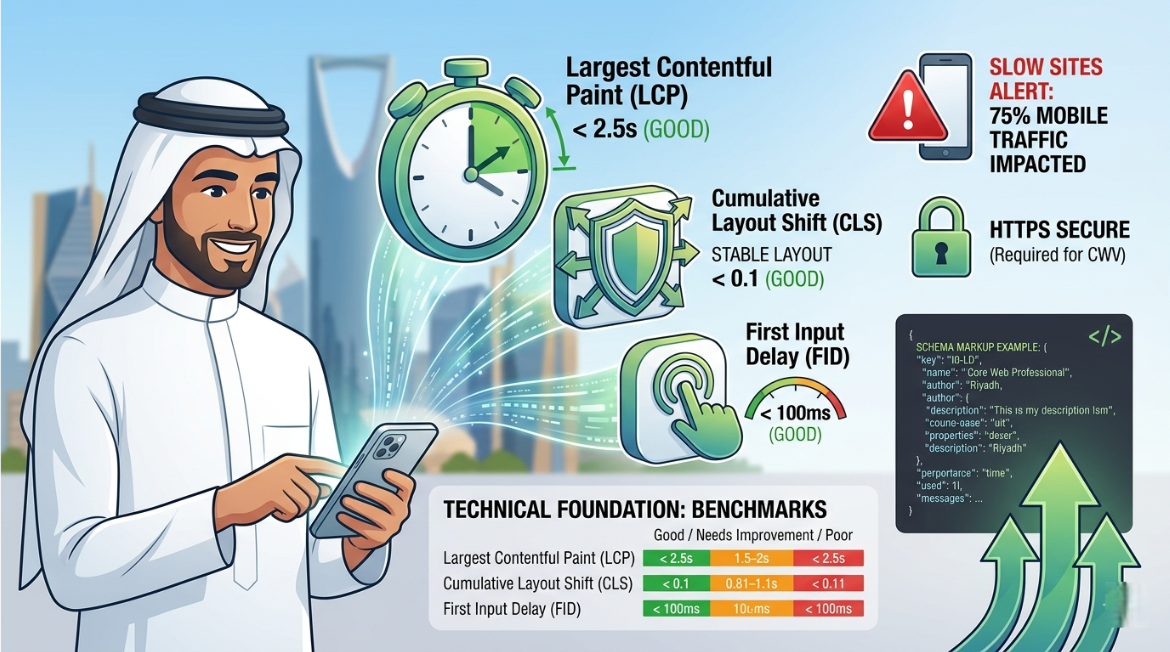
There are several technical requirements that a business website simply cannot fail on. These are not differentiators ,they are entry requirements:
Core Web Vitals and Page Speed
Google's Core Web Vitals ,a set of metrics measuring loading performance, interactivity, and visual stability ,are now a direct ranking factor in search results. More importantly, they are a direct measure of user experience. The three key metrics are Largest Contentful Paint (LCP), which measures how long it takes for the main content to load and should be under 2.5 seconds; Cumulative Layout Shift (CLS), which measures how much the page shifts as elements load and should be below 0.1; and First Input Delay (FID), which measures the responsiveness of the page when a user first interacts with it and should be under 100 milliseconds.
Failing these metrics does not just hurt your search rankings ,it means a significant percentage of your visitors are experiencing a frustrating website that reflects poorly on your business.
Mobile-First Design
Mobile-first design means the website is designed and optimized for the mobile experience first, with the desktop experience as a secondary consideration. This is the opposite of the traditional approach, which built for desktop and adapted for mobile. Given the Saudi market's mobile usage patterns, any website built on the traditional approach is already behind.
Mobile-first design affects every element of the site: navigation structure, content hierarchy, button sizes, form design, image handling, and typography. Done correctly, it produces a website that is excellent on mobile and equally strong on desktop. Done poorly, it produces a site that feels cramped and awkward on both.
HTTPS and Security
HTTPS is no longer optional. Google marks non-HTTPS sites as insecure in the Chrome browser, and this warning appears prominently to users before they have even seen your content. Beyond the SEO penalty, an HTTP website is communicating to every visitor that basic security is not a priority ,a deeply problematic signal for a B2B business asking for contact information or handling any form of transaction.
Structured Data and Schema Markup
Schema markup is code added to your website that helps search engines understand your content ,what type of business you are, where you are located, what services you offer, what your reviews say, and more. For Saudi businesses, implementing Organization, LocalBusiness, and Service schema markup makes your business more visible in rich search results and is increasingly important for appearing in AI-generated search summaries.
Content Architecture: How to Structure Your Website for Conversion
The structure of your website ,which pages exist, how they connect to each other, and what content each contains ,is a strategic decision, not a design decision. The most common structural mistake in Saudi business websites is building a site organized around what the company wants to say rather than what the visitor is trying to find.
The Homepage: Your Fastest Pitch
Your homepage has one job: communicate clearly who you are, what you do, who you serve, and why you are credible ,quickly enough that an interested visitor reads further rather than leaving. This requires a headline that is specific and benefit-oriented rather than generic and abstract, a sub-headline that adds context and directs the visitor, a clear primary call to action, visible credibility signals (years in operation, client logos, certifications, industry memberships), and a structured presentation of your core service areas.
The biggest homepage mistakes in the Saudi market are headlines that describe what the company is rather than what it delivers ('A Leading IT Solutions Company in Saudi Arabia' versus 'IT Systems That Help Saudi Businesses Operate Faster and Compete Harder'), excessive use of animation and visual effects that slow load time without adding clarity, and a contact button buried so deep in the page that interested visitors give up before finding it.
Service Pages: Where Decisions Are Made
Each of your core services should have a dedicated page ,not a section on a general services overview page. Dedicated service pages allow you to target the specific search terms people use when looking for that service, provide the depth of information that a serious buyer needs to make a contact decision, and build credibility through specific, verifiable claims rather than general statements.
A high-performing service page covers what the service is and what problem it solves, who the service is right for, how your approach to delivering this service differs from a generic provider, the specific outcomes clients should expect, relevant case studies or client references, and a prominent call to action with minimal friction.
The About Page: Building Human Trust
The About page is consistently one of the most visited pages on a business website ,and consistently one of the least invested in. For Saudi businesses, where long-term partnership and personal trust are significant factors in B2B purchasing decisions, the About page is a genuine business development asset.
An effective About page for a Saudi business covers the company's founding story and how long it has been operating, the leadership team with genuine photographs and brief professional backgrounds, any industry credentials, certifications, or regulatory registrations, a clear statement of the company's values and how they show up in client relationships, and geographic presence and local knowledge.
Arabic Language Content
The question of whether to have an Arabic version of your website is not a design decision ,it is a market access decision. A significant portion of B2B buyers in Saudi Arabia prefer to research in Arabic, and a website that offers only English content is effectively excluding them before the conversation begins. More practically, Arabic-language search volume for many B2B services categories is substantial ,and the SEO competition for Arabic keywords is generally lower than for English equivalents.
A well-executed Arabic website is not a word-for-word translation of the English version. Arabic web users have different navigation expectations, different content length preferences, and right-to-left layout requirements that affect everything from button placement to image composition. A properly built bilingual website accounts for all of these differences.
SEO: The Difference Between a Website and a Business Development Asset
A website that does not appear in search results is dependent entirely on the people who already know you. SEO ,the practice of optimizing your website to appear in relevant search results ,is what converts a static digital presence into a channel that introduces your business to people who are actively looking for what you offer.
For Saudi businesses, effective SEO requires attention to keyword research that reflects actual Saudi search behavior (not assumptions), on-page optimization that places relevant terms in the right structural positions, technical SEO that ensures search engines can crawl and index your site correctly, local SEO that ensures your business appears in location-specific searches, and content development that builds topical authority over time.
One area that is increasingly important is optimizing for AI-generated search responses. As Google and other search engines incorporate AI summaries into their results pages, websites that are structured as authoritative, well-sourced references to specific topics are more likely to be cited. This requires depth of content, clear information architecture, factual specificity, and structured data ,all of which align with broader good SEO practice.
Conversion: Turning Visitors into Enquiries
Traffic without conversion is an expensive vanity metric. The goal of a business website is enquiries, calls, bookings, or purchases ,not page views. Every element of your website should be evaluated through the question: does this help a qualified visitor take the next step, or does it create friction?
Conversion rate optimization for Saudi B2B websites specifically requires multiple, clearly visible call-to-action elements throughout the page ,not just at the top and bottom, enquiry forms that are short (four to six fields maximum) and immediately functional, phone numbers and WhatsApp links that are prominent and work correctly on mobile, trust signals distributed throughout the page rather than confined to a single testimonials section, and page load speed that does not create an excuse to leave before the call to action is reached.
Key Takeaways
✓ The majority of Saudi web traffic is mobile ,a website not optimized for mobile is already losing most of its potential visitors.
✓ Core Web Vitals are both a Google ranking factor and a direct measure of user experience ,failing them costs you rankings and conversions simultaneously.
✓ Every core service needs a dedicated page with specific, verifiable claims ,not a section on a general overview page.
✓ Arabic-language content is not optional for businesses serving the Saudi market ,it is a market access and SEO opportunity.
✓ SEO is what converts a website from a static presence to a business development asset ,without it, you are dependent only on the people who already know you.
✓ Conversion optimization is about removing friction between a qualified visitor and their decision to contact you ,every element should serve that goal.
Frequently Asked Questions
Q: How much should a high-quality business website cost in Saudi Arabia?
A: A custom business website built to the performance standards described in this guide ,mobile-first, Core Web Vitals compliant, SEO-optimized, with Arabic and English versions ,typically costs between SAR 15,000 and SAR 60,000 depending on the number of pages, level of custom functionality, and content production requirements. Sites at the lower end of this range are appropriate for professional service businesses with a defined set of pages. E-commerce, enterprise systems, and custom platform integrations add to this range. Beware of quotes significantly below this range ,they almost always involve templates, offshore development, or missing components.
Q: How long does it take to build a custom business website?
A: A well-managed custom website project typically takes six to twelve weeks from contract to launch, depending on scope and the speed of client content and feedback. The most common cause of delays is slow client approval of designs or late delivery of content. Establishing a clear project timeline with defined review windows at each stage significantly improves delivery speed.
Q: Should we build on WordPress, a custom CMS, or a no-code platform?
A: The right platform depends on your content management needs, technical resources, and growth trajectory. WordPress is appropriate for content-heavy sites where your team will regularly update pages and blog content ,it is well-supported, widely understood, and SEO-capable when properly configured. Custom development is appropriate when your requirements cannot be met by an existing platform, particularly for complex integrations or unique user experiences. No-code platforms like Webflow offer a middle ground that can produce high-quality results for many business websites. Softriva evaluates platform fit as part of every scoping process.
Q: How do we measure whether our website is actually performing?
A: The key performance indicators for a business website are organic search traffic (visitors arriving through unpaid search results), enquiry conversion rate (the percentage of visitors who submit an enquiry or make contact), Core Web Vitals scores, keyword ranking positions for your target terms, and bounce rate on key landing pages. These metrics should be tracked through Google Analytics 4 and Google Search Console, both of which are free and provide the data needed to make informed optimization decisions.
Q: How often should a business website be redesigned?
A: A fundamental redesign is typically appropriate every three to five years, driven by significant changes in your service offering, a meaningful decline in website performance, or the emergence of new technical standards that your current site cannot accommodate. More important than periodic redesigns is ongoing maintenance and optimization ,regular content updates, technical SEO improvements, speed optimization, and conversion rate testing extend the effective life of a well-built site significantly.
Conclusion
A high-performing business website is not a one-time investment ,it is an ongoing asset that requires the same attention and strategic thinking as any other channel through which your business develops new relationships. In the Saudi market, where digital research precedes most B2B purchase decisions and where mobile usage is among the highest in the world, the quality of your web presence is a direct input to your business development capacity.
The gap between a website that looks professional and one that actively generates business is not a creative gap ,it is a strategic and technical one. It is the difference between a site built to satisfy a brief and a site built to perform a function. The function is converting qualified visitors into conversations.
Softriva has been building custom web solutions for Saudi businesses since 2006. Every project we deliver is built mobile-first, Core Web Vitals compliant, SEO-structured, and conversion-optimized ,in English and Arabic. We do not build templates and we do not consider a project complete until it is generating results.
If you are not sure whether your current website is working hard enough for your business, a free website audit is the most useful starting point. In 30 minutes, we will give you a clear, specific assessment of where your site is strong, where it is costing you opportunities, and what the most impactful improvements would be.


