
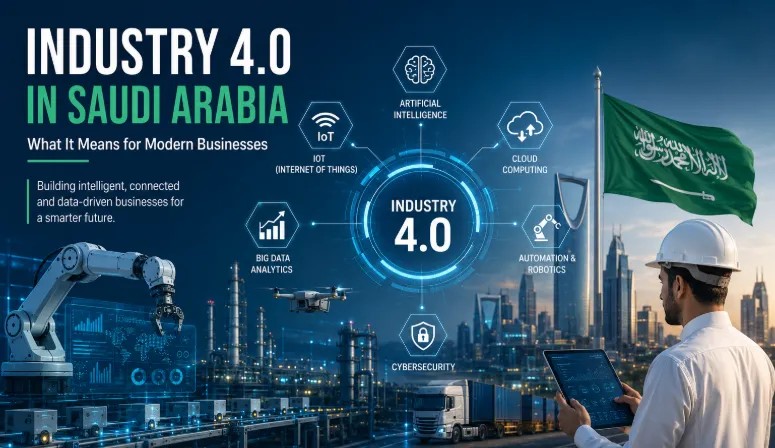
Industry 4.0 in Saudi Arabia: What It Means for Modern Businesses
Introduction
Every major industrial revolution has fundamentally changed how businesses operate.
The first revolution introduced mechanization through water and steam power.
The second brought mass production through electricity.
The third introduced computers and automation.
Today, we are experiencing the fourth industrial revolution—commonly known as Industry 4.0.
Unlike previous revolutions, Industry 4.0 is not driven by a single technology. Instead, it combines multiple innovations including artificial intelligence, cloud computing, Internet of Things (IoT), automation, robotics, big data analytics, machine learning, and cybersecurity into a connected digital ecosystem.
For businesses across Saudi Arabia, Industry 4.0 is becoming a critical component of competitiveness, efficiency, and long-term growth.
Organizations that embrace intelligent technologies are gaining greater visibility into operations, reducing costs, improving productivity, and responding faster to changing market demands.
Meanwhile, businesses that delay modernization risk falling behind increasingly digital competitors.
As Saudi Arabia continues its economic transformation under Vision 2030, Industry 4.0 technologies are playing an important role in helping organizations improve operational excellence and build sustainable competitive advantages.
This guide explores what Industry 4.0 means, why it matters, and how businesses can prepare for the future.
What Is Industry 4.0?
Industry 4.0 refers to the integration of digital technologies into business and industrial operations.
The goal is to create intelligent, connected, and data-driven environments where systems can communicate, analyze information, and support decision-making in real time.
Unlike traditional automation, Industry 4.0 focuses on connectivity and intelligence.
Instead of isolated systems operating independently, machines, software, sensors, employees, and business processes become interconnected.
Information flows continuously across the organization, enabling greater efficiency and visibility.
Industry 4.0 is often described as the convergence of physical operations and digital technologies.
The Technologies Driving Industry 4.0
Several technologies work together to enable Industry 4.0 capabilities.
Artificial Intelligence (AI)
AI helps organizations analyze large volumes of data, identify patterns, predict outcomes, and automate decision-making.
Examples include:
Predictive maintenance
Demand forecasting
Customer service automation
Quality control
AI transforms raw data into actionable business insights.
Internet of Things (IoT)
IoT devices collect real-time information from connected equipment, vehicles, facilities, and assets.
Examples include:
Production monitoring
Asset tracking
Environmental monitoring
Energy management
These connected devices provide continuous operational visibility.
Cloud Computing
Cloud platforms enable businesses to store, process, and access information from anywhere.
Benefits include:
Scalability
Flexibility
Reduced infrastructure costs
Improved collaboration
Cloud computing serves as the foundation for many Industry 4.0 initiatives.
Big Data Analytics
Modern organizations generate enormous amounts of information.
Analytics platforms help businesses:
Identify trends
Measure performance
Improve forecasting
Optimize operations
Data-driven decisions are a core principle of Industry 4.0.
Automation and Robotics
Automation reduces manual intervention in repetitive tasks.
Robotics can improve:
Productivity
Accuracy
Consistency
Safety
Advanced automation enables organizations to scale operations efficiently.
Cybersecurity
As operations become increasingly connected, cybersecurity becomes essential.
Industry 4.0 environments require:
Access controls
Network security
Endpoint protection
Security monitoring
Protecting digital assets is critical to maintaining operational resilience.
Why Industry 4.0 Matters for Saudi Businesses
Industry 4.0 is relevant across multiple sectors—not just manufacturing.
Organizations in:
Healthcare
Logistics
Retail
Construction
Energy
Financial services
Government
are all benefiting from intelligent technologies.
Several factors make Industry 4.0 particularly important in Saudi Arabia.
Supporting Vision 2030
Saudi Arabia's Vision 2030 emphasizes innovation, technology adoption, operational efficiency, and economic diversification.
Industry 4.0 technologies support these objectives by enabling smarter operations and enhanced productivity.
Businesses investing in modernization are better positioned to participate in future growth opportunities.
Improving Competitiveness
Modern markets are increasingly digital.
Organizations that leverage automation, analytics, and intelligent systems can:
Respond faster
Reduce costs
Improve quality
Enhance customer experiences
These advantages become increasingly important as competition intensifies.
Enhancing Operational Efficiency
Many businesses still rely on manual processes and disconnected systems.
Industry 4.0 enables:
Process optimization
Workflow automation
Real-time monitoring
Improved resource utilization
The result is greater efficiency across the organization.
Key Benefits of Industry 4.0
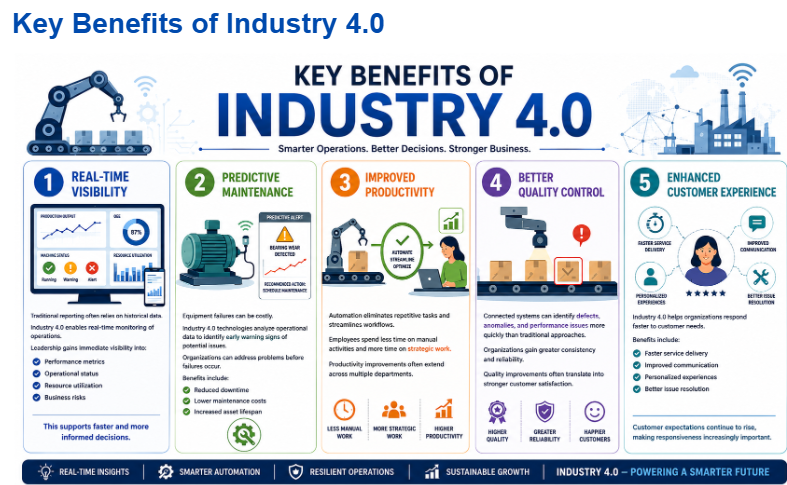
Real-Time Visibility
Traditional reporting often relies on historical data.
Industry 4.0 enables real-time monitoring of operations.
Leadership gains immediate visibility into:
Performance metrics
Operational status
Resource utilization
Business risks
This supports faster and more informed decisions.
Predictive Maintenance
Equipment failures can be costly.
Industry 4.0 technologies analyze operational data to identify early warning signs of potential issues.
Organizations can address problems before failures occur.
Benefits include:
Reduced downtime
Lower maintenance costs
Increased asset lifespan
Improved Productivity
Automation eliminates repetitive tasks and streamlines workflows.
Employees spend less time on manual activities and more time on strategic work.
Productivity improvements often extend across multiple departments.
Better Quality Control
Connected systems can identify defects, anomalies, and performance issues more quickly than traditional approaches.
Organizations gain greater consistency and reliability.
Quality improvements often translate into stronger customer satisfaction.
Enhanced Customer Experience
Industry 4.0 helps organizations respond faster to customer needs.
Benefits include:
Faster service delivery
Improved communication
Personalized experiences
Better issue resolution
Customer expectations continue to rise, making responsiveness increasingly important.
Common Industry 4.0 Use Cases
Smart Manufacturing
Manufacturers use connected equipment and automation to improve production efficiency.
Applications include:
Production monitoring
Quality assurance
Inventory optimization
Predictive maintenance
Intelligent Supply Chains
Supply chain visibility is critical for operational success.
Industry 4.0 technologies enable:
Asset tracking
Inventory management
Demand forecasting
Logistics optimization
Organizations gain greater control over complex supply networks.
Smart Facilities
Connected buildings can monitor:
Energy usage
Environmental conditions
Equipment performance
Occupancy patterns
These insights improve efficiency and reduce operating costs.
Data-Driven Decision Making
Industry 4.0 provides leadership teams with actionable information.
Instead of relying on assumptions, decisions can be supported by real-time operational data.
Challenges Businesses Must Address
While Industry 4.0 offers significant benefits, successful implementation requires planning.
Legacy Systems
Many organizations operate older systems that were not designed for modern integration requirements.
Modernization may be necessary before advanced capabilities can be implemented.
Data Quality
Industry 4.0 depends on reliable information.
Poor-quality data limits the effectiveness of analytics, automation, and AI initiatives.
Skills and Training
Employees require new skills to work effectively within digital environments.
Organizations should invest in ongoing training and development.
Cybersecurity Risks
Increased connectivity creates new security considerations.
Businesses must implement strong cybersecurity practices from the beginning.
How to Prepare for Industry 4.0
Organizations do not need to transform overnight.
A phased approach is often the most effective.
Step 1: Assess Current Digital Maturity
Evaluate:
Systems
Processes
Infrastructure
Data capabilities
Understanding the current environment provides a foundation for future planning.
Step 2: Identify Business Priorities
Technology investments should support specific business objectives.
Examples include:
Reducing costs
Improving productivity
Enhancing customer experience
Increasing operational visibility
Step 3: Modernize Core Systems
Connected operations require modern technology foundations.
Examples include:
ERP platforms
CRM systems
Cloud infrastructure
Business intelligence tools
Step 4: Invest in Data and Analytics
Industry 4.0 depends on information.
Organizations should prioritize data quality, governance, and reporting capabilities.
Step 5: Expand Through Automation and AI
Once foundational systems are established, advanced technologies can deliver additional value.
Automation and AI often provide some of the highest long-term returns.
The Future of Industry 4.0 in Saudi Arabia
Industry 4.0 adoption is expected to accelerate across Saudi Arabia over the coming years.
Several trends are likely to shape future development:
Increased AI adoption
Expanded automation initiatives
Greater cloud utilization
Enhanced cybersecurity investment
Growth in connected infrastructure
Organizations that begin preparing today will be better positioned to capitalize on these opportunities.
The businesses leading tomorrow's markets are building digital capabilities today.
Key Takeaways
Industry 4.0 combines AI, IoT, automation, cloud computing, analytics, and cybersecurity into connected digital ecosystems.
Industry 4.0 is relevant across manufacturing, healthcare, retail, logistics, construction, and many other sectors.
Saudi Arabia's Vision 2030 supports technology adoption and digital transformation initiatives.
Real-time visibility, predictive maintenance, automation, and analytics are among the most significant benefits.
Data quality and cybersecurity are critical success factors.
Businesses should adopt a phased approach rather than attempting large-scale transformation all at once.
Modern systems create the foundation for future Industry 4.0 capabilities.
Organizations that invest early gain stronger competitiveness and operational agility.
Frequently Asked Questions
Q: What is Industry 4.0?
A: Industry 4.0 refers to the integration of intelligent digital technologies such as AI, IoT, automation, analytics, and cloud computing into business and industrial operations.
Q: Is Industry 4.0 only for manufacturers?
A: No. While manufacturing is a major area of adoption, Industry 4.0 technologies benefit organizations across healthcare, logistics, retail, construction, energy, finance, and other sectors.
Q: What are the biggest benefits of Industry 4.0?
A: Common benefits include improved productivity, real-time visibility, predictive maintenance, enhanced customer experiences, stronger decision-making, and reduced operational costs.
Q: How does Industry 4.0 support digital transformation?
A: Industry 4.0 technologies help organizations automate processes, improve connectivity, leverage data, and create smarter operational environments.
Q: How can businesses start their Industry 4.0 journey?
A: Begin by assessing digital maturity, identifying business priorities, modernizing core systems, improving data capabilities, and gradually expanding automation and AI initiatives.
Conclusion
Industry 4.0 is not a future concept—it is already transforming how organizations operate, compete, and grow.
Businesses across Saudi Arabia are increasingly leveraging intelligent technologies to improve efficiency, gain operational visibility, enhance customer experiences, and support long-term growth.
The organizations achieving the greatest success are not necessarily adopting every new technology available.
Instead, they are building strong digital foundations, focusing on business outcomes, and implementing innovation strategically.
Industry 4.0 is ultimately about creating smarter businesses—not simply deploying more technology.
Softriva helps organizations across Saudi Arabia navigate digital transformation, automation, data analytics, cloud modernization, and emerging technologies that support sustainable business growth.
If you're evaluating how Industry 4.0 technologies can benefit your organization, begin with a structured assessment of your current capabilities and future objectives.


